Department of Pharmacology, Stony Brook University Renaissance School of Medicine, Stony Brook, NY, 11794-8651, USA.
Regeneron Pharmaceuticals, Inc., Tarrytown, NY, 10591, USA.
J Neuroinflammation. 2022 Sep 12;19(1):225. doi: 10.1186/s12974-022-02586-9.
Early invasion of the central nervous system (CNS) by human immunodeficiency virus (HIV) (Gray et al. in Brain Pathol 6:1-15, 1996; An et al. in Ann Neurol 40:611-6172, 1996), results in neuroinflammation, potentially through extracellular vesicles (EVs) and their micro RNAs (miRNA) cargoes (Sharma et al. in FASEB J 32:5174-5185, 2018; Hu et al. in Cell Death Dis 3:e381, 2012). Although the basal ganglia (BG) is a major target and reservoir of HIV in the CNS (Chaganti et al. in Aids 33:1843-1852, 2019; Mintzopoulos et al. in Magn Reson Med 81:2896-2904, 2019), whether BG produces EVs and the effect of HIV and/or the phytocannabinoid-delta-9-tetrahydrocannabinol (THC) on BG-EVs and HIV neuropathogenesis remain unknown.
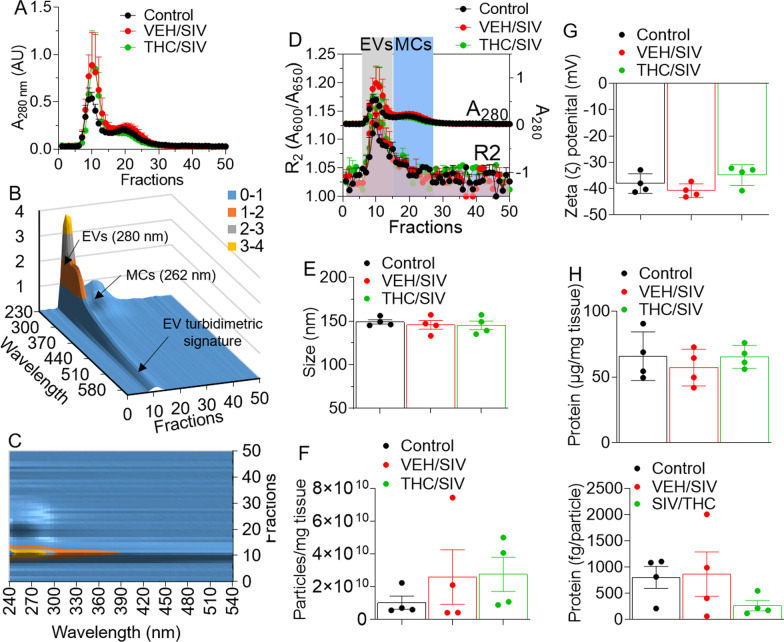
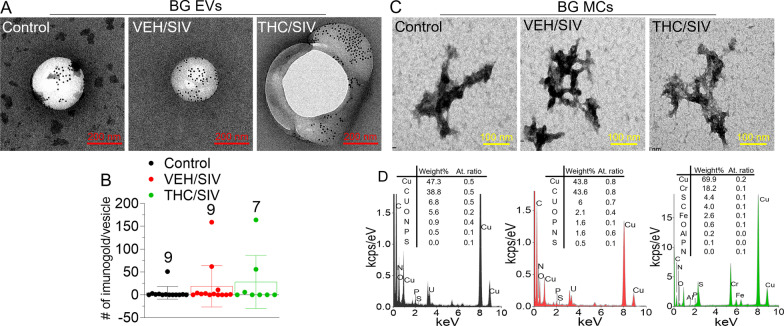
We used the simian immunodeficiency virus (SIV) model of HIV and THC treatment in rhesus macaques (Molina et al. in AIDS Res Hum Retroviruses 27:585-592, 2011) to demonstrate for the first time that BG contains EVs (BG-EVs), and that BG-EVs cargo and function are modulated by SIV and THC. We also used primary astrocytes from the brains of wild type (WT) and CX3CR1 mice to investigate the significance of BG-EVs in CNS cells.
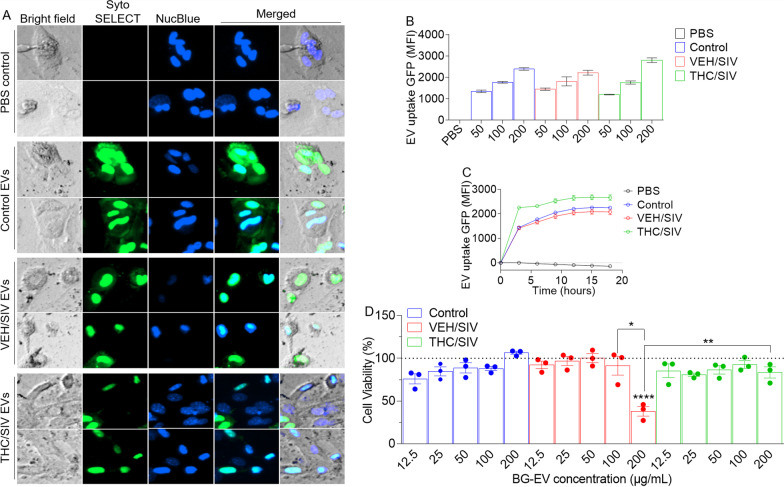
Significant changes in BG-EV-associated miRNA specific to SIV infection and THC treatment were observed. BG-EVs from SIV-infected rhesus macaques (SIV EVs) contained 11 significantly downregulated miRNAs. Remarkably, intervention with THC led to significant upregulation of 37 miRNAs in BG-EVs (SIV-THC EVs). Most of these miRNAs are predicted to regulate pathways related to inflammation/immune regulation, TLR signaling, Neurotrophin TRK receptor signaling, and cell death/response. BG-EVs activated WT and CX3CR1 astrocytes and altered the expression of CD40, TNFα, MMP-2, and MMP-2 gene products in primary mouse astrocytes in an EV and CX3CR1 dependent manners.
Our findings reveal a role for BG-EVs as a vehicle with potential to disseminate HIV- and THC-induced changes within the CNS.
人类免疫缺陷病毒(HIV)早期侵犯中枢神经系统(CNS)(Gray 等人,Brain Pathol 6:1-15, 1996;An 等人,Ann Neurol 40:611-6172, 1996),导致神经炎症,可能通过细胞外囊泡(EVs)及其 micro RNA(miRNA)货物(Sharma 等人,FASEB J 32:5174-5185, 2018;Hu 等人,Cell Death Dis 3:e381, 2012)。尽管基底神经节(BG)是 HIV 在中枢神经系统(CNS)的主要靶标和储库(Chaganti 等人,Aids 33:1843-1852, 2019;Mintzopoulos 等人,Magn Reson Med 81:2896-2904, 2019),但 BG 是否产生 EVs,以及 HIV 和/或植物大麻素 -delta-9-四氢大麻酚(THC)对 BG-EVs 和 HIV 神经发病机制的影响仍不清楚。
我们使用猴免疫缺陷病毒(SIV)模型和 THC 治疗恒河猴(Molina 等人,AIDS Res Hum Retroviruses 27:585-592, 2011),首次证明 BG 含有 EVs(BG-EVs),并且 SIV 和 THC 调节 BG-EVs 的货物和功能。我们还使用来自野生型(WT)和 CX3CR1 小鼠大脑的原代星形胶质细胞,研究了 BG-EVs 在中枢神经系统细胞中的意义。
观察到与 SIV 感染和 THC 治疗相关的 BG-EV 相关 miRNA 特异性的显著变化。来自 SIV 感染恒河猴的 BG-EVs(SIV EVs)含有 11 个明显下调的 miRNA。值得注意的是,用 THC 干预导致 BG-EVs 中 37 个 miRNA 的显著上调(SIV-THC EVs)。这些 miRNA 中的大多数被预测调节与炎症/免疫调节、TLR 信号、神经营养素 TRK 受体信号和细胞死亡/反应相关的途径。BG-EVs 激活 WT 和 CX3CR1 星形胶质细胞,并以 EV 和 CX3CR1 依赖的方式改变原代小鼠星形胶质细胞中 CD40、TNFα、MMP-2 和 MMP-2 基因产物的表达。
我们的研究结果揭示了 BG-EVs 作为一种载体的作用,具有在中枢神经系统内传播 HIV 和 THC 诱导变化的潜力。