Department of Biological Sciences and CERMO-FC Research Centre, Université du Québec à Montréal, Montreal, QC H2X 3Y7, Canada.
Infectious Diseases and Immunity in Global Health Program, Research Institute of the McGill University Health Centre, Montreal, QC H4A 3J1, Canada.
Cells. 2023 Jul 8;12(14):1811. doi: 10.3390/cells12141811.
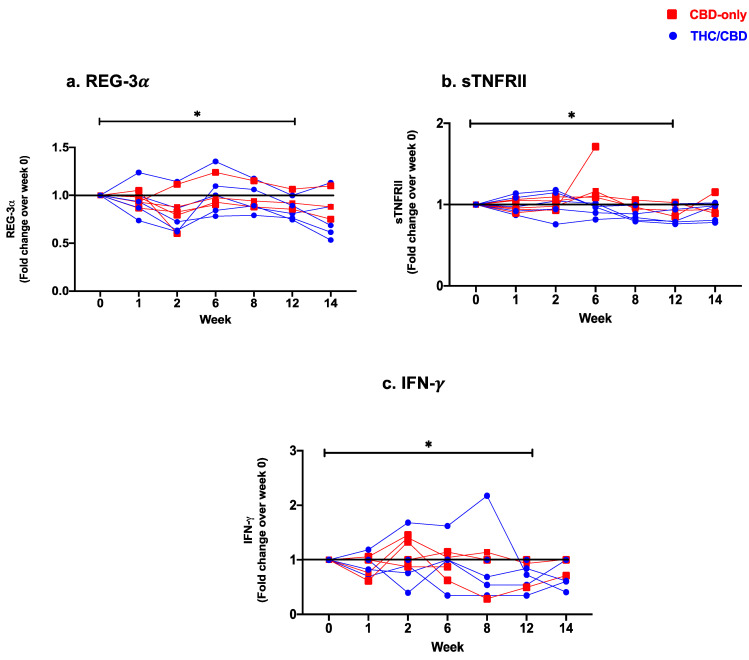
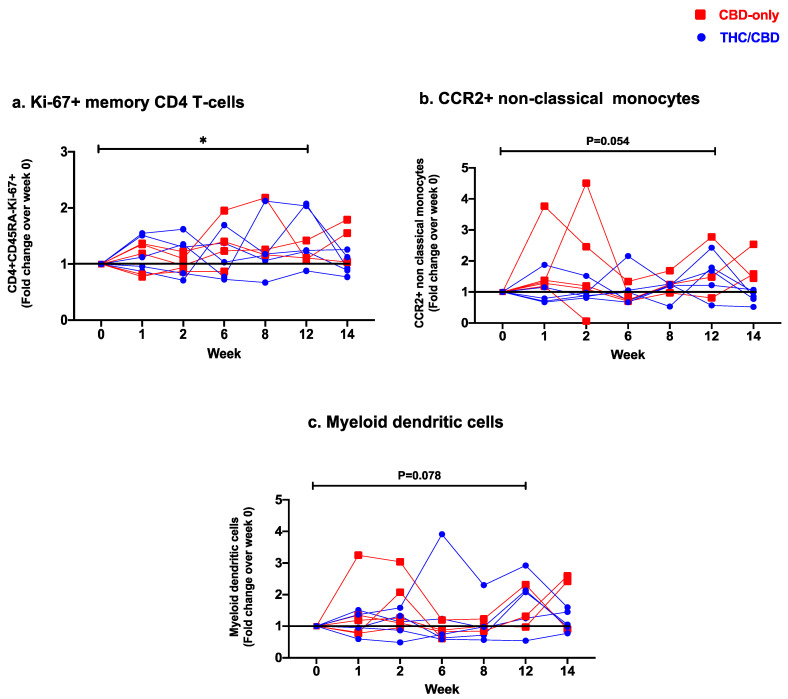
Chronic HIV infection is characterized by persistent inflammation despite antiretroviral therapy (ART). Cannabinoids may help reduce systemic inflammation in people with HIV (PWH). To assess the effects of oral cannabinoids during HIV, ten PWH on ART were randomized ( = 5/group) to increasing doses of oral Δ9-tetrahydrocannabinol (THC): cannabidiol (CBD) combination (2.5:2.5-15:15 mg/day) capsules or CBD-only (200-800 mg/day) capsules for 12 weeks. Blood specimens were collected prospectively 7-21 days prior to treatment initiation and at weeks 0 to 14. Plasma cytokine levels were determined via Luminex and ELISA. Immune cell subsets were characterized by flow cytometry. HIV DNA/RNA were measured in circulating CD4 T-cells and sperm by ultra-sensitive qPCR. Results from both arms were combined for statistical analysis. Plasma levels of IFN-γ, IL-1β, sTNFRII, and REG-3α were significantly reduced at the end of treatment ( ˂ 0.05). A significant decrease in frequencies of PD1+ memory CD4 T-cells, CD73+ regulatory CD4 T-cells, and M-DC8+ intermediate monocytes was also observed ( ˂ 0.05), along with a transient decrease in CD28-CD57+ senescent CD4 and CD8 T-cells. Ki-67+ CD4 T-cells, CCR2+ non-classical monocytes, and myeloid dendritic cells increased over time ( ˂ 0.05). There were no significant changes in other inflammatory markers or HIV DNA/RNA levels. These findings can guide future large clinical trials investigating cannabinoid anti-inflammatory properties.
慢性 HIV 感染的特征是尽管进行了抗逆转录病毒治疗(ART),但仍持续存在炎症。大麻素可能有助于降低 HIV 感染者(PWH)的全身炎症。为了评估口服大麻素在 HIV 期间的作用,10 名正在接受 ART 治疗的 PWH 被随机分为( = 5/组)递增剂量的口服 Δ9-四氢大麻酚(THC):大麻二酚(CBD)联合(2.5:2.5-15:15mg/天)胶囊或仅 CBD(200-800mg/天)胶囊,疗程为 12 周。前瞻性采集治疗开始前 7-21 天和第 0 至 14 周的血标本。通过 Luminex 和 ELISA 测定血浆细胞因子水平。通过流式细胞术对免疫细胞亚群进行特征描述。通过超灵敏 qPCR 测量循环 CD4 T 细胞和精子中的 HIV DNA/RNA。对两个治疗组的结果进行合并分析。治疗结束时,血浆 IFN-γ、IL-1β、sTNFRII 和 REG-3α 水平显著降低( ˂ 0.05)。还观察到 PD1+记忆 CD4 T 细胞、CD73+调节性 CD4 T 细胞和 M-DC8+中间单核细胞的频率显著降低( ˂ 0.05),同时 CD28-CD57+衰老 CD4 和 CD8 T 细胞短暂减少。Ki-67+CD4 T 细胞、CCR2+非经典单核细胞和髓样树突状细胞随时间增加( ˂ 0.05)。其他炎症标志物或 HIV DNA/RNA 水平无显著变化。这些发现可以为未来研究大麻素抗炎特性的大型临床试验提供指导。