Sun Jian, Pan Jinjin, Liu Qinlong, Cheng Jizhong, Tang Qing, Ji Yuke, Cheng Ke, Wang Rui, Liu Liang, Wang Dingyou, Wu Na, Zheng Xu, Li Junxia, Zhang Xueyan, Zhu Zhilong, Ding Yanchun, Zheng Feng, Li Jia, Zhang Ying, Yuan Yuhui
The Second Affiliated Hospital, Institute of Cancer Stem Cell, Dalian Medical University, Dalian 116044, China.
Section of Nephrology, Department of Medicine, Baylor College of Medicine, Houston, TX 77030, USA.
Biomol Ther (Seoul). 2023 Jan 1;31(1):97-107. doi: 10.4062/biomolther.2022.054. Epub 2022 Sep 13.
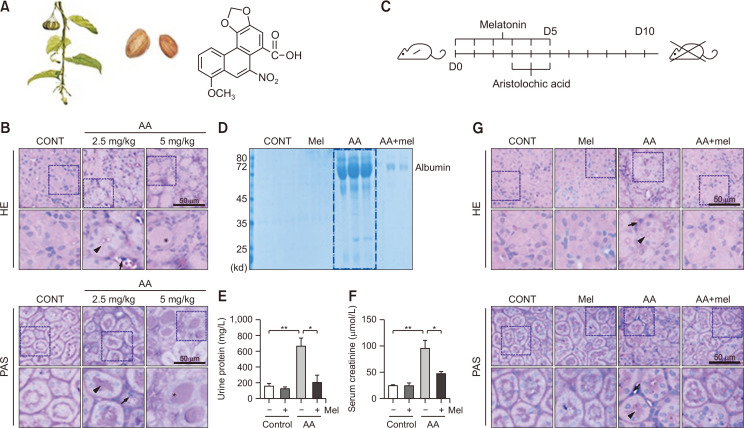
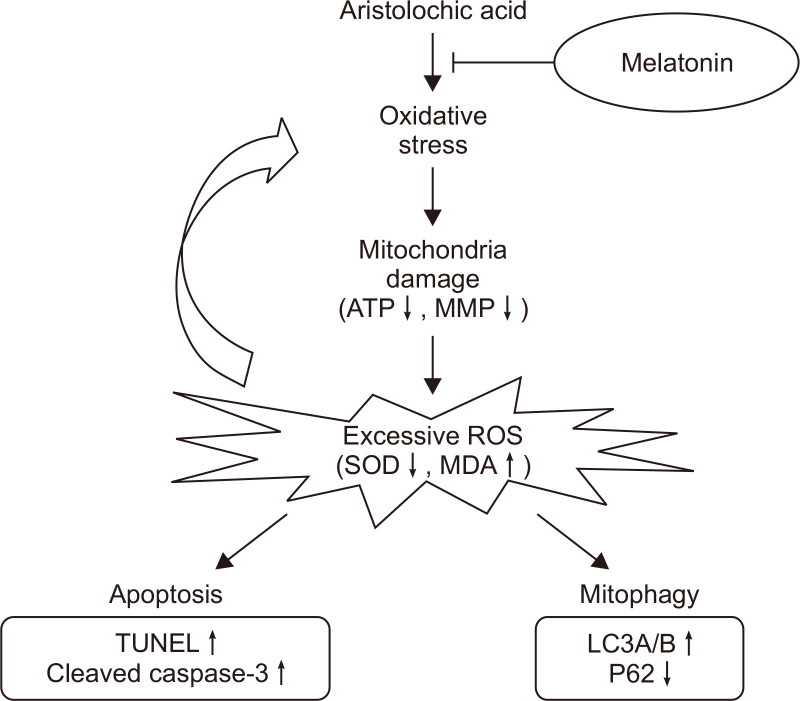
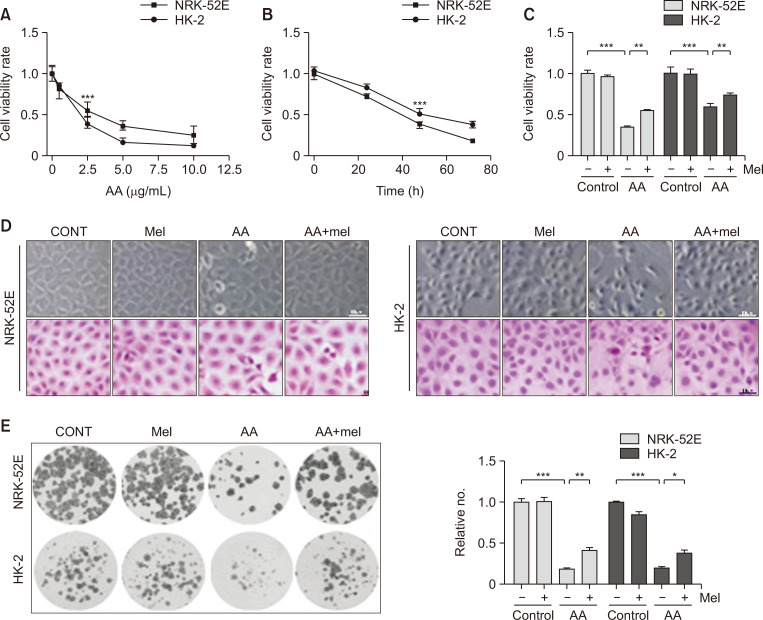
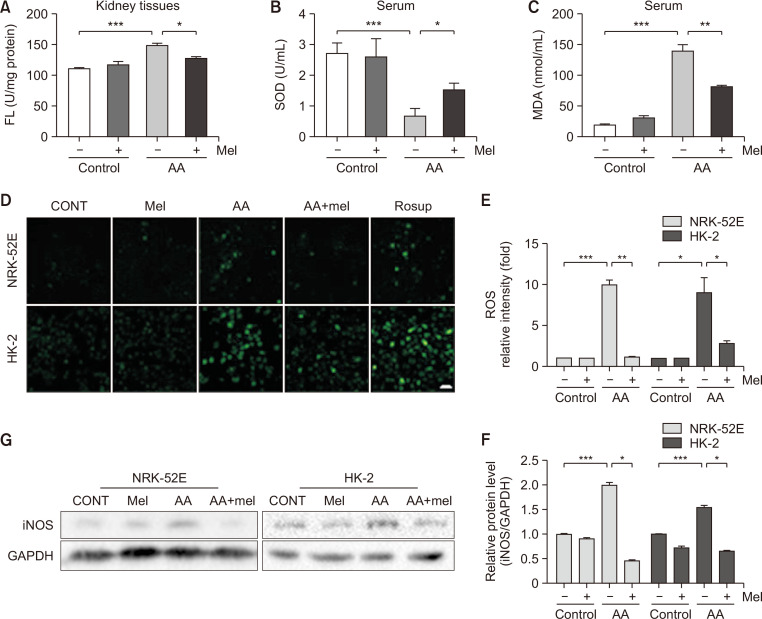
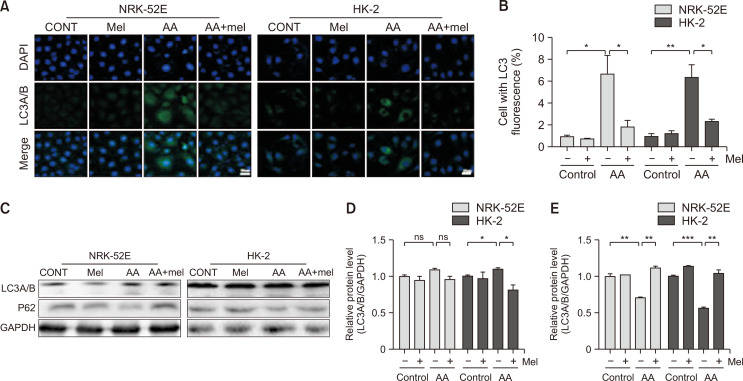
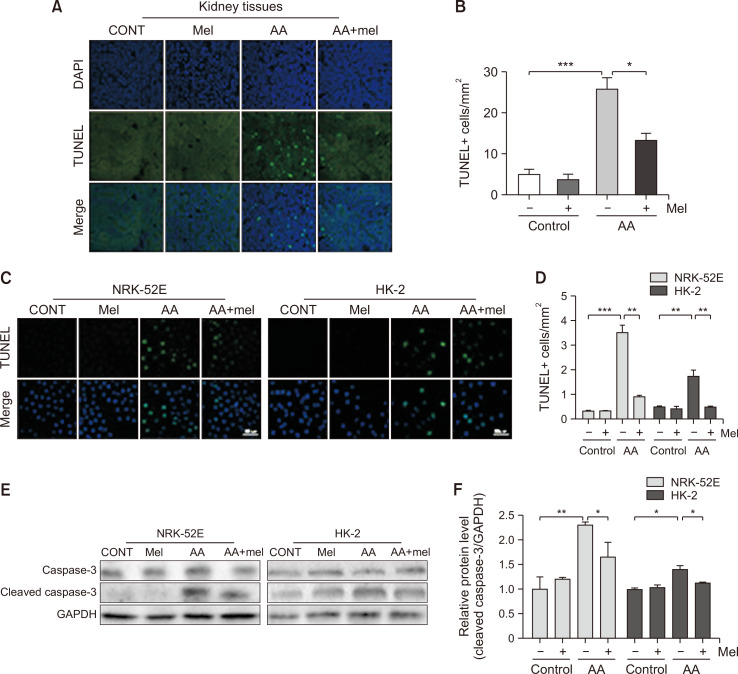
Aristolochic acid (AA), extracted from Aristolochiaceae plants, plays an essential role in traditional herbal medicines and is used for different diseases. However, AA has been found to be nephrotoxic and is known to cause aristolochic acid nephropathy (AAN). AA-induced acute kidney injury (AKI) is a syndrome in AAN with a high morbidity that manifests mitochondrial damage as a key part of its pathological progression. Melatonin primarily serves as a mitochondria-targeted antioxidant. However, its mitochondrial protective role in AA-induced AKI is barely reported. In this study, mice were administrated 2.5 mg/kg AA to induce AKI. Melatonin reduced the increase in Upro and Scr and attenuated the necrosis and atrophy of renal proximal tubules in mice exposed to AA. Melatonin suppressed ROS generation, MDA levels and iNOS expression and increased SOD activities and . Intriguingly, the study revealed that melatonin decreased mitochondrial fragmentation in renal proximal tubular cells and increased ATP levels in kidney tissues in response to AA. , melatonin restored the mitochondrial membrane potential (MMP) in NRK-52E and HK-2 cells and led to an elevation in ATP levels. Confocal immunofluorescence data showed that puncta containing Mito-tracker and GFP-LC3A/B were reduced, thereby impeding the mitophagy of tubular epithelial cells. Furthermore, melatonin decreased LC3A/B-II expression and increased p62 expression. The apoptosis of tubular epithelial cells induced by AA was decreased. Therefore, our findings revealed that melatonin could prevent AA-induced AKI by attenuating mitochondrial damage, which may provide a potential therapeutic method for renal AA toxicity.
马兜铃酸(AA)从马兜铃科植物中提取,在传统草药中发挥着重要作用,用于治疗多种疾病。然而,已发现AA具有肾毒性,可导致马兜铃酸肾病(AAN)。AA诱导的急性肾损伤(AKI)是AAN中的一种综合征,发病率高,其病理进展的关键部分表现为线粒体损伤。褪黑素主要作为一种靶向线粒体的抗氧化剂。然而,其在AA诱导的AKI中的线粒体保护作用鲜有报道。在本研究中,给小鼠注射2.5mg/kg AA以诱导AKI。褪黑素降低了AA处理小鼠的尿蛋白(Upro)和血肌酐(Scr)升高,并减轻了肾近端小管的坏死和萎缩。褪黑素抑制了活性氧(ROS)生成、丙二醛(MDA)水平和诱导型一氧化氮合酶(iNOS)表达,并增加了超氧化物歧化酶(SOD)活性。有趣的是,研究发现褪黑素可减少肾近端小管细胞中的线粒体碎片化,并增加肾脏组织中的三磷酸腺苷(ATP)水平。此外,褪黑素恢复了NRK-52E和HK-2细胞中的线粒体膜电位(MMP),并导致ATP水平升高。共聚焦免疫荧光数据显示,含有线粒体追踪染料和绿色荧光蛋白标记的微管相关蛋白轻链3A/B(GFP-LC3A/B)的点状结构减少,从而抑制了肾小管上皮细胞的线粒体自噬。此外,褪黑素降低了LC3A/B-II表达并增加了p62表达。AA诱导的肾小管上皮细胞凋亡减少。因此,我们的研究结果表明,褪黑素可通过减轻线粒体损伤来预防AA诱导的AKI,这可能为肾脏AA毒性提供一种潜在的治疗方法。