Szent János Hospital, Budapest, Hungary.
National Healthcare Service Centre, Budapest, Hungary.
Rev Neurol. 2022 Sep 16;75(6):143-147. doi: 10.33588/rn.7506.2021479.
The effect of the date of birth on the incidence of cardiovascular disease was confirmed in earlier studies. We aimed to determine whether the season of birth may be associated with a higher incidence of stroke in later life by analyzing thrombolysis numbers according over a ten-year period in Hungary.
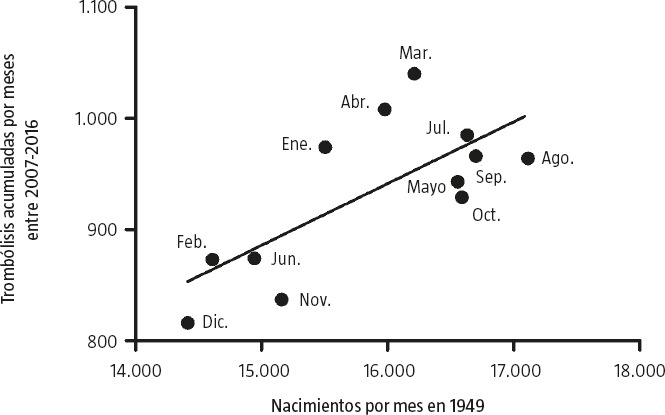
We analyzed daily thrombolysis numbers between 2007 and 2016 according to the patients' date of birth based on seasons. The correlation between cumulative thrombolysis numbers between 2007 and 2016 per month and birth numbers per month based on data of the 1949 census were also examined.
Our results indicate that being born in the spring and summer in the northern hemisphere may be associated with a higher frequency of ischemic stroke necessitating thrombolytic treatment. This equates to a higher risk when conception and early pregnancy occur in the summer and autumn months.
This, however, cannot be defined as a causal relationship if we consider the number of live births in 1949, as both measures change similarly during the year, as indicated by the strong positive correlation between thrombolysis frequency according to date of birth between 2007 and 2016 and the number of births in the 1949 census by month.
早期研究证实了出生日期对心血管疾病发病率的影响。我们旨在通过分析匈牙利十年间的溶栓数据,确定出生季节是否与晚年更高的中风发病率有关。
我们根据季节分析了 2007 年至 2016 年期间每日的溶栓人数,根据 1949 年人口普查数据,还分析了 2007 年至 2016 年期间每月溶栓人数与每月出生人数之间的相关性。
我们的结果表明,在北半球的春季和夏季出生可能与需要溶栓治疗的缺血性中风频率较高有关。这相当于在夏季和秋季受孕和早期妊娠时风险更高。
然而,如果考虑到 1949 年的活产数量,这不能被定义为因果关系,因为这两个指标在一年中变化相似,2007 年至 2016 年期间根据出生日期的溶栓频率与 1949 年按月份出生的数量之间存在很强的正相关关系。