Pediatric Neurosurgery, Charité Universitaetsmedizin Berlin, Campus Virchow Klinikum, Augustenburger Platz 1, 13353, Berlin, Germany.
Childs Nerv Syst. 2023 Jan;39(1):185-195. doi: 10.1007/s00381-022-05659-5. Epub 2022 Sep 13.
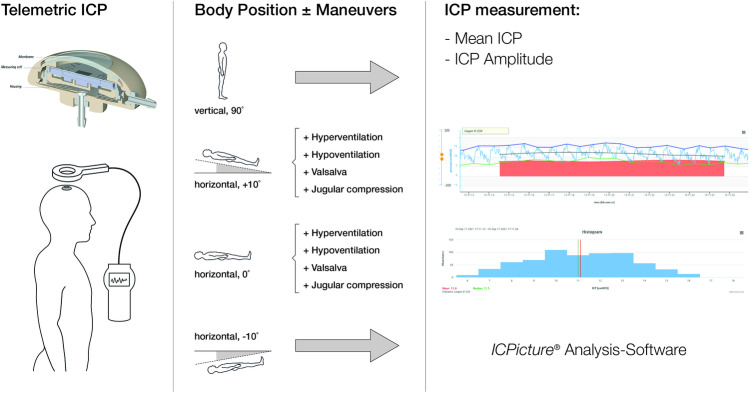
Telemetric intracranial pressure measurement (tICPM) offers new opportunities to acquire objective information in shunted and non-shunted patients. The sensor reservoir (SR) provides tICPM modality at a decent sampling rate as an integrated component of the CSF shunt system. The aim of this study is to perform tICPM during a defined protocol of maneuvers in an outpatient setting as feasibility study including either shunt-dependent patients or candidates for possible shunt therapy.
A total of 17 patients received a SR and were investigated within a protocol of maneuver measurements involving different body postures (90°, 10°, 0°, and - 10°), breathing patterns (hypo- and hyperventilation), and mild venous congestion (Valsalva, Jugular vein compression), while the latter two were performed in lying postures (10° and 0°). The cohort included 11 shunted and 6 non-shunted (stand-alone-SR) patients. All measurements were evaluated using an ICP-analysis software (ICPicture, Miethke, Germany) looking at ICP changes and amplitude (AMP) characteristics.
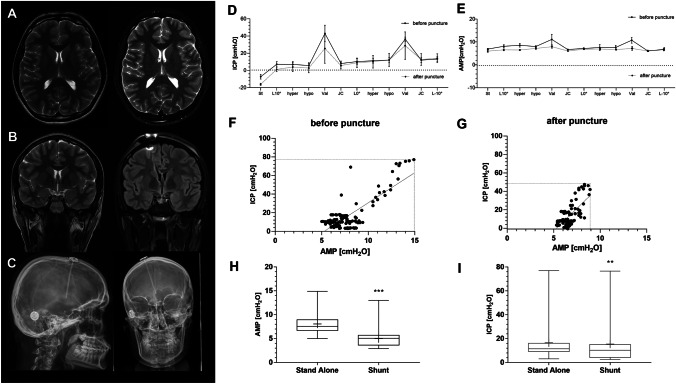
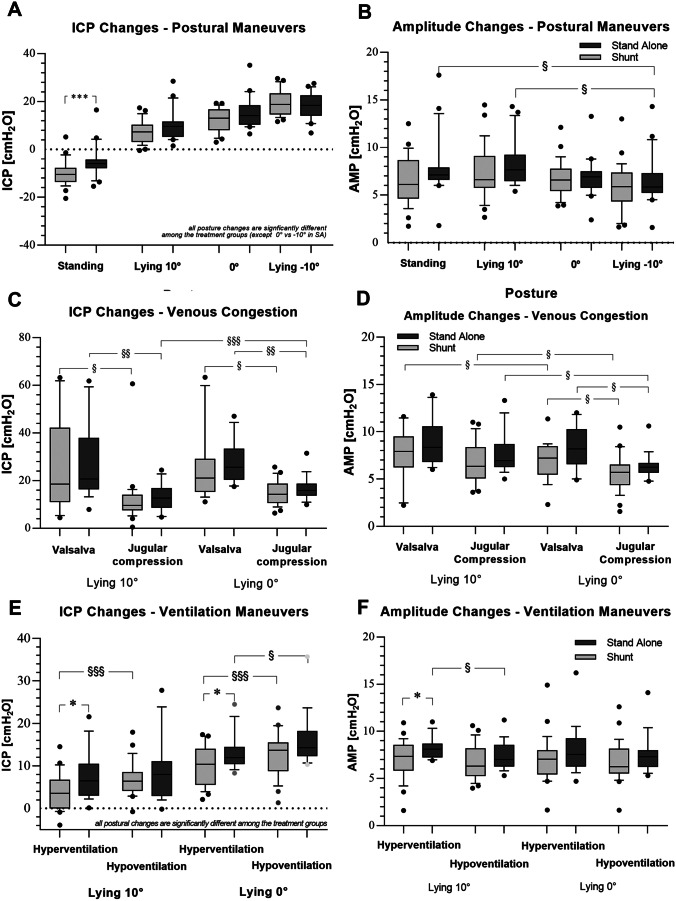
The shunted patient group consisted of 11 patients (median age: 15.8 years; range: 4-35.2 years) with either a primary shunt (n=9) and 2 patients received a shunt after stand-alone-SR tICPM. Six patients were enrolled with a stand-alone SR (median age 11.9 years, range 3.6-17.7 years). In the stand-alone SR group, maneuver related ICP and AMP changes were more sensitive compared to shunted patients. Postural maneuvers caused significant ICP changes in all body positions in both groups. The highest ICP values were seen during Valsalva maneuver, provoked by the patients themselves. In the stand-alone group, significant higher ICP values during hyperventilation were observed compared to shunted individuals. In shunted patients, a significant correlation between ICP and AMP was observed only during hyperventilation maneuver, while this correlation was additionally seen in Valsalva and jugular vein compression in stand-alone patients.
SR-related tICPM is helpful to objectify diagnostic evaluation in patients with CSF dynamic disturbances. The defined protocol did result in a wide range of ICP changes with promising potential for effective outpatient tICPM investigation. Since the correlation of ICP and AMP was observed during mild venous congestion maneuvers it appears to be specifically helpful for the evaluation of intracranial compliance. Further investigations of maneuver-related tICPM in a larger population, including variable pathologies, are needed to further establish the protocol in the clinical practice.
遥测颅内压测量(tICPM)为分流和非分流患者提供了获取客观信息的新机会。传感器储液器(SR)作为脑脊液分流系统的集成组件,以合理的采样率提供 tICPM 模式。本研究的目的是在门诊环境中按照操作方案进行 tICPM,该方案包括依赖分流的患者或可能需要分流治疗的患者。
共有 17 名患者接受了 SR 治疗,并在一项涉及不同体位(90°、10°、0°和-10°)、呼吸模式(低通气和高通气)和轻度静脉充血(瓦尔萨尔瓦动作、颈静脉压迫)的操作测量方案中进行了研究,而后两种体位是在 10°和 0°的卧位进行的。该队列包括 11 例分流患者和 6 例非分流患者(独立 SR)。所有测量均使用 ICP 分析软件(ICPicture,Miethke,德国)进行评估,观察 ICP 变化和幅度(AMP)特征。
分流患者组包括 11 名患者(中位年龄:15.8 岁;范围:4-35.2 岁),其中原发性分流 9 例,2 例在独立 SR tICPM 后接受分流。6 名患者接受了独立 SR 治疗(中位年龄 11.9 岁,范围 3.6-17.7 岁)。在独立 SR 组中,与分流患者相比,操作相关的 ICP 和 AMP 变化更敏感。在两组中,体位操作都会导致所有体位的 ICP 显著变化。在患者自主进行的瓦尔萨尔瓦动作中,观察到最高的 ICP 值。在独立 SR 组中,与分流患者相比,在过度通气期间观察到显著更高的 ICP 值。在分流患者中,仅在过度通气操作期间观察到 ICP 和 AMP 之间存在显著相关性,而在独立患者中,在瓦尔萨尔瓦和颈静脉压迫操作期间也观察到这种相关性。
SR 相关的 tICPM 有助于客观评估 CSF 动力学障碍患者的诊断。所定义的方案确实导致了广泛的 ICP 变化,为有效的门诊 tICPM 研究提供了有希望的潜力。由于在轻度静脉充血操作期间观察到 ICP 和 AMP 之间的相关性,因此它似乎特别有助于评估颅内顺应性。需要进一步在包括各种病理的更大人群中进行与操作相关的 tICPM 研究,以在临床实践中进一步建立该方案。