Department of Biochemistry and Molecular Biology, School of Preclinical Medicine and Forensic Medicine, North Sichuan Medical College, Nanchong, Sichuan Province, China.
Research Center for Integrative Medicine, Affiliated Traditional Medicine Hospital of Southwest Medical University, Luzhou, China.
J Clin Lab Anal. 2022 Oct;36(10):e24692. doi: 10.1002/jcla.24692. Epub 2022 Sep 13.
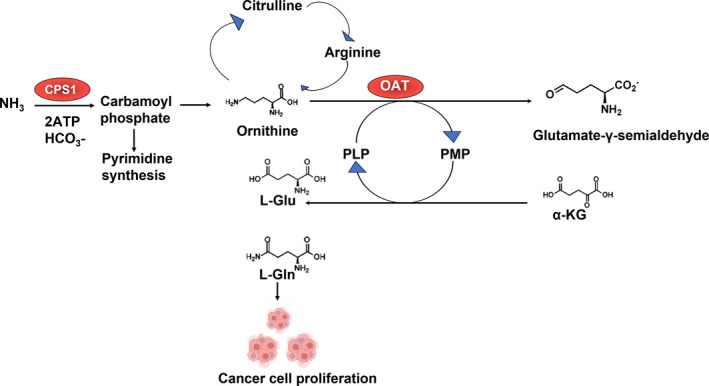
The sensitivity and specificity of current biomarkers for gastric cancer were insufficient. The aim of the present study was to screen novel biomarkers and determine the diagnostic values of ornithine aminotransferase (OAT) and carbamoyl phosphate synthetase 1 (CPS1) for detecting gastric cancer.
With stable isotope tags, we labelled an initial discovery group of four paired gastric cancer tissue samples and identified with LC-ESI-MS/MS. A validation group of 159 gastric cancer samples and 30 healthy controls were used to validate the candidate targets. GSEA was used to explore the pathways activated in gastric cancer.
Four hundred and thirty one proteins were found differentially expressed in gastric cancer tissues. Of these proteins, OAT and CPS1 were found over-expressed in gastric cancer patients, with sensitivity of 70.4% (95% CI: 63.3%-77.6%) and specificity of 80.5% (95% CI: 74.3%-86.7%) for ornithine aminotransferase, and with sensitivity of 68.6% (95% CI: 61.3%-75.8%) and specificity of 73% (95% CI: 66%-79.9%) for carbamoyl phosphate synthetase 1. The co-expression of OAT and CPS1 in gastric cancer tissues has a sensitivity of 81% (95% CI: 73.2%-88.8%) and specificity of 89% (95% CI: 83%-95%). Furthermore, both OAT and CPS1 were overexpressed in patients with local invasion T3 and T4 stages than those in patients with T1 and T2 stages. The co-expression of OAT and CPS1 was strongly correlated with histological grade I 68% (95% CI: 58.7%-77.3%) and TNM stage I/II 52% (95% CI: 42%-62%). The areas under ROC curves were up to 0.758 for the co-expression of OAT and CPS1 in gastric cancer. GSEA results showed that two gene sets and 30 gene sets were activated in OAT high- and CPS1 high-expression patients with gastric cancer, respectively.
The present findings indicated a tight correlation between the co-expression of OAT and CPS1 and the histological grade, local invasion, and TNM stages of gastric cancer. Therefore, OAT and CPS1 might be predictors for gastric cancer invasion and potential targets for anticancer drug design for gastric cancer.
当前用于胃癌的生物标志物的灵敏度和特异性不足。本研究旨在筛选新型生物标志物,并确定鸟氨酸转氨酶(OAT)和氨基甲酰磷酸合成酶 1(CPS1)用于检测胃癌的诊断价值。
采用稳定同位素标记,对 4 对配对胃癌组织样本进行初始发现组标记,并通过 LC-ESI-MS/MS 进行鉴定。使用 159 例胃癌样本和 30 例健康对照对候选靶标进行验证。采用 GSEA 探索胃癌中激活的通路。
在胃癌组织中发现 431 种差异表达的蛋白质。在这些蛋白质中,OAT 和 CPS1 在胃癌患者中表达过高,OAT 的灵敏度为 70.4%(95%CI:63.3%-77.6%),特异性为 80.5%(95%CI:74.3%-86.7%),CPS1 的灵敏度为 68.6%(95%CI:61.3%-75.8%),特异性为 73%(95%CI:66%-79.9%)。胃癌组织中 OAT 和 CPS1 的共表达灵敏度为 81%(95%CI:73.2%-88.8%),特异性为 89%(95%CI:83%-95%)。此外,局部浸润 T3 和 T4 期患者的 OAT 和 CPS1 表达均高于 T1 和 T2 期患者。OAT 和 CPS1 的共表达与组织学分级 I(68%[95%CI:58.7%-77.3%])和 TNM 分期 I/II(52%[95%CI:42%-62%])密切相关。OAT 和 CPS1 共表达在胃癌中的 ROC 曲线下面积高达 0.758。GSEA 结果表明,OAT 高表达和 CPS1 高表达的胃癌患者分别有两个基因集和 30 个基因集被激活。
本研究结果表明,OAT 和 CPS1 的共表达与胃癌的组织学分级、局部浸润和 TNM 分期密切相关。因此,OAT 和 CPS1 可能是胃癌侵袭的预测因子,也是胃癌抗癌药物设计的潜在靶点。