Xiangya School of Nursing, Central South University, 172 Tongzipo Road of Yuelu District, Changsha, 410013, China.
University of Houston Graduate College of Social Work, Houston, TX, USA.
BMC Geriatr. 2022 Sep 14;22(1):749. doi: 10.1186/s12877-022-03406-8.
Anxiety and depressive symptoms are associated with fear of falling and fear of falling-related activity restrictions. However, it remains unknown whether anxiety or depressive symptoms alone could predict fear of falling and activity restrictions in older adults. We sought to determine if anxiety and depressive symptoms alone could be an independent predictor of fear of falling and activity restrictions in community-dwelling older adults.
This longitudinal analysis used waves 5 (time 1, [T1]) and 6 (time 2, [T2], 1 year from T1) data (N = 6376) from the National Health and Aging Trends Study. The Generalized Anxiety Disorder Scale 2 and Patient Health Questionnaire 2 were used to assess anxiety and depressive symptoms, respectively. Interview questions included demographics, health-related data, and fall worry levels (no fear of falling, fear of falling but no activity restrictions, and activity restrictions). Using multinomial logistic regression models, we examined whether anxiety and depressive symptoms (T1) predicted fear of falling and activity restrictions (T2).
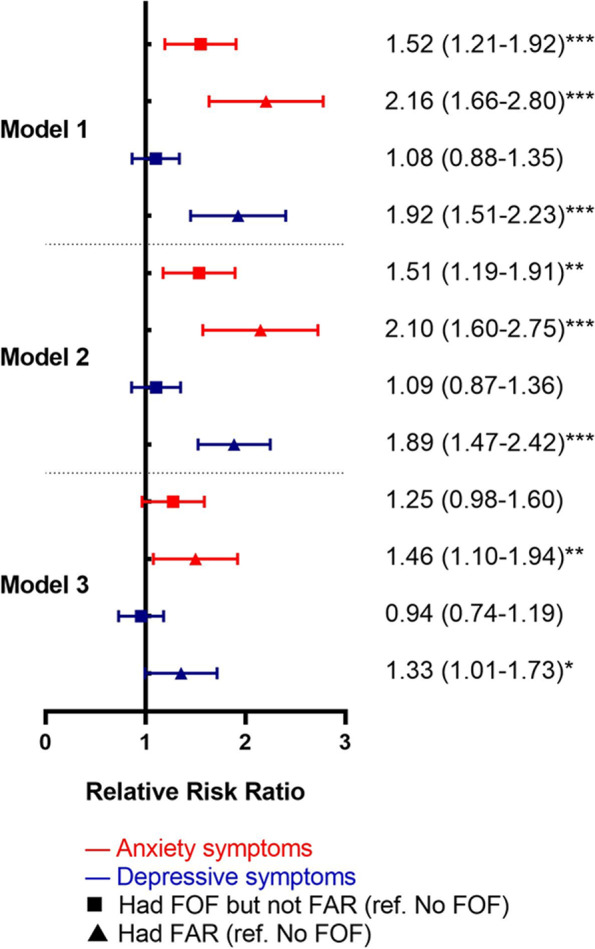
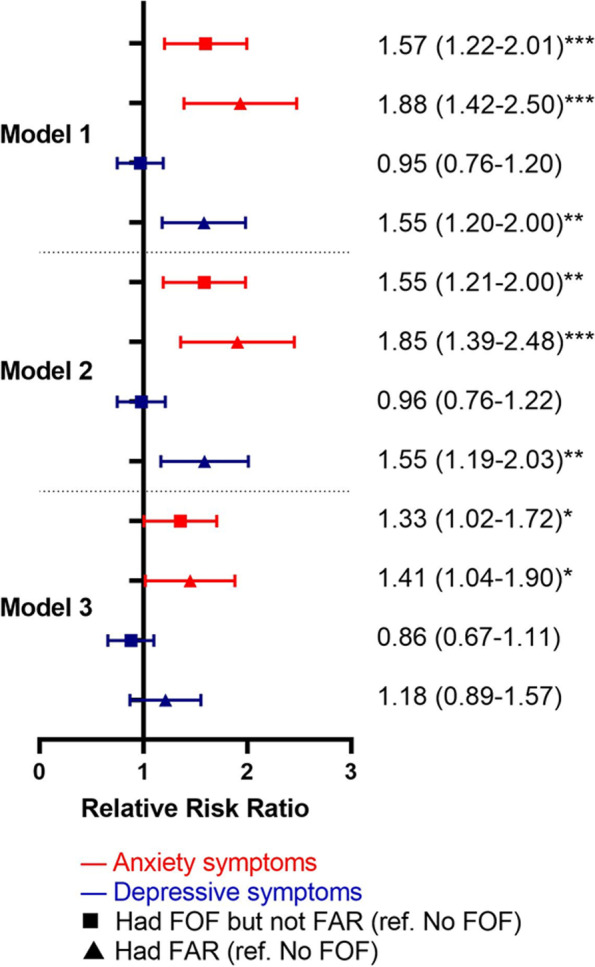
In wave 5 (T1, mean age: 78 years, 58.1% female), 10 and 13% of participants reported anxiety and depressive symptoms. About 19% of participants experienced fear of falling but not activity restrictions, and 10% of participants developed activity restrictions in wave 6 (T2), respectively. Participants with anxiety symptoms at T1 had a 1.33 times higher risk of fear of falling (95% CI = 1.02-1.72) and 1.41 times higher risk of activity restrictions (95% CI = 1.04-1.90) at T2. However, having depressive symptoms did not show any significance after adjusting for anxiety symptoms.
Anxiety symptoms seemed to be an independent risk factor for future fear of falling and activity restrictions, while depressive symptoms were not. To prevent future fear of falling and activity restrictions, we should pay special attention to older individuals with anxiety symptoms.
焦虑和抑郁症状与跌倒恐惧和与跌倒相关的活动限制有关。然而,尚不清楚焦虑或抑郁症状本身是否可以预测老年人的跌倒恐惧和活动限制。我们试图确定焦虑和抑郁症状本身是否可以成为社区居住的老年人跌倒恐惧和活动限制的独立预测因素。
这项纵向分析使用了国家健康老龄化趋势研究的第 5 波(时间 1 [T1])和第 6 波(时间 2 [T2],T1 后 1 年)数据(N=6376)。使用广泛性焦虑症量表 2 和患者健康问卷 2 分别评估焦虑和抑郁症状。访谈问题包括人口统计学、与健康相关的数据以及跌倒担忧程度(无跌倒恐惧、跌倒但无活动限制和活动限制)。使用多项逻辑回归模型,我们检查了焦虑和抑郁症状(T1)是否预测跌倒恐惧和活动限制(T2)。
在第 5 波(T1,平均年龄:78 岁,58.1%为女性)中,有 10%和 13%的参与者报告有焦虑和抑郁症状。约 19%的参与者经历了跌倒恐惧但无活动限制,10%的参与者在第 6 波(T2)中出现了活动限制。在 T1 时患有焦虑症状的参与者在 T2 时跌倒恐惧的风险增加了 1.33 倍(95%CI=1.02-1.72),活动限制的风险增加了 1.41 倍(95%CI=1.04-1.90)。然而,在调整了焦虑症状后,抑郁症状并没有显示出任何意义。
焦虑症状似乎是未来跌倒恐惧和活动限制的独立危险因素,而抑郁症状则不是。为了预防未来的跌倒恐惧和活动限制,我们应该特别关注有焦虑症状的老年人。