Bendary Mahmoud M, Abd El-Hamid Marwa I, Alhomrani Majid, Alamri Abdulhakeem S, Elshimy Rana, Mosbah Rasha A, Bahnass Mosa M, Omar Nasreen N, Al-Sanea Mohammad M, Elmanakhly Arwa R, Safwat Nesreen A, Alshareef Walaa A
Department of Microbiology and Immunology, Faculty of Pharmacy, Port Said University, Port Said 42511, Egypt.
Department of Microbiology, Faculty of Veterinary Medicine, Zagazig University, Zagazig 44511, Egypt.
Biology (Basel). 2022 Jul 2;11(7):1004. doi: 10.3390/biology11071004.
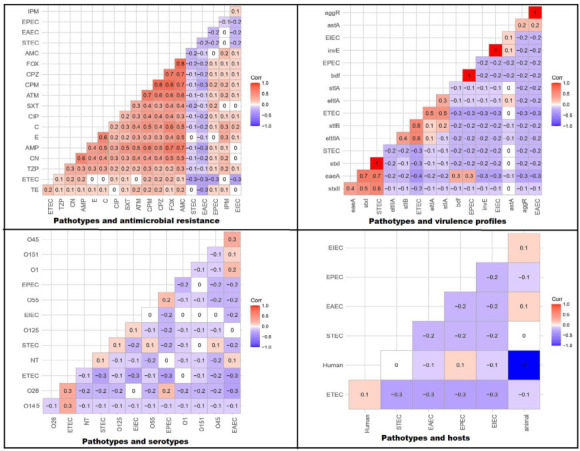
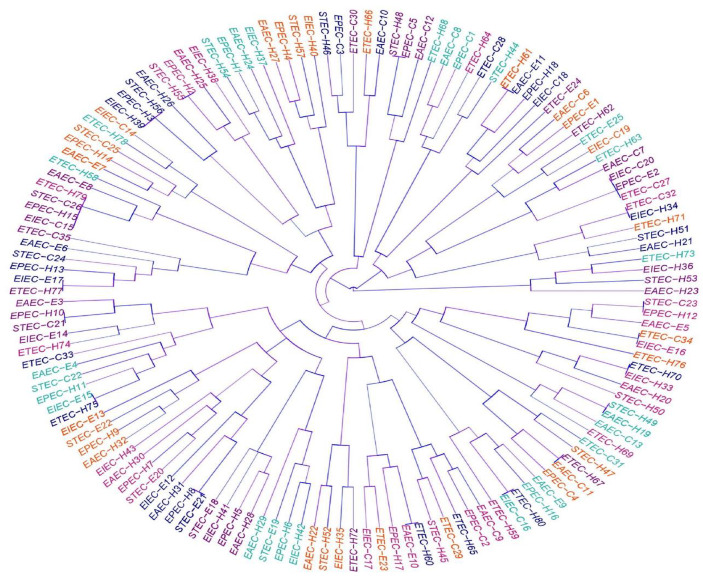
The treatment failure recorded among patients and animals infected with diarrheagenic (DEC) was increased due to the presence of specific virulence markers among these strains. These markers were used to classify DEC into several pathotypes. We analyzed the correlations between DEC pathotypes and antimicrobial resistances, the existence of virulence genes, serotypes, and hosts. The ETEC pathotype was detected with a high prevalence rate (25%). Moreover, the ETEC and EPEC pathotypes were highly associated with human infections in contrast to the EIEC and EAEC phenotypes, which were commonly recognized among animal isolates. Interestingly, the antimicrobial resistance was affected by pathotypes. With the exception of EIEC and STEC, imipenem represented the most effective antibiotic against the other pathotypes. There were fixed correlations between the DEC pathotypes and the presence of virulence markers and hosts; meanwhile, their correlation with serotypes was variable. Additionally, the vast majority of our isolates were highly diverse, based on both phenotypic and ERIC molecular typing techniques. Our promising results gave a clear indication for the heterogeneity and weak clonality of DEC pathotypes in Egypt, which can be utilized in the evaluation of the current therapeutic protocols and infection control guidelines.
在感染致泻性大肠埃希菌(DEC)的患者和动物中记录的治疗失败率因这些菌株中存在特定毒力标记而增加。这些标记用于将DEC分为几种致病型。我们分析了DEC致病型与抗菌药物耐药性、毒力基因的存在、血清型和宿主之间的相关性。检测到肠毒素型大肠埃希菌(ETEC)致病型的患病率很高(25%)。此外,与肠侵袭型大肠埃希菌(EIEC)和肠集聚型大肠埃希菌(EAEC)表型相比,ETEC和肠致病性大肠埃希菌(EPEC)致病型与人类感染高度相关,EIEC和EAEC表型在动物分离株中较为常见。有趣的是,抗菌药物耐药性受致病型影响。除EIEC和产志贺毒素大肠埃希菌(STEC)外,亚胺培南是针对其他致病型最有效的抗生素。DEC致病型与毒力标记和宿主的存在之间存在固定的相关性;同时,它们与血清型的相关性是可变的。此外,基于表型和ERIC分子分型技术,我们分离的绝大多数菌株具有高度多样性。我们的这些有前景的结果清楚地表明了埃及DEC致病型的异质性和弱克隆性,这可用于评估当前的治疗方案和感染控制指南。