Bioengineering Graduate Program Georgia Institute of Technology Atlanta GA.
School of Electrical and Computer Engineering Georgia Institute of Technology Atlanta GA.
J Am Heart Assoc. 2022 Sep 20;11(18):e026067. doi: 10.1161/JAHA.122.026067. Epub 2022 Sep 14.
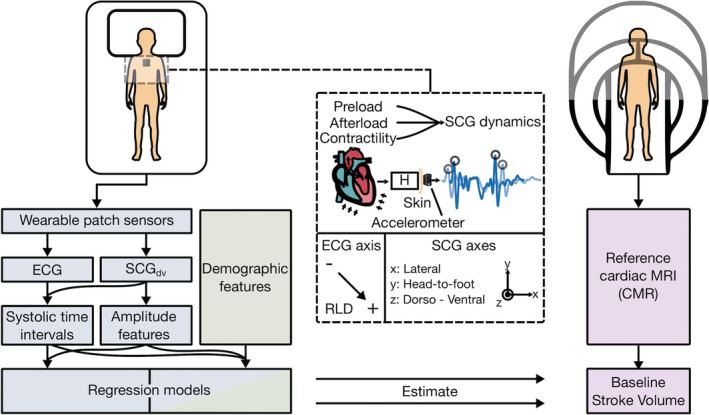
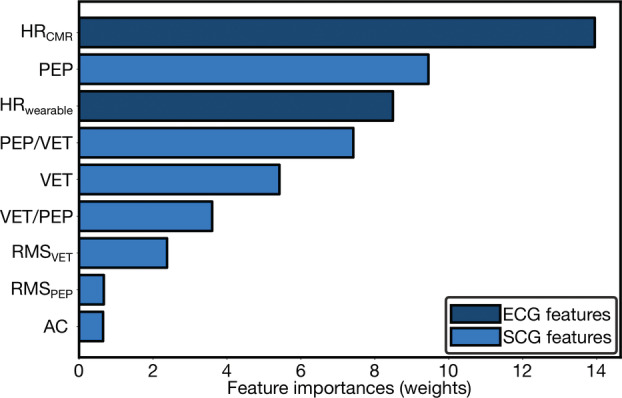
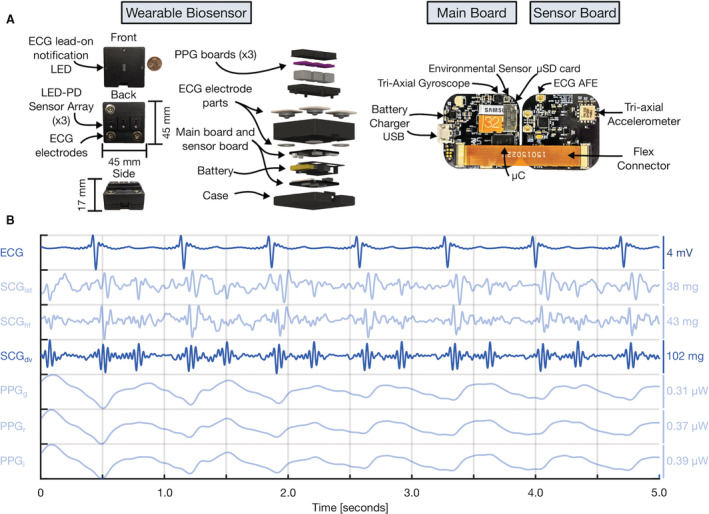
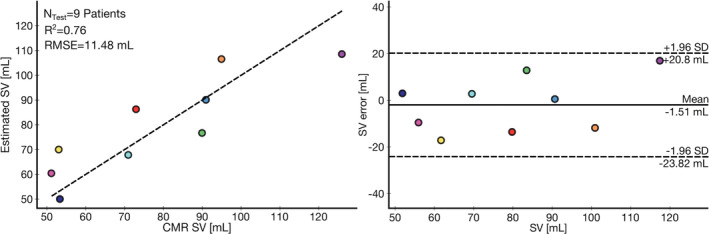
Background Patients with congenital heart disease (CHD) are at risk for the development of low cardiac output and other physiologic derangements, which could be detected early through continuous stroke volume (SV) measurement. Unfortunately, existing SV measurement methods are limited in the clinic because of their invasiveness (eg, thermodilution), location (eg, cardiac magnetic resonance imaging), or unreliability (eg, bioimpedance). Multimodal wearable sensing, leveraging the seismocardiogram, a sternal vibration signal associated with cardiomechanical activity, offers a means to monitoring SV conveniently, affordably, and continuously. However, it has not been evaluated in a population with significant anatomical and physiological differences (ie, children with CHD) or compared against a true gold standard (ie, cardiac magnetic resonance). Here, we present the feasibility of wearable estimation of SV in a diverse CHD population (N=45 patients). Methods and Results We used our chest-worn wearable biosensor to measure baseline ECG and seismocardiogram signals from patients with CHD before and after their routine cardiovascular magnetic resonance imaging, and derived features from the measured signals, predominantly systolic time intervals, to estimate SV using ridge regression. Wearable signal features achieved acceptable SV estimation (28% error with respect to cardiovascular magnetic resonance imaging) in a held-out test set, per cardiac output measurement guidelines, with a root-mean-square error of 11.48 mL and of 0.76. Additionally, we observed that using a combination of electrical and cardiomechanical features surpassed the performance of either modality alone. Conclusions A convenient wearable biosensor that estimates SV enables remote monitoring of cardiac function and may potentially help identify decompensation in patients with CHD.
背景
患有先天性心脏病 (CHD) 的患者存在心输出量降低和其他生理紊乱的风险,这些风险可以通过连续测量stroke volume (SV) 来早期发现。不幸的是,由于现有的 SV 测量方法具有侵入性(例如,热稀释法)、位置限制(例如,心脏磁共振成像)或不可靠性(例如,生物阻抗法),因此在临床上受到限制。多模态可穿戴传感器利用与心肌机械活动相关的胸骨振动信号——地震心动图,提供了一种方便、经济且连续监测 SV 的方法。然而,它尚未在解剖结构和生理机能存在显著差异的人群(即患有 CHD 的儿童)中进行评估,也未与真正的金标准(即心脏磁共振)进行比较。在这里,我们展示了在具有多样性的 CHD 患者群体中(N=45 例患者)使用可穿戴设备估计 SV 的可行性。
方法和结果
我们使用佩戴在胸部的可穿戴生物传感器在患者进行常规心血管磁共振成像之前和之后测量 CHD 患者的基线心电图和地震心动图信号,并从测量信号中提取特征,主要是收缩时间间隔,使用岭回归来估计 SV。根据心血管磁共振成像的测量指南,根据心输出量测量指南,可穿戴信号特征在独立测试集中实现了可接受的 SV 估计(相对于心血管磁共振成像有 28%的误差),均方根误差为 11.48 mL,相关系数为 0.76。此外,我们观察到使用电气和心肌力学特征的组合优于任何单一模态的性能。
结论
一种方便的可穿戴生物传感器,能够估计 SV,可实现远程监测心脏功能,并可能有助于识别 CHD 患者的失代偿。