National Institute for Health and Care Research (NIHR) School for Primary Care Research, Division of Population Health, Health Services Research and Primary Care, School of Health Sciences, Faculty of Biology, Medicine and Health, Manchester Academic Health Science Centre, University of Manchester, Manchester, UK
National Institute for Health Research Greater Manchester Patient Safety Translational Research Centre, Division of Population Health, Health Services Research and Primary Care, University of Manchester, Manchester, UK.
BMJ. 2022 Sep 14;378:e070442. doi: 10.1136/bmj-2022-070442.
To examine the association of physician burnout with the career engagement and the quality of patient care globally.
Systematic review and meta-analysis.
Medline, PsycINFO, Embase, and CINAHL were searched from database inception until May 2021.
Observational studies assessing the association of physician burnout (including a feeling of overwhelming emotional exhaustion, feelings of cynicism and detachment from job defined as depersonalisation, and a sense of ineffectiveness and little personal accomplishment) with career engagement (job satisfaction, career choice regret, turnover intention, career development, and productivity loss) and the quality of patient care (patient safety incidents, low professionalism, and patient satisfaction). Data were double extracted by independent reviewers and checked through contacting all authors, 84 (49%) of 170 of whom confirmed their data. Random-effect models were used to calculate the pooled odds ratio, prediction intervals expressed the amount of heterogeneity, and meta-regressions assessed for potential moderators with significance set using a conservative level of P<0.10.
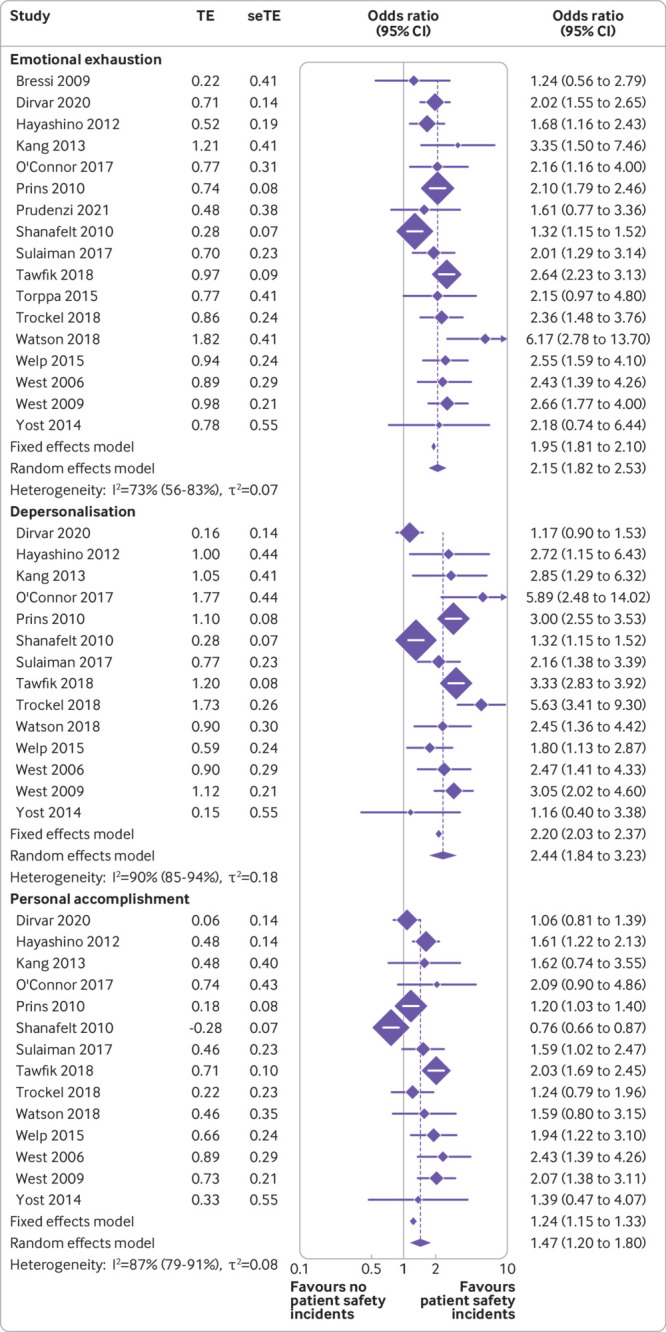
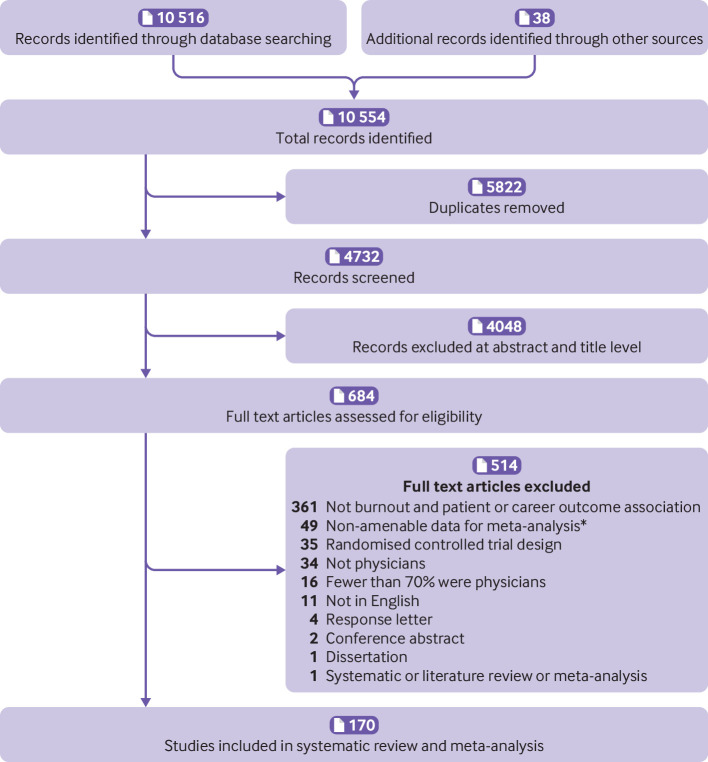
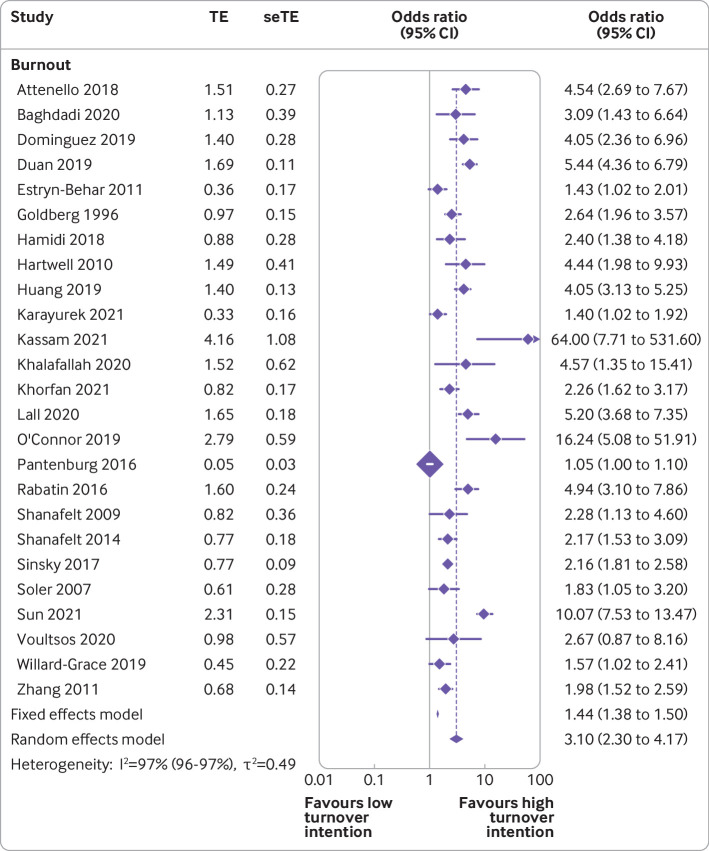
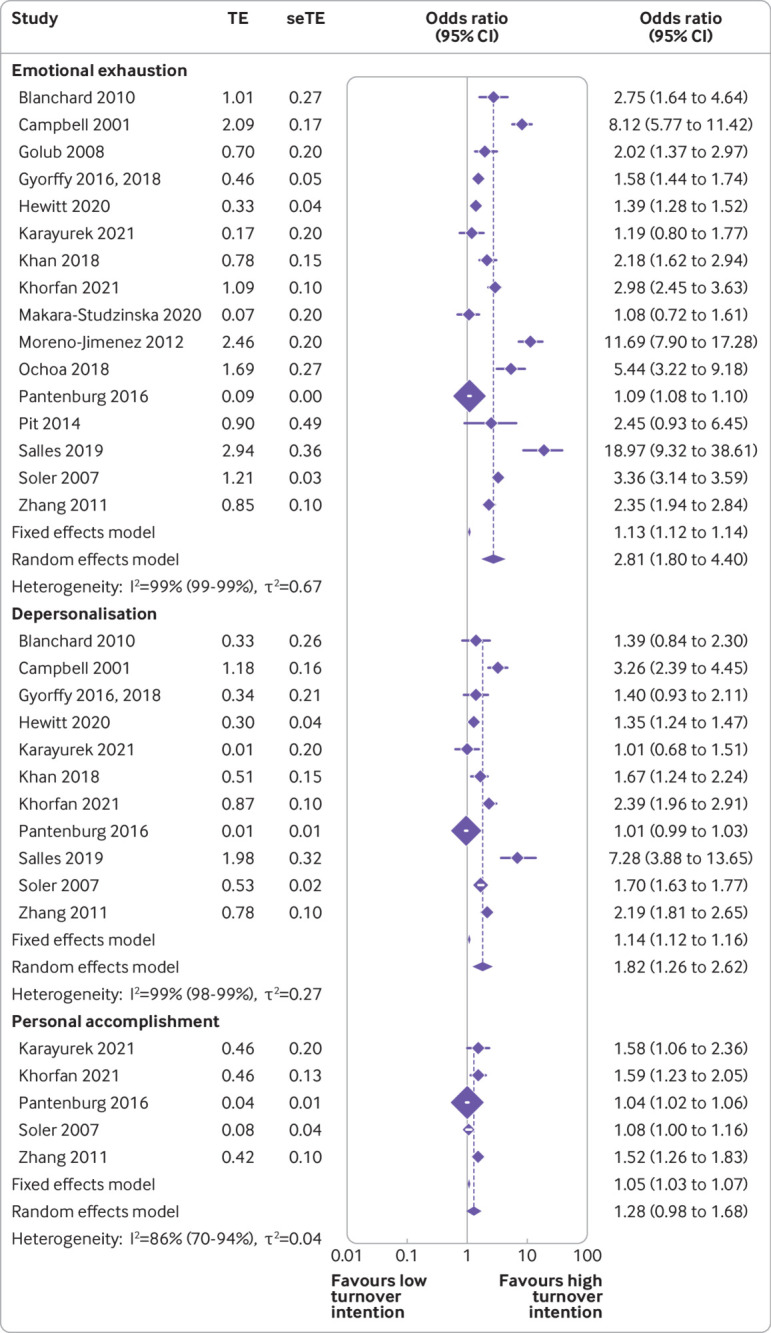
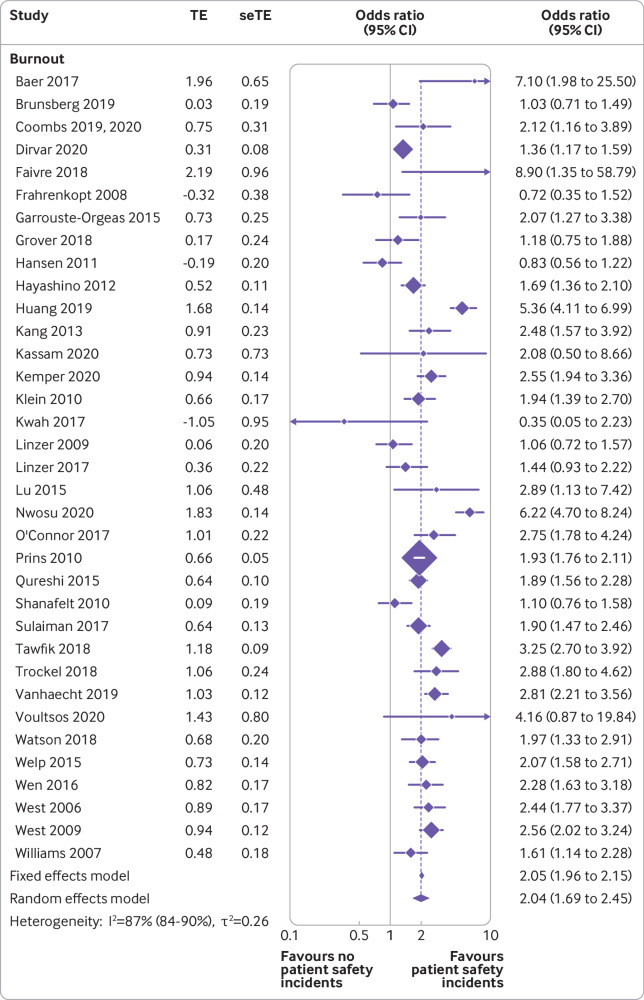
4732 articles were identified, of which 170 observational studies of 239 246 physicians were included in the meta-analysis. Overall burnout in physicians was associated with an almost four times decrease in job satisfaction compared with increased job satisfaction (odds ratio 3.79, 95% confidence interval 3.24 to 4.43, I=97%, k=73 studies, n=146 980 physicians). Career choice regret increased by more than threefold compared with being satisfied with their career choice (3.49, 2.43 to 5.00, I=97%, k=16, n=33 871). Turnover intention also increased by more than threefold compared with retention (3.10, 2.30 to 4.17, I=97%, k=25, n=32 271). Productivity had a small but significant effect (1.82, 1.08 to 3.07, I=83%, k=7, n=9581) and burnout also affected career development from a pooled association of two studies (3.77, 2.77 to 5.14, I=0%, n=3411). Overall physician burnout doubled patient safety incidents compared with no patient safety incidents (2.04, 1.69 to 2.45, I=87%, k=35, n=41 059). Low professionalism was twice as likely compared with maintained professionalism (2.33, 1.96 to 2.70, I=96%, k=40, n=32 321), as was patient dissatisfaction compared with patient satisfaction (2.22, 1.38 to 3.57, I=75%, k=8, n=1002). Burnout and poorer job satisfaction was greatest in hospital settings (1.88, 0.91 to 3.86, P=0.09), physicians aged 31-50 years (2.41, 1.02 to 5.64, P=0.04), and working in emergency medicine and intensive care (2.16, 0.98 to 4.76, P=0.06); burnout was lowest in general practitioners (0.16, 0.03 to 0.88, P=0.04). However, these associations did not remain significant in the multivariable regressions. Burnout and patient safety incidents were greatest in physicians aged 20-30 years (1.88, 1.07 to 3.29, P=0.03), and people working in emergency medicine (2.10, 1.09 to 3.56, P=0.02). The association of burnout with low professionalism was smallest in physicians older than 50 years (0.36, 0.19 to 0.69, P=0.003) and greatest in physicians still in training or residency (2.27, 1.45 to 3.60, P=0.001), in those who worked in a hospital (2.16, 1.46 to 3.19, P<0.001), specifically in emergency medicine specialty (1.48, 1.01 to 2.34, P=0.042), or situated in a low to middle income country (1.68, 0.94 to 2.97, P=0.08).
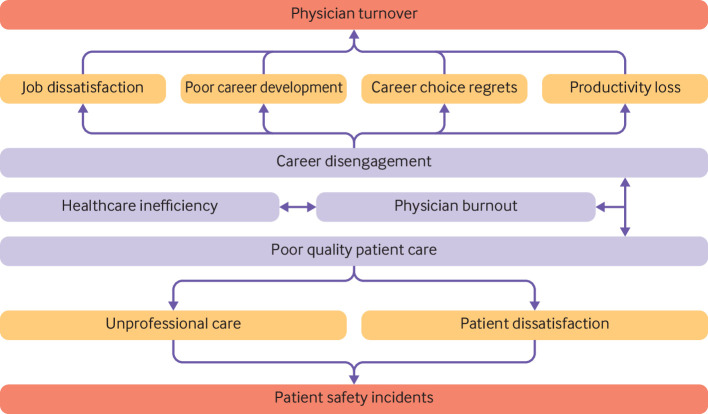
This meta-analysis provides compelling evidence that physician burnout is associated with poor function and sustainability of healthcare organisations primarily by contributing to the career disengagement and turnover of physicians and secondarily by reducing the quality of patient care. Healthcare organisations should invest more time and effort in implementing evidence-based strategies to mitigate physician burnout across specialties, and particularly in emergency medicine and for physicians in training or residency.
PROSPERO number CRD42021249492.
全球范围内考察医生职业倦怠与职业投入和患者护理质量之间的关联。
系统评价和荟萃分析。
从数据库创建之初到 2021 年 5 月,检索了 Medline、PsycINFO、Embase 和 CINAHL。
评估医生职业倦怠(包括压倒性的情绪疲惫感、对工作的愤世嫉俗和与工作脱节的感觉,即去人性化,以及无效感和成就感低)与职业投入(工作满意度、职业选择后悔、离职意向、职业发展和生产力损失)和患者护理质量(患者安全事件、职业素养低下和患者满意度)之间关联的观察性研究。数据由两名独立的审查员进行双重提取,并通过联系所有作者进行检查,其中 84 名(49%)来自 170 篇论文的作者确认了他们的数据。使用随机效应模型计算合并的优势比,预测区间表示异质性的程度,元回归评估潜在的调节因素,使用保守的 P<0.10 水平确定显著性。
共确定了 4732 篇文章,其中纳入了 170 项观察性研究,共涉及 239246 名医生。与职业倦怠相比,医生的整体职业倦怠与工作满意度的降低几乎呈四倍相关(优势比 3.79,95%置信区间 3.24 至 4.43,I=97%,k=73 项研究,n=146980 名医生)。与对职业选择满意相比,职业选择后悔增加了三倍以上(3.49,2.43 至 5.00,I=97%,k=16 项研究,n=33871 名医生)。离职意向也增加了三倍以上,与留任相比(3.10,2.30 至 4.17,I=97%,k=25 项研究,n=32271 名医生)。生产力也有较小但显著的影响(1.82,1.08 至 3.07,I=83%,k=7 项研究,n=9581 名医生),并且职业倦怠也从两项研究的总体关联中影响了职业发展(3.77,2.77 至 5.14,I=0%,n=3411 名医生)。与没有患者安全事件相比,整体医生职业倦怠导致患者安全事件增加了一倍(2.04,1.69 至 2.45,I=87%,k=35 项研究,n=41059 名医生)。与保持职业素养相比,职业素养低下的可能性是其两倍(2.33,1.96 至 2.70,I=96%,k=40 项研究,n=32321 名医生),与患者满意度相比,患者不满意的可能性也是其两倍(2.22,1.38 至 3.57,I=75%,k=8 项研究,n=1002 名医生)。在医院环境中(1.88,0.91 至 3.86,P=0.09)、31-50 岁的医生(2.41,1.02 至 5.64,P=0.04)和从事急诊医学和重症监护的医生(2.16,0.98 至 4.76,P=0.06)中,职业倦怠和较差的工作满意度与较差的职业倦怠最为相关;在全科医生中(0.16,0.03 至 0.88,P=0.04),职业倦怠程度最低。然而,这些关联在多变量回归中并不显著。在 20-30 岁的医生中(1.88,1.07 至 3.29,P=0.03)和从事急诊医学的医生中(2.10,1.09 至 3.56,P=0.02),职业倦怠与患者安全事件的关联最大。在年龄大于 50 岁的医生中(0.36,0.19 至 0.69,P=0.003),与职业倦怠相关的职业素养低下的关联最小,而在仍在培训或住院医师的医生中(2.27,1.45 至 3.60,P=0.001),在在医院工作的医生中(2.16,1.46 至 3.19,P<0.001),特别是在急诊医学专业中(1.48,1.01 至 2.34,P=0.042),或者在中低收入国家(1.68,0.94 至 2.97,P=0.08),这种关联最大。
这项荟萃分析提供了令人信服的证据,表明医生职业倦怠与医疗保健组织的功能和可持续性不佳密切相关,主要是通过导致医生职业倦怠和离职,其次是通过降低患者护理质量。医疗保健组织应投入更多时间和精力实施基于证据的策略,以减轻整个专业领域的医生职业倦怠,特别是在急诊医学和培训或住院医师中。
PROSPERO 编号 CRD42021249492。