Thorsen-Meyer Hans-Christian, Placido Davide, Kaas-Hansen Benjamin Skov, Nielsen Anna P, Lange Theis, Nielsen Annelaura B, Toft Palle, Schierbeck Jens, Strøm Thomas, Chmura Piotr J, Heimann Marc, Belling Kirstine, Perner Anders, Brunak Søren
Novo Nordisk Foundation Center for Protein Research, Faculty of Health and Medical Sciences, University of Copenhagen, DK-2200, Copenhagen, Denmark.
Department of Intensive Care, Rigshospitalet, Copenhagen University Hospital, DK-2100, Copenhagen, Denmark.
NPJ Digit Med. 2022 Sep 14;5(1):142. doi: 10.1038/s41746-022-00679-6.
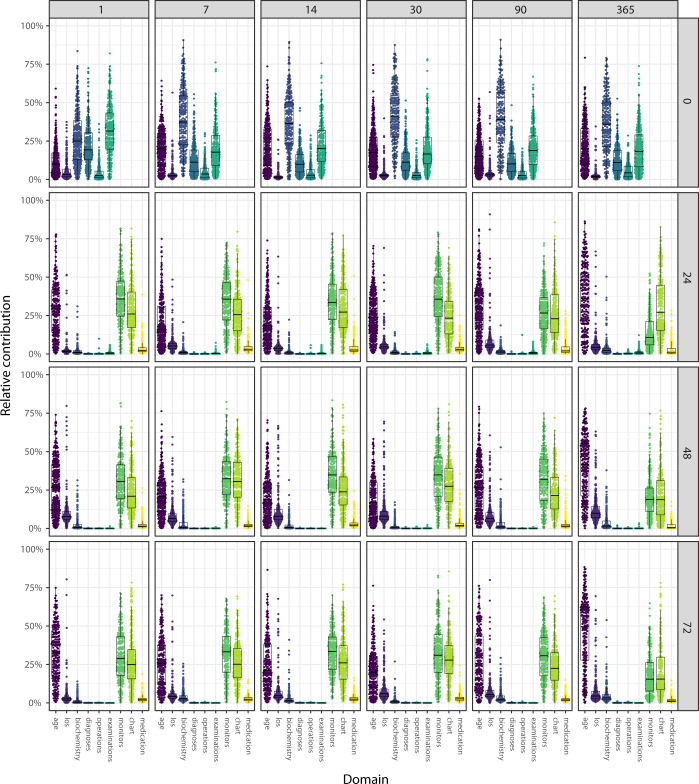
Prediction of survival for patients in intensive care units (ICUs) has been subject to intense research. However, no models exist that embrace the multiverse of data in ICUs. It is an open question whether deep learning methods using automated data integration with minimal pre-processing of mixed data domains such as free text, medical history and high-frequency data can provide discrete-time survival estimates for individual ICU patients. We trained a deep learning model on data from patients admitted to ten ICUs in the Capital Region of Denmark and the Region of Southern Denmark between 2011 and 2018. Inspired by natural language processing we mapped the electronic patient record data to an embedded representation and fed the data to a recurrent neural network with a multi-label output layer representing the chance of survival at different follow-up times. We evaluated the performance using the time-dependent concordance index. In addition, we quantified and visualized the drivers of survival predictions using the SHAP methodology. We included 37,355 admissions of 29,417 patients in our study. Our deep learning models outperformed traditional Cox proportional-hazard models with concordance index in the ranges 0.72-0.73, 0.71-0.72, 0.71, and 0.69-0.70, for models applied at baseline 0, 24, 48, and 72 h, respectively. Deep learning models based on a combination of entity embeddings and survival modelling is a feasible approach to obtain individualized survival estimates in data-rich settings such as the ICU. The interpretable nature of the models enables us to understand the impact of the different data domains.
重症监护病房(ICU)患者生存情况的预测一直是深入研究的课题。然而,目前尚无涵盖ICU中多元数据的模型。利用深度学习方法,对自由文本、病史和高频数据等混合数据域进行最少预处理后自动整合数据,能否为个体ICU患者提供离散时间生存估计,这仍是一个悬而未决的问题。我们基于2011年至2018年期间丹麦首都地区和南丹麦地区十家ICU收治患者的数据,训练了一个深度学习模型。受自然语言处理启发,我们将电子病历数据映射为嵌入表示,并将数据输入到具有多标签输出层的循环神经网络中,该输出层表示不同随访时间的生存几率。我们使用时间依赖一致性指数评估模型性能。此外,我们使用SHAP方法对生存预测的驱动因素进行了量化和可视化。我们的研究纳入了29417名患者的37355次入院数据。我们的深度学习模型在基线0、24、48和72小时应用的模型中,一致性指数分别在0.72 - 0.73、0.71 - 0.72、0.71和0.69 - 0.70范围内,优于传统的Cox比例风险模型。基于实体嵌入和生存建模相结合的深度学习模型,是在ICU等数据丰富的环境中获得个性化生存估计的可行方法。模型的可解释性使我们能够理解不同数据域的影响。