Zhang Joe, Budhdeo Sanjay, William Wasswa, Cerrato Paul, Shuaib Haris, Sood Harpreet, Ashrafian Hutan, Halamka John, Teo James T
Institute of Global Health Innovation, Imperial College London, London, UK.
Department of Critical Care, Guy's and St. Thomas' NHS Foundation Trust, London, UK.
NPJ Digit Med. 2022 Sep 15;5(1):143. doi: 10.1038/s41746-022-00690-x.
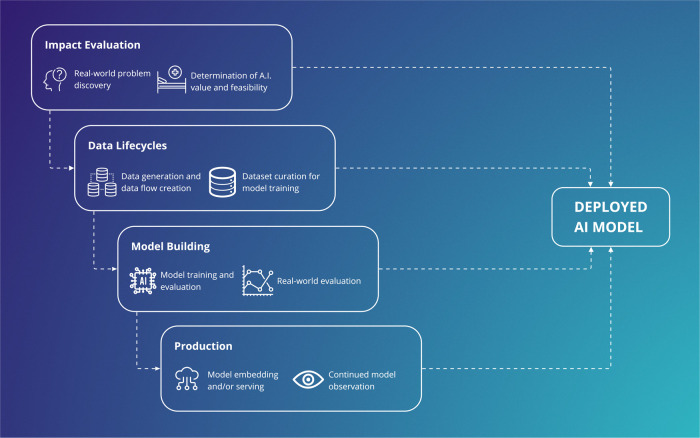
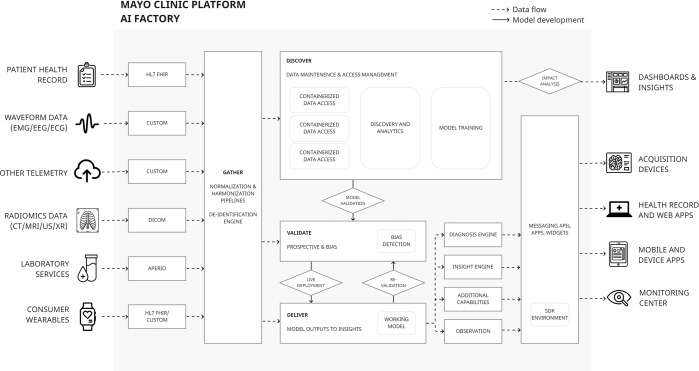
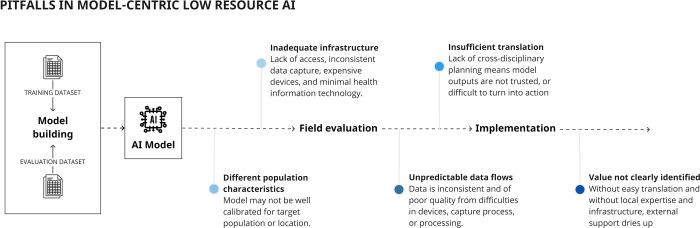
Substantial interest and investment in clinical artificial intelligence (AI) research has not resulted in widespread translation to deployed AI solutions. Current attention has focused on bias and explainability in AI algorithm development, external validity and model generalisability, and lack of equity and representation in existing data. While of great importance, these considerations also reflect a model-centric approach seen in published clinical AI research, which focuses on optimising architecture and performance of an AI model on best available datasets. However, even robustly built models using state-of-the-art algorithms may fail once tested in realistic environments due to unpredictability of real-world conditions, out-of-dataset scenarios, characteristics of deployment infrastructure, and lack of added value to clinical workflows relative to cost and potential clinical risks. In this perspective, we define a vertically integrated approach to AI development that incorporates early, cross-disciplinary, consideration of impact evaluation, data lifecycles, and AI production, and explore its implementation in two contrasting AI development pipelines: a scalable "AI factory" (Mayo Clinic, Rochester, United States), and an end-to-end cervical cancer screening platform for resource poor settings (Paps AI, Mbarara, Uganda). We provide practical recommendations for implementers, and discuss future challenges and novel approaches (including a decentralised federated architecture being developed in the NHS (AI4VBH, London, UK)). Growth in global clinical AI research continues unabated, and introduction of vertically integrated teams and development practices can increase the translational potential of future clinical AI projects.
对临床人工智能(AI)研究的大量关注和投资并未带来广泛的成果转化,即未能广泛应用于实际部署的AI解决方案。目前的关注点集中在AI算法开发中的偏差和可解释性、外部有效性和模型通用性,以及现有数据中缺乏公平性和代表性。虽然这些考量非常重要,但它们也反映了已发表的临床AI研究中以模型为中心的方法,该方法侧重于在最佳可用数据集上优化AI模型的架构和性能。然而,即使是使用最先进算法构建的强大模型,一旦在现实环境中进行测试,也可能会失败,原因包括现实世界条件的不可预测性、数据集外的情况、部署基础设施的特点,以及相对于成本和潜在临床风险而言,对临床工作流程缺乏附加值。从这个角度来看,我们定义了一种垂直整合的AI开发方法,该方法早期就跨学科地考虑影响评估、数据生命周期和AI生产,并在两个截然不同的AI开发流程中探索其实施:一个可扩展的“AI工厂”(美国罗切斯特市梅奥诊所),以及一个针对资源匮乏地区的端到端宫颈癌筛查平台(乌干达姆巴拉拉市的Paps AI)。我们为实施者提供了实用建议,并讨论了未来的挑战和新方法(包括英国国家医疗服务体系(NHS,英国伦敦)正在开发的去中心化联邦架构(AI4VBH))。全球临床AI研究的增长仍在持续,引入垂直整合的团队和开发实践可以提高未来临床AI项目的转化潜力。