Kwon Joon-Myoung, Jo Yong-Yeon, Lee Soo Youn, Kang Seonmi, Lim Seon-Yu, Lee Min Sung, Kim Kyung-Hee
Medical Research Team, Medical AI, Inc., San Francisco, CA 94103, USA.
Artificial Intelligence and Big Data Research Center, Sejong Medical Research Institute, Bucheon 14754, Korea.
Diagnostics (Basel). 2022 Mar 8;12(3):654. doi: 10.3390/diagnostics12030654.
We developed and validated an artificial intelligence (AI)-enabled smartwatch ECG to detect heart failure-reduced ejection fraction (HFrEF).
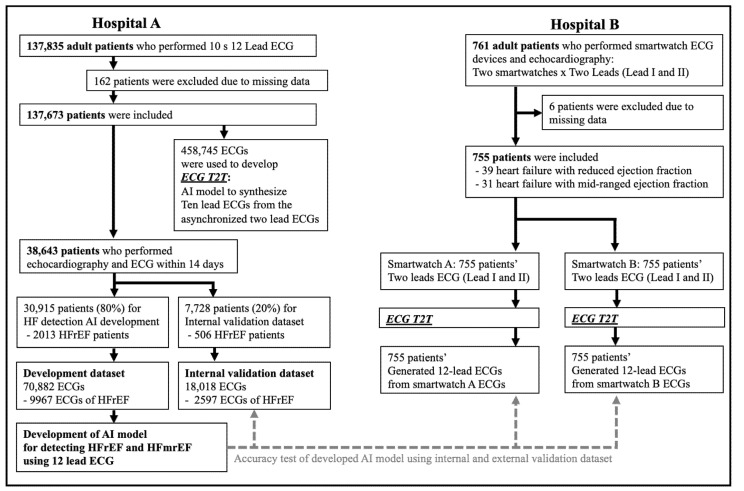
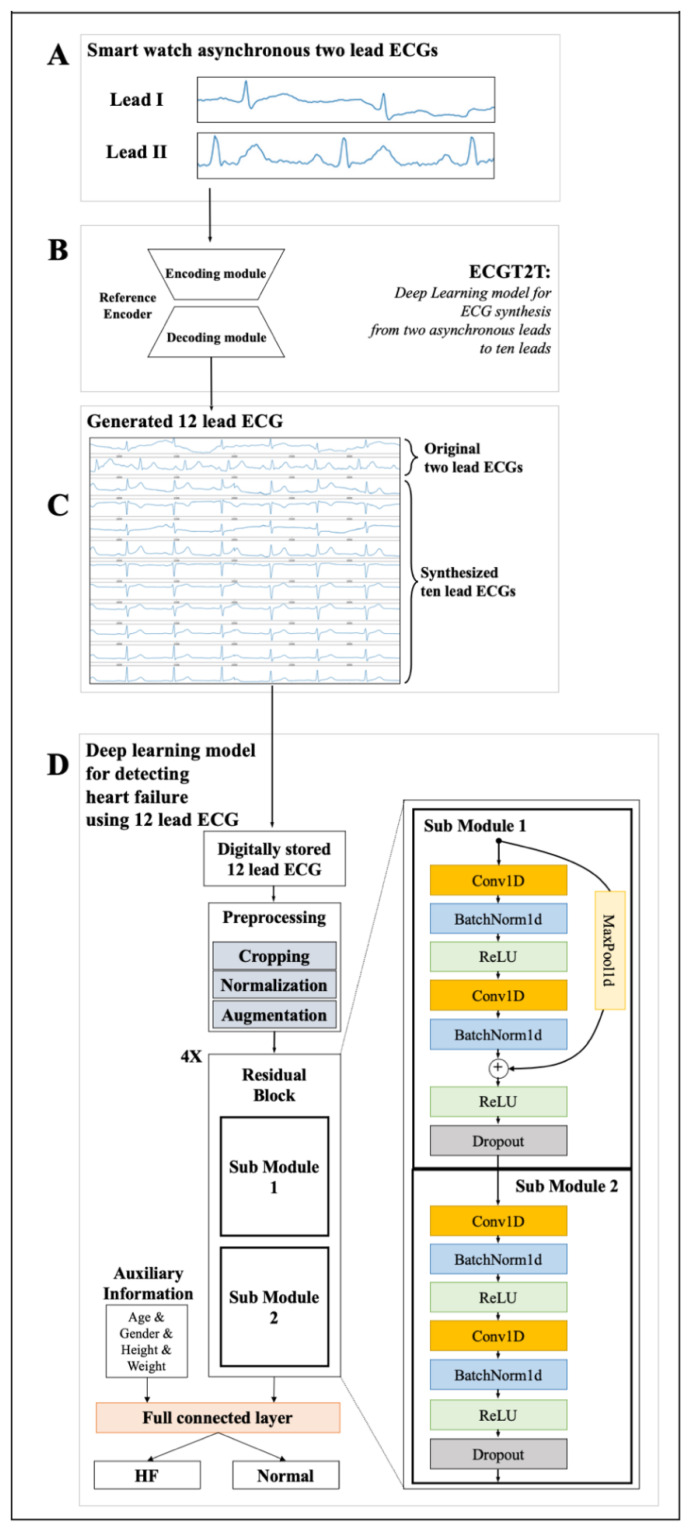
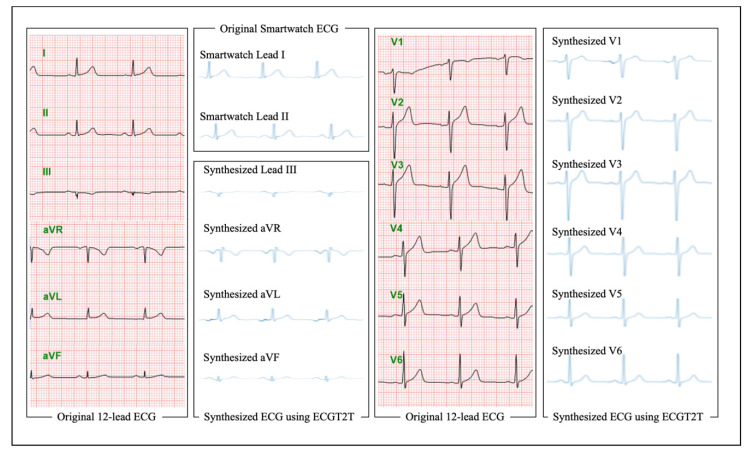
This was a cohort study involving two hospitals (A and B). We developed the AI in two steps. First, we developed an AI model (ECGT2T) to synthesize ten-lead ECG from the asynchronized 2-lead ECG (Lead I and II). ECGT2T is a deep learning model based on a generative adversarial network, which translates source ECGs to reference ECGs by learning styles of the reference ECGs. For this, we included adult patients aged ≥18 years from hospital A with at least one digitally stored 12-lead ECG. Second, we developed an AI model to detect HFrEF using a 10 s 12-lead ECG. The AI model was based on convolutional neural network. For this, we included adult patients who underwent ECG and echocardiography within 14 days. To validate the AI, we included adult patients from hospital B who underwent two-lead smartwatch ECG and echocardiography on the same day. The AI model generates a 10 s 12-lead ECG from a two-lead smartwatch ECG using ECGT2T and detects HFrEF using the generated 12-lead ECG.
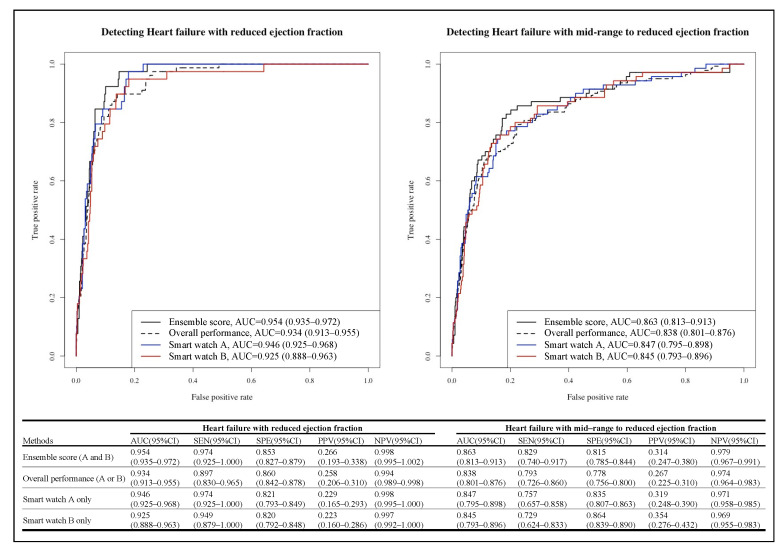
We included 137,673 patients with 458,745 ECGs and 38,643 patients with 88,900 ECGs from hospital A for developing the ECGT2T and HFrEF detection models, respectively. The area under the receiver operating characteristic curve of AI for detecting HFrEF using smartwatch ECG was 0.934 (95% confidence interval 0.913-0.955) with 755 patients from hospital B. The sensitivity, specificity, positive predictive value, and negative predictive value of AI were 0.897, 0.860, 0.258, and 0.994, respectively.
An AI-enabled smartwatch 2-lead ECG could detect HFrEF with reasonable performance.
我们开发并验证了一种基于人工智能(AI)的智能手表心电图技术,用于检测射血分数降低的心力衰竭(HFrEF)。
这是一项涉及两家医院(A和B)的队列研究。我们分两步开发了人工智能。首先,我们开发了一个人工智能模型(ECGT2T),用于从异步双导联心电图(导联I和II)合成十导联心电图。ECGT2T是一个基于生成对抗网络的深度学习模型,它通过学习参考心电图的样式将源心电图转换为参考心电图。为此,我们纳入了来自医院A的年龄≥18岁且至少有一份数字存储的12导联心电图的成年患者。其次,我们开发了一个使用10秒12导联心电图检测HFrEF的人工智能模型。该人工智能模型基于卷积神经网络。为此,我们纳入了在14天内接受心电图和超声心动图检查的成年患者。为了验证人工智能,我们纳入了来自医院B的在同一天接受双导联智能手表心电图和超声心动图检查的成年患者。人工智能模型使用ECGT2T从双导联智能手表心电图生成10秒12导联心电图,并使用生成的12导联心电图检测HFrEF。
我们分别纳入了来自医院A的137673例患者的458745份心电图和38643例患者的88900份心电图,用于开发ECGT2T和HFrEF检测模型。使用智能手表心电图检测HFrEF的人工智能的受试者操作特征曲线下面积为0.934(95%置信区间0.913 - 0.955),来自医院B的患者有755例。人工智能的敏感性、特异性、阳性预测值和阴性预测值分别为0.897、0.860、0.258和0.994。
基于人工智能的智能手表双导联心电图能够以合理的性能检测HFrEF。