Čiučiulkaitė Ieva, Möhlendick Birte, Thümmler Laura, Fisenkci Neslinur, Elsner Carina, Dittmer Ulf, Siffert Winfried, Lindemann Monika
Institute of Pharmacogenetics, University Hospital Essen, University of Duisburg-Essen, Essen, Germany.
Institute for Transfusion Medicine, University Hospital Essen, University of Duisburg-Essen, Essen, Germany.
Front Genet. 2022 Aug 29;13:932043. doi: 10.3389/fgene.2022.932043. eCollection 2022.
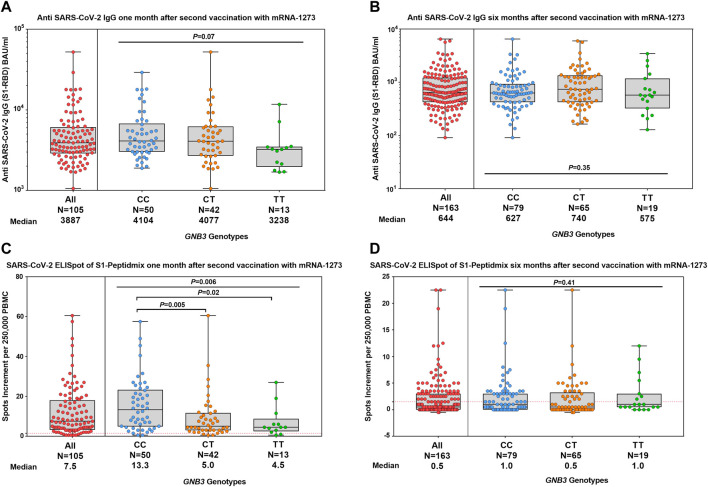
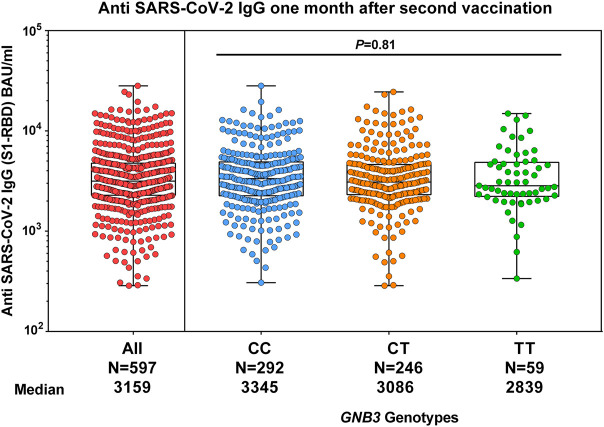
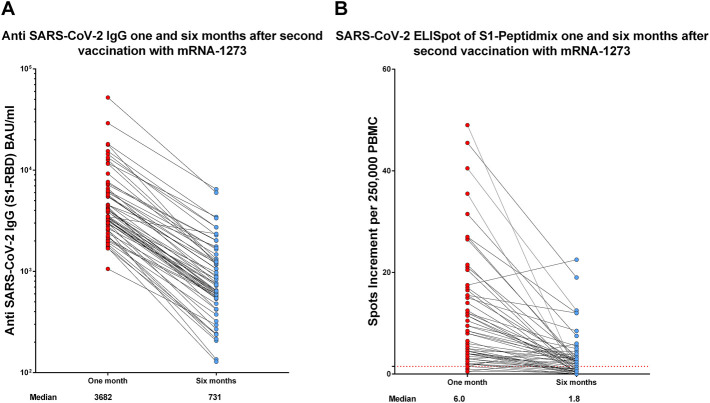
Immune responses following vaccination against COVID-19 with different vaccines and the waning of immunity vary within the population. Genetic host factors are likely to contribute to this variability. However, to the best of our knowledge, no study on G protein polymorphisms and vaccination responses against COVID-19 has been published so far. Antibodies against the SARS-CoV-2 spike protein and T-cell responses against a peptide pool of SARS-CoV-2 S1 proteins were measured 1 and 6 months after the second vaccination with mRNA-1273 in the main study group of 204 participants. Additionally, antibodies against the SARS-CoV-2 spike protein were measured in a group of 597 participants 1 month after the second vaccination with mRNA-1273. Genotypes of c.825C>T were determined in all participants. The median antibody titer against the SARS-CoV-2 spike protein and median values of spots increment in the SARS-CoV-2 IFN-γ ELISpot assay against the S1-peptide pool were significantly decreased from months 1 to 6 ( < 0.0001). Genotypes of c.825C>T had no influence on the humoral immune response. At month 1, CC genotype carriers had significantly increased T-cell responses compared to CT ( = 0.005) or TT ( = 0.02) genotypes. CC genotype carriers had an almost 6-fold increased probability compared to TT genotype carriers and an almost 3-fold increased probability compared to T-allele carriers to mount a SARS-CoV-2-specific T-cell response above the median value. CC genotype carriers of the c.825C>T polymorphism have an increased T-cell immune response to SARS-CoV-2, which may indicate better T-cell-mediated protection against COVID-19 after vaccination with mRNA-1273.
接种不同的新冠疫苗后的免疫反应以及免疫力的减弱在人群中存在差异。宿主基因因素可能导致了这种变异性。然而,据我们所知,目前尚未发表关于G蛋白多态性与新冠疫苗接种反应的研究。在主要研究组的204名参与者中,在第二次接种mRNA - 1273疫苗后的1个月和6个月测量了针对严重急性呼吸综合征冠状病毒2(SARS-CoV-2)刺突蛋白的抗体以及针对SARS-CoV-2 S1蛋白肽池的T细胞反应。此外,在597名参与者第二次接种mRNA - 1273疫苗后的1个月测量了针对SARS-CoV-2刺突蛋白的抗体。在所有参与者中确定了c.825C>T的基因型。针对SARS-CoV-2刺突蛋白的抗体滴度中位数以及针对S1肽池的SARS-CoV-2干扰素-γ酶联免疫斑点试验(ELISpot)中斑点增加的中位数从第1个月到第6个月显著下降(<0.0001)。c.825C>T的基因型对体液免疫反应没有影响。在第1个月时,与CT(P = 0.005)或TT(P = 0.02)基因型相比,CC基因型携带者的T细胞反应显著增加。与TT基因型携带者相比,CC基因型携带者产生高于中位数的SARS-CoV-2特异性T细胞反应的概率几乎增加了6倍,与T等位基因携带者相比增加了近3倍。c.825C>T多态性的CC基因型携带者对SARS-CoV-2的T细胞免疫反应增强,这可能表明接种mRNA - 1273疫苗后T细胞介导的针对新冠病毒的保护作用更好。