Klinikum Rechts der Isar derTechnische Universität München 81675 München Germany.
Signal Processing GroupTechnische Universität München 80333 München Germany.
IEEE J Transl Eng Health Med. 2022 Aug 29;10:1900508. doi: 10.1109/JTEHM.2022.3202749. eCollection 2022.
Physicians use electrocardiograms (ECG) to diagnose cardiac abnormalities. Sometimes they need to take a deeper look at abnormal heartbeats to diagnose the patients more precisely. The objective of this research is to design a more accurate heartbeat classification algorithm to assist physicians in identifying specific types of the heartbeat.
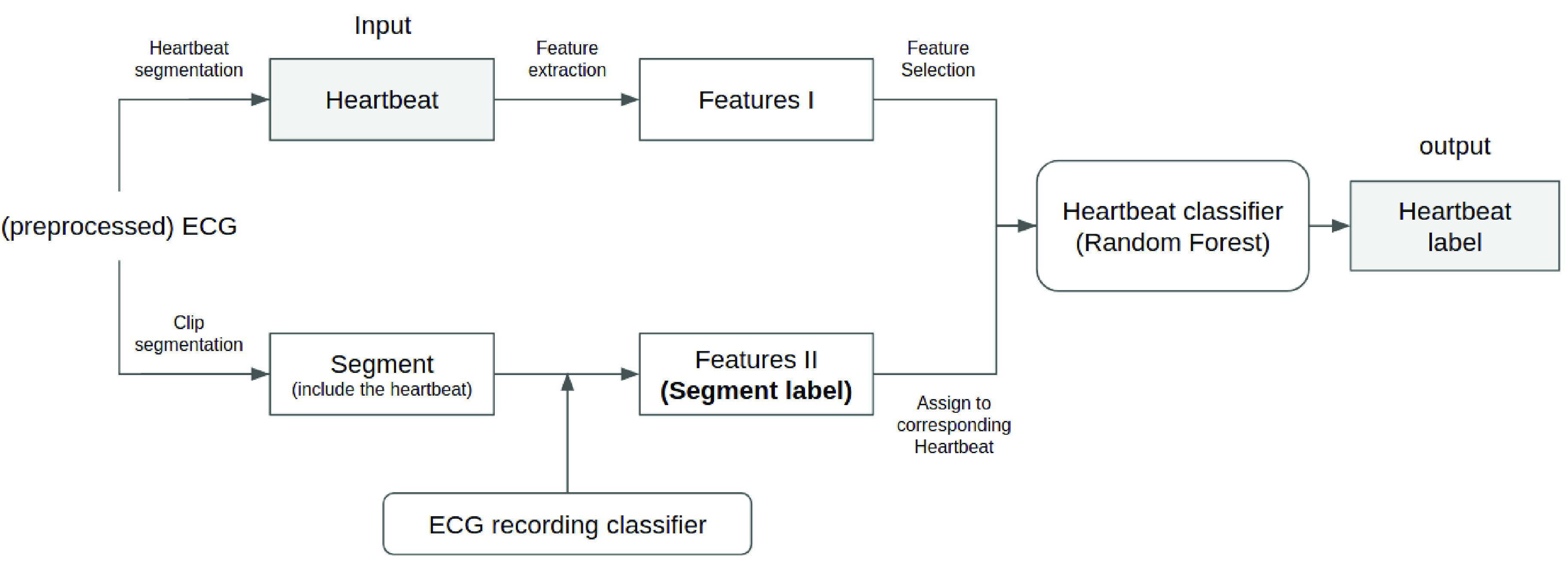
In this paper, we propose a novel feature called a segment label, to improve the performance of a heartbeat classifier. This feature, provided by a Convolutional Neural Network, encodes the information surrounding the particular heartbeat. The random forest classifier is trained based on this new feature and other traditional features to classify the heartbeats.
We validate our method on the MIT-BIH Arrhythmia dataset following the inter-patient evaluation paradigm. The proposed method is competitive with other similar works. It achieves an accuracy of 0.96, and F1-scores for normal beats, ventricular ectopic beats, and Supra-Ventricular Ectopic Beats (SVEB) of 0.98, 0.93, and 0.74, respectively. The precision and sensitivity for SVEB are 0.76 and 0.78, which outperforms the state-of-the-art methods.
This study demonstrates that the segment label can contribute to precisely classifying heartbeats, especially those that require rhythm information as context information (e.g. SVEB). Using a medical devices embedding our algorithm could ease the physicians' processes of diagnosing cardiovascular diseases, especially for SVEB, in clinical implementation.
医生使用心电图(ECG)来诊断心脏异常。有时,他们需要更深入地观察异常心跳,以更准确地诊断患者。本研究的目的是设计一种更准确的心跳分类算法,以帮助医生识别特定类型的心跳。
在本文中,我们提出了一种称为段标签的新特征,以提高心跳分类器的性能。该特征由卷积神经网络提供,编码特定心跳周围的信息。随机森林分类器基于该新特征和其他传统特征进行训练,以对心跳进行分类。
我们按照患者间评估的范例,在 MIT-BIH 心律失常数据集上验证了我们的方法。所提出的方法与其他类似工作具有竞争力。它实现了 0.96 的准确率,以及正常心跳、室性异位心跳和室上性异位心跳(SVEB)的 F1 分数分别为 0.98、0.93 和 0.74。SVEB 的精度和敏感度分别为 0.76 和 0.78,优于现有方法。
本研究表明,段标签可以有助于精确分类心跳,特别是那些需要节律信息作为上下文信息的心跳(例如 SVEB)。在临床实施中,使用嵌入我们算法的医疗设备可以简化医生诊断心血管疾病的过程,特别是对于 SVEB。