Liu Zeming, Zeng Ning, Yu Jing, Huang Chunyu, Huang Qinqin
Department of Molecular Pathology, The Second Affiliated Hospital of Zhengzhou University, Zhengzhou, China.
Department of Plastic and Cosmetic Surgery, Tongji Hospital, Tongji Medical College, Huazhong University of Science and Technology, Wuhan, China.
Front Bioeng Biotechnol. 2022 Aug 30;10:998571. doi: 10.3389/fbioe.2022.998571. eCollection 2022.
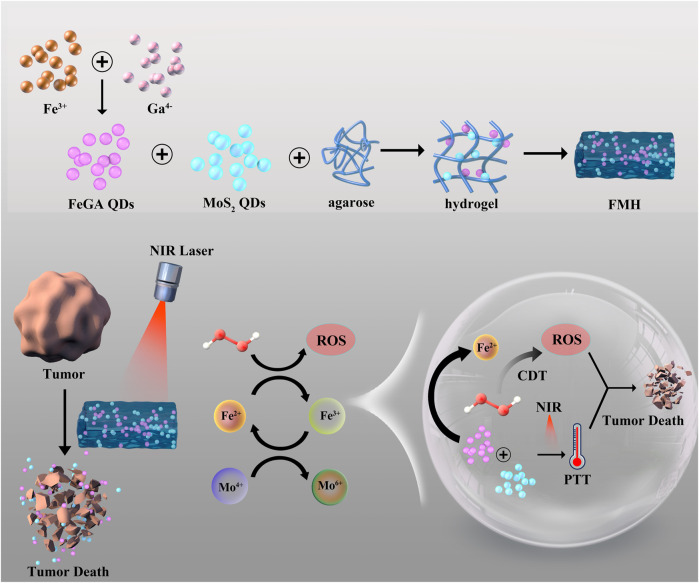
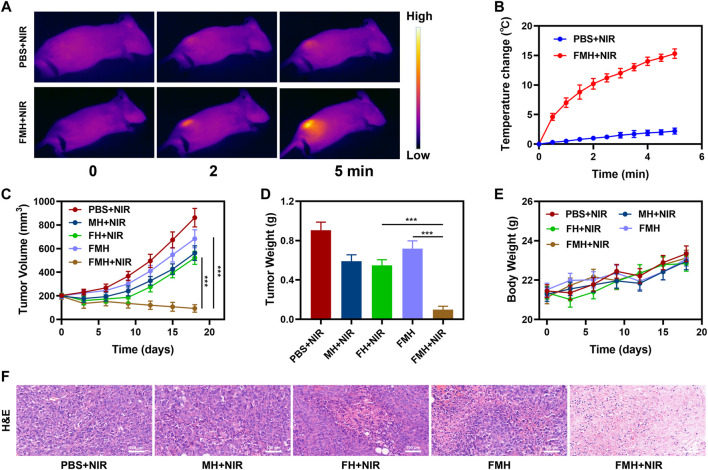
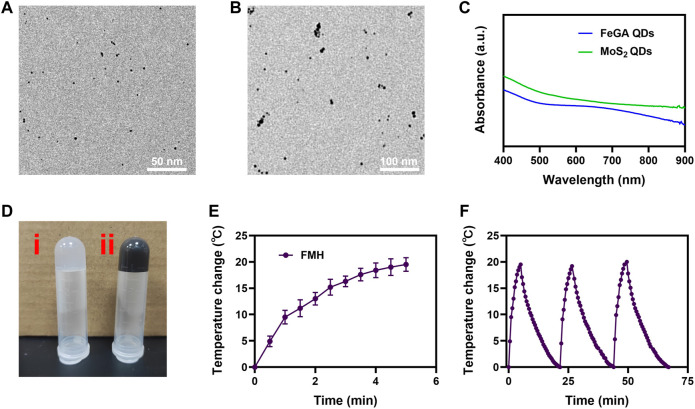
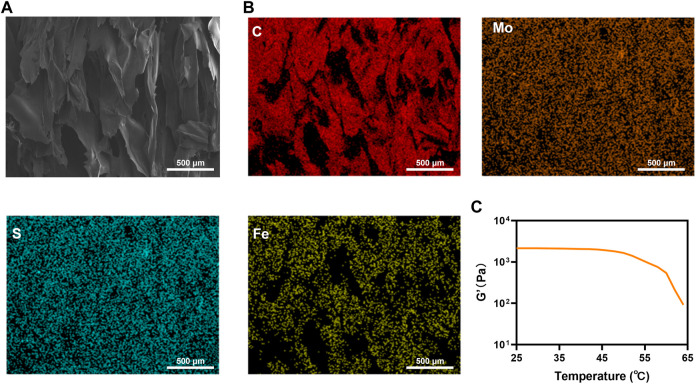
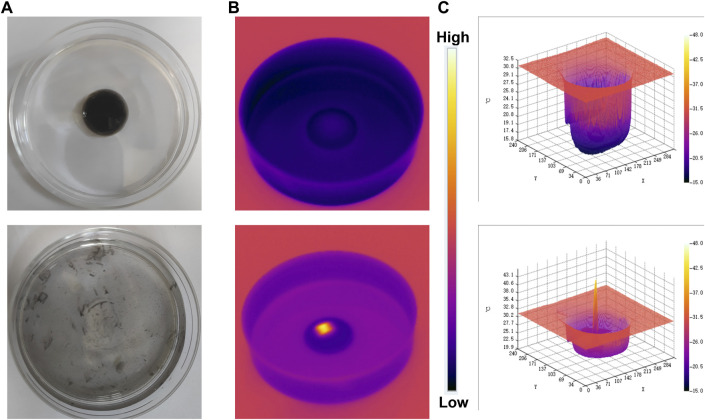
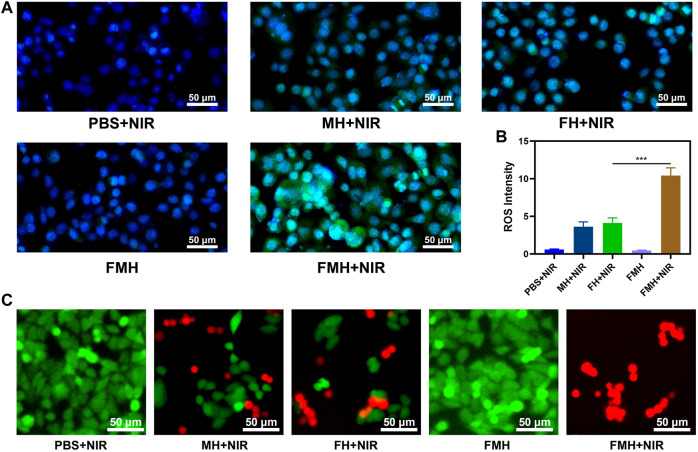
Due to its responsiveness to the tumour microenvironment (TME), chemodynamic therapy (CDT) based on the Fenton reaction to produce cytotoxic reactive oxygen species (ROS) to destroy tumor has drawn more interest. However, the Fenton's reaction potential for therapeutic use is constrained by its modest efficacy. Here, we develop a novel injectable hydrogel system (FMH) on the basis of FeGA/MoS dual quantum dots (QDs), which uses near-infrared (NIR) laser in order to trigger the synergistic catalysis and photothermal effect of FeGA/MoS for improving the efficiency of the Fenton reaction. Mo in MoS QDs can accelerate the conversion of Fe to Fe, thereby promoting the efficiency of Fenton reaction, and benefiting from the synergistically enhanced CDT/PTT, FMH combined with NIR has achieved good anti-tumour effects and experiments. Furthermore, the quantum dots are easily metabolized after treatment because of their ultrasmall size, without causing any side effects. This is the first report to study the co-catalytic effect of MoS and Fe at the quantum dot level, as well as obtain a good PTT/CDT synergy, which have implications for future anticancer research.
由于其对肿瘤微环境(TME)的响应性,基于芬顿反应产生细胞毒性活性氧(ROS)以破坏肿瘤的化学动力疗法(CDT)引起了更多关注。然而,芬顿反应在治疗应用中的潜力受到其疗效一般的限制。在此,我们基于FeGA/MoS双量子点(QDs)开发了一种新型可注射水凝胶系统(FMH),该系统利用近红外(NIR)激光触发FeGA/MoS的协同催化和光热效应,以提高芬顿反应的效率。MoS QDs中的Mo可以加速Fe向Fe的转化,从而提高芬顿反应的效率,并且受益于协同增强的CDT/PTT,FMH与NIR联合使用在实验中取得了良好的抗肿瘤效果。此外,量子点由于尺寸超小,在治疗后易于代谢,不会引起任何副作用。这是首次研究MoS和Fe在量子点水平上的共催化作用以及获得良好的PTT/CDT协同效应的报告,这对未来的抗癌研究具有重要意义。