Key Laboratory of Occupational Environment and Health, Guangzhou Twelfth People's Hospital, Guangzhou, China.
Department of Hematology, Guangzhou Twelfth People's Hospital, Guangzhou, China.
Front Public Health. 2022 Aug 30;10:966507. doi: 10.3389/fpubh.2022.966507. eCollection 2022.
Gaps remained in the updated information of the firearm violence (FV) burden from a global landscape. Understanding the global burden of FV could contribute to decision-making.
Data on the FV burden, including physical violence by firearm (PVF), self-harm by firearm (SHF), and unintentional firearm injuries (UFI), were extracted from the Global Burden of Disease 2019. The temporal trends of age-standardized rate (ASR) were estimated using estimated annual percentage change (EAPC).
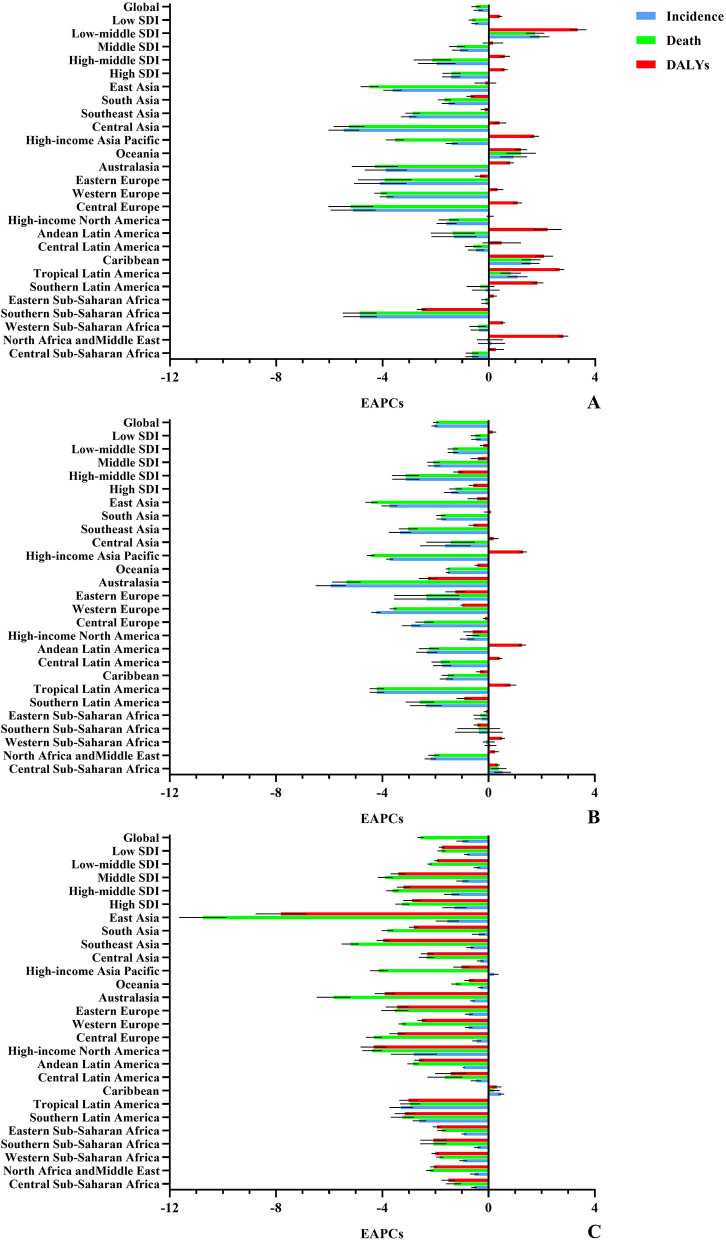
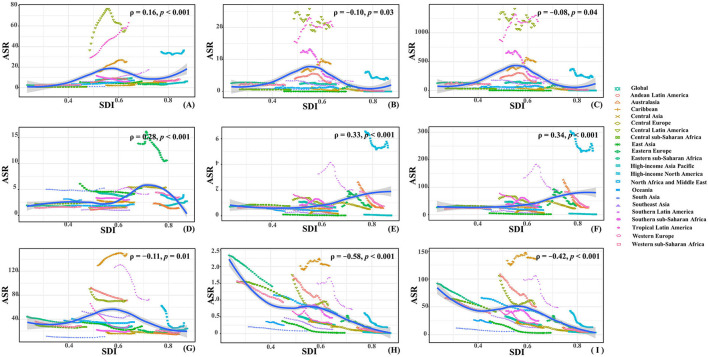
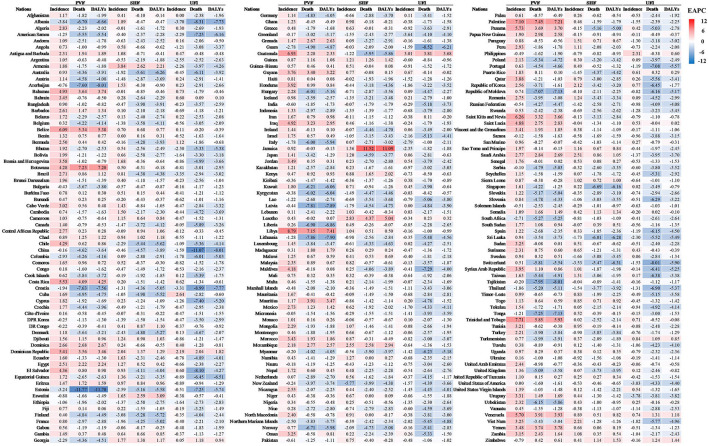
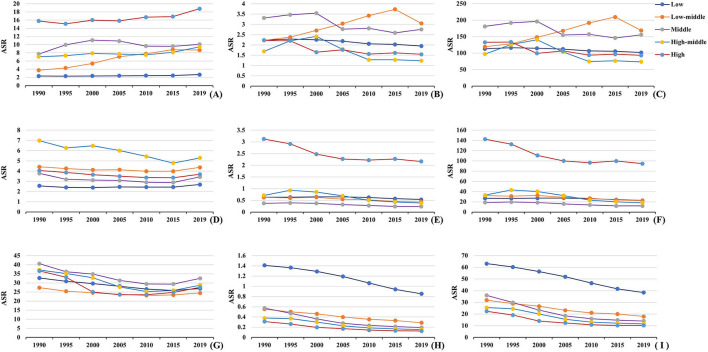
In 2019, PVF, SHF, and UFI reported 710.64 × 10, 335.25 × 10, and 2,133.88 × 10, respectively, incident cases worldwide. Their ASR (/100,000 people-years) were 9.31, 4.05, and 28.07. During 1990-2019, the overall incident ASRs of PVF presented an increasing trend (EAPC = 0.61, 95% confidence interval [CI]: 0.48 to 0.75). Notably, pronounced increasing trends were observed in Tropical Latin America, and North Africa and Middle East. However, incident trends of SHF and UFI declined globally, with the respective EAPCs being -0.68 (95% CI: -0.83 to -0.54) and -0.98 (95% CI: -1.19 to -0.77). In 2019, the ASR of death due to PVF, SHF, and UFI were 2.23, 0.65, and 0.26, and that of DALYs were 127.56, 28.10, and 17.64, respectively. Decreasing trends in the ASRs of FV were observed in most regions and countries worldwide over the past three decades, particularly that of PVF in Estonia.
The FV burden was heterogeneous across regions and countries, which was deeply subjected to socioeconomic factors. The findings highlighted that specific prevention strategies and interventions were required, particularly in the high prevalent settings.
从全球范围来看,枪支暴力(FV)负担的最新信息仍存在差距。了解全球 FV 负担有助于决策。
从 2019 年全球疾病负担中提取有关 FV 负担的数据,包括枪支所致身体暴力(PVF)、枪支所致自我伤害(SHF)和意外枪支伤害(UFI)。使用估计的年平均百分比变化(EAPC)来估计年龄标准化率(ASR)的时间趋势。
2019 年,全球报告的 PVF、SHF 和 UFI 事件分别为 710.64×10、335.25×10 和 2133.88×10 例。其 ASR(/100,000 人年)分别为 9.31、4.05 和 28.07。1990-2019 年期间,PVF 的总事件 ASR 呈上升趋势(EAPC=0.61,95%置信区间[CI]:0.48 至 0.75)。值得注意的是,热带拉丁美洲以及北非和中东地区的上升趋势明显。然而,全球范围内 SHF 和 UFI 的事件趋势呈下降趋势,相应的 EAPC 分别为-0.68(95%CI:-0.83 至-0.54)和-0.98(95%CI:-1.19 至-0.77)。2019 年,PVF、SHF 和 UFI 导致的死亡率分别为 2.23、0.65 和 0.26,伤残调整生命年(DALYs)分别为 127.56、28.10 和 17.64。在过去的三十年中,世界上大多数地区和国家的 FV 负担呈下降趋势,尤其是爱沙尼亚的 PVF。
各地区和国家的 FV 负担存在差异,这深深受到社会经济因素的影响。研究结果强调,需要制定具体的预防策略和干预措施,特别是在高发地区。