Department for Anesthesiology, Intensive Care, Emergency and Pain Medicine, University Hospital Würzburg, 97080 Würzburg, Germany.
Institute of General Practice, Faculty of Medicine, Heinrich Heine University Düsseldorf, 40227 Düsseldorf, Germany.
Thromb Res. 2022 Nov;219:40-48. doi: 10.1016/j.thromres.2022.09.001. Epub 2022 Sep 8.
Thromboembolic events are common complications of COVID-19. Clinical study results on safety and efficacy of anticoagulation in COVID-19 are controversial.
This report updates our systematic review and random-effects meta-analysis on randomized controlled trials (RCTs) comparing standard prophylactic anticoagulation and intermediate or therapeutic anticoagulation in COVID-19 patients. We searched eligible studies for the update up to 4 February 2022 by weekly monitoring of RCTs in the Cochrane COVID-19 Study Register. Certainty of evidence was assessed using GRADE (Grading of Recommendations Assessment, Development and Evaluation).
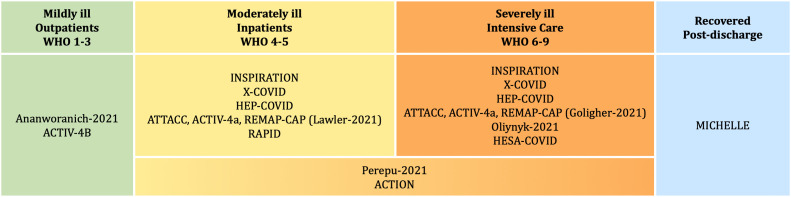
For this update we included five new trials; a total of 13 RCTs with 7364 patients. Certainty of evidence was very low to low. We are uncertain whether low-dose prophylactic anticoagulation is favoured over placebo or no anticoagulation in the outpatient- or post-discharge-setting. In hospitalized patients with moderate and severe COVID-19, intermediate-dose anticoagulation may have little or no effect on thrombotic events or death (RR 1.03, 95 % CI 0.86-1.24), but may increase severe bleeding non-significantly (RR 1.48, 95 % CI 0.53-4.15). Therapeutic-dose anticoagulation may decrease thrombotic events or deaths in hospitalized patients with moderate COVID-19 (RR 0.64, 95 % CI 0.38-1.07; fixed-effect model RR 0.72, 95 % CI 0.57-0.91), but may have little or no effect in patients with severe disease (RR 0.98, 95 % CI 0.86-1.12). With therapeutic-dose anticoagulation, the risk of major bleeding may increase regardless of COVID-19 severity (RR 1.78, 95 % CI 1.15-2.74).
Hospitalized, moderately ill COVID-19 patients may benefit from therapeutic-dose anticoagulation, while critically ill patients may not. Risk of major bleeding must be considered.
血栓栓塞事件是 COVID-19 的常见并发症。关于 COVID-19 抗凝治疗的安全性和疗效的临床研究结果存在争议。
本报告更新了我们对 COVID-19 患者中标准预防性抗凝与中剂量或治疗性抗凝进行比较的随机对照试验(RCT)的系统评价和随机效应荟萃分析。我们通过每周监测 Cochrane COVID-19 研究注册库中的 RCT 来更新截至 2022 年 2 月 4 日的符合条件的研究。使用 GRADE(推荐评估、制定与评价)评估证据确定性。
本次更新纳入了 5 项新试验;共有 13 项 RCT 纳入 7364 例患者。证据确定性为极低至低。我们不确定在门诊或出院环境中,低剂量预防性抗凝是否优于安慰剂或无抗凝治疗。对于中重度 COVID-19 住院患者,中剂量抗凝可能对血栓事件或死亡没有影响或影响很小(RR 1.03,95%CI 0.86-1.24),但可能会轻微增加严重出血事件(RR 1.48,95%CI 0.53-4.15)。对于中重度 COVID-19 住院患者,治疗剂量抗凝可能会降低血栓事件或死亡(RR 0.64,95%CI 0.38-1.07;固定效应模型 RR 0.72,95%CI 0.57-0.91),但对于重度疾病患者可能没有影响或影响很小(RR 0.98,95%CI 0.86-1.12)。无论 COVID-19 严重程度如何,治疗剂量抗凝可能会增加大出血的风险(RR 1.78,95%CI 1.15-2.74)。
对于住院的、病情中等的 COVID-19 患者,可能会从治疗剂量抗凝中获益,而对于重症患者则可能不会。必须考虑大出血的风险。