Department of Mental Health, Graduate School of Medicine, The University of Tokyo, Tokyo, Japan.
Department of Public Mental Health Research, National Institute of Mental Health, National Center of Neurology and Psychiatry, Tokyo, Japan.
Psychiatry Clin Neurosci. 2022 Nov;76(11):570-578. doi: 10.1111/pcn.13458. Epub 2022 Sep 16.
Prevention of perinatal depression beginning from the antenatal period is essential. Therefore, this study aimed to investigate the effectiveness of recently developed internet-delivered cognitive behavioral therapy (iCBT) for preventing the onset of a major depressive episode (MDE) in the third trimester and at 3 months postpartum.
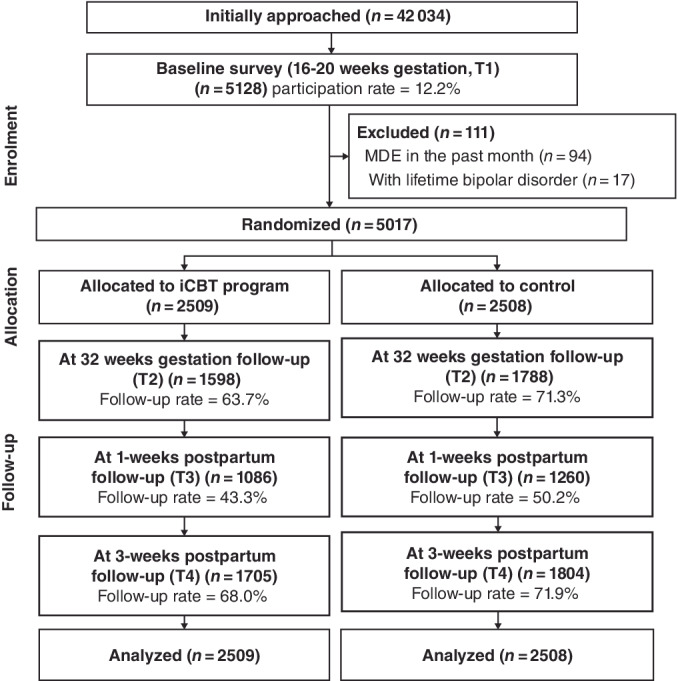
This is a two-arm, parallel-group, general-information controlled, randomized controlled trial. Participants were 5017 pregnant women at 16-20 weeks' gestation without MDE at baseline. They were randomly assigned to an iCBT (intervention; n = 2509) or general-information (control; n = 2508) group, stratified by psychological distress at baseline. The primary outcomes were the numbers of new MDE onsets, measured using the World Health Organization Composite International Diagnostic Interview 3.0, at 32 weeks' gestation and at 3 months postpartum.
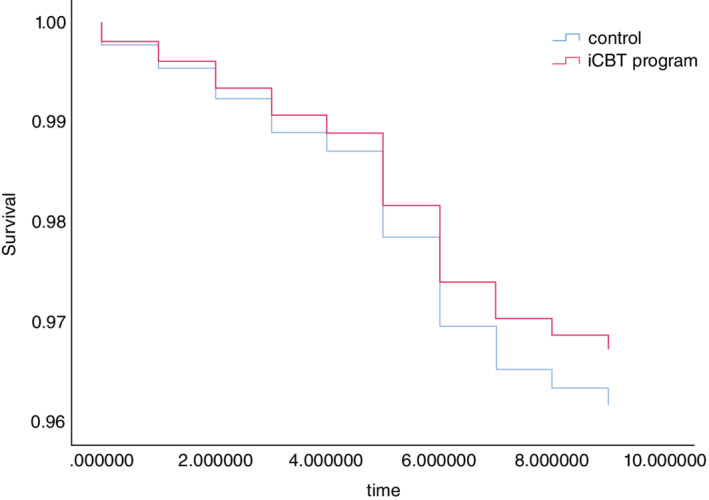
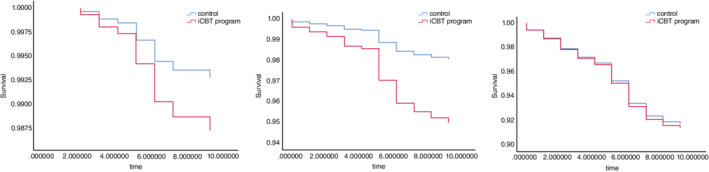
New MDE onset was reported by 59 participants (2.35%) in the intervention group and 73 (2.91%) in the control group during follow-up. Compared with the control group, the hazard ratio (HR) of MDE in the intervention group was 0.85 (95% CI 0.61-1.20), which was not significantly different. Among participants who scored between 5 and 8 on K6 at baseline, 10 (1.37%) in the intervention group reported new onset of MDE, compared with 28 (3.81%) in the control group, and the HR of MDE was 0.38 (95%CI 0.19-0.79).
No intervention effect was found for iCBT in preventing new onset of perinatal MDE. iCBT might prevent perinatal depression only among pregnant women with subthreshold depressive symptoms.
UMIN000038190.
从产前阶段开始预防围产期抑郁症至关重要。因此,本研究旨在探讨最近开发的互联网认知行为疗法(iCBT)在预防第三孕期和产后 3 个月发生重度抑郁发作(MDE)中的有效性。
这是一项两臂、平行组、一般性信息对照、随机对照试验。研究对象为 5017 名孕 16-20 周且基线时无 MDE 的孕妇。她们被随机分配到 iCBT(干预组;n=2509)或一般性信息(对照组;n=2508)组,按基线时的心理困扰进行分层。主要结局是在 32 周妊娠和产后 3 个月时使用世界卫生组织复合国际诊断访谈 3.0 测量的新 MDE 发作数量。
在随访期间,干预组有 59 名(2.35%)参与者报告出现新的 MDE 发作,对照组有 73 名(2.91%)。与对照组相比,干预组 MDE 的风险比(HR)为 0.85(95%CI 0.61-1.20),差异无统计学意义。在基线时 K6 评分在 5-8 分之间的参与者中,干预组有 10 名(1.37%)报告新发生 MDE,对照组有 28 名(3.81%),MDE 的 HR 为 0.38(95%CI 0.19-0.79)。
iCBT 对预防围产期新发 MDE 没有干预效果。iCBT 可能仅对有亚临床抑郁症状的孕妇预防围产期抑郁。
UMIN000038190。