Clinical Research Unit for Anxiety and Depression (CRUfAD), UNSW School of Psychiatry at St Vincent's Hospital, Level 4, O'Brien Centre, St Vincent's Hospital, 394 Victoria Street, Sydney, NSW, 2010, Australia.
School of Psychology, Faculty of Science, UNSW Sydney, 1302 Mathews Building, Kensington, NSW, 2052, Australia.
Trials. 2018 Jan 22;19(1):56. doi: 10.1186/s13063-017-2422-5.
We aimed to evaluate the acceptability and efficacy of two brief, Internet-delivered cognitive behavioural therapy interventions-MUMentum Pregnancy (study 1) and MUMentum Postnatal (study 2)-in reducing maternal symptoms of anxiety, depression and overall psychological distress compared to usual care in the perinatal period.
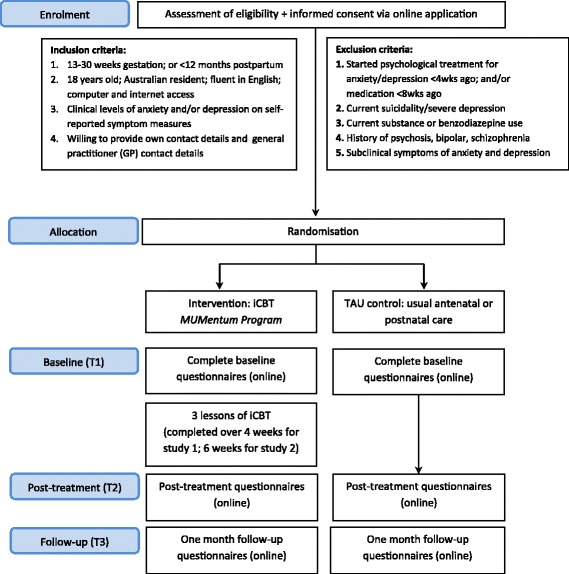
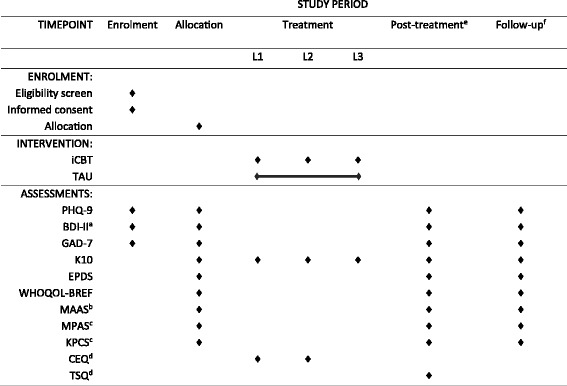
METHODS/DESIGN: Women who are pregnant (study 1) or < 12 months postpartum (study 2) with current clinically elevated symptoms of anxiety and/or depression according to validated self-report measures, will be recruited via the research arm of a not-for-profit clinical and research unit in Australia and randomised to the intervention group or treatment as usual control group. The minimum sample size for each study (alpha 0.05; power 0.80 for a g of 0.80) was identified as 50 with at least 10% more to be recruited to account for expected attrition. The co-primary outcome measures are the Patient Health Questionnaire 9-item scale and Generalised Anxiety Disorder 7-item scale to measure depression and anxiety symptom severity, respectively, and will be administered at the following primary time-points: baseline; post treatment; and at one-month follow-up. Psychological distress will be measured according to the Kessler-10 psychological distress scale at each primary time-point and will also be completed before each lesson for those in the intervention group. The total trial period nine weeks for study 1 and 11 weeks for study 2. Program efficacy will be determined using intent-to-treat mixed models. Maintenance of gains will be assessed at one-month follow-up.
The current randomised controlled trial seeks to extend the literature by evaluating the efficacy of a self-help intervention for women in the perinatal period. If efficacious, the MUMentum programs have the potential to be easily disseminated via https://thiswayup.org.au/ to large numbers of women across Australia as an intervention for women screening positive for anxiety, depressive or distress symptoms during pregnancy or postpartum.
Australian New Zealand Clinical Trials Registry, ACTRN12616000560493 ; ACTRN12616000559415 . Registered on 2nd May 2016.
本研究旨在评估两种简短的、基于互联网的认知行为疗法干预措施——MUMentum 妊娠(研究 1)和 MUMentum 产后(研究 2)——在减少围产期母亲焦虑、抑郁和整体心理困扰方面的有效性和可接受性,与常规护理相比。
方法/设计:在澳大利亚非营利性临床和研究机构的研究部分招募目前根据经过验证的自我报告措施显示有临床显著焦虑和/或抑郁症状的孕妇(研究 1)或产后<12 个月的女性(研究 2),并将其随机分配到干预组或常规治疗对照组。每个研究的最小样本量(α 0.05;g 为 0.80 时功率为 0.80)确定为 50 名,招募更多人数(至少 10%)以考虑预期的失访。主要结局测量指标是患者健康问卷 9 项量表和广泛性焦虑症 7 项量表,分别用于测量抑郁和焦虑症状的严重程度,并将在以下主要时间点进行测量:基线;治疗后;和一个月随访。在每个主要时间点,将根据 Kessler-10 心理困扰量表测量心理困扰,并在干预组的每节课之前完成。整个试验周期为研究 1 的 9 周和研究 2 的 11 周。将使用意向治疗混合模型确定方案疗效。在一个月随访时评估维持增益的情况。
本随机对照试验旨在通过评估围产期女性自我帮助干预措施的疗效来扩展文献。如果有效,MUMentum 计划有可能通过 https://thiswayup.org.au/ 轻松传播给澳大利亚各地的大量女性,作为针对怀孕或产后焦虑、抑郁或困扰症状筛查阳性的女性的干预措施。
澳大利亚和新西兰临床试验注册处,ACTRN12616000560493;ACTRN12616000559415。于 2016 年 5 月 2 日注册。