Adamo Daniela, Canfora Federica, Calabria Elena, Coppola Noemi, Leuci Stefania, Pecoraro Giuseppe, Cuocolo Renato, Ugga Lorenzo, D'Aniello Luca, Aria Massimo, Mignogna Michele D
Department of Neuroscience, Reproductive Sciences and Dentistry, University of Naples Federico II, Naples, Italy.
Department of Clinical Medicine and Surgery, University of Naples Federico II, Naples, Italy.
Front Aging Neurosci. 2022 Sep 1;14:923720. doi: 10.3389/fnagi.2022.923720. eCollection 2022.
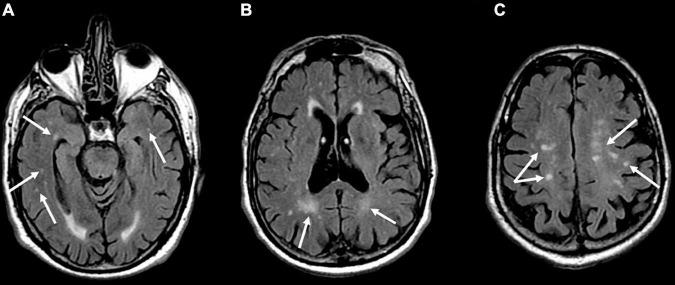
White matter hyperintensities (WMHs) of the brain are observed in normal aging, in various subtypes of dementia and in chronic pain, playing a crucial role in pain processing. The aim of the study has been to assess the WMHs in Burning Mouth Syndrome (BMS) patients by means of the Age-Related White Matter Changes scale (ARWMCs) and to analyze their predictors.
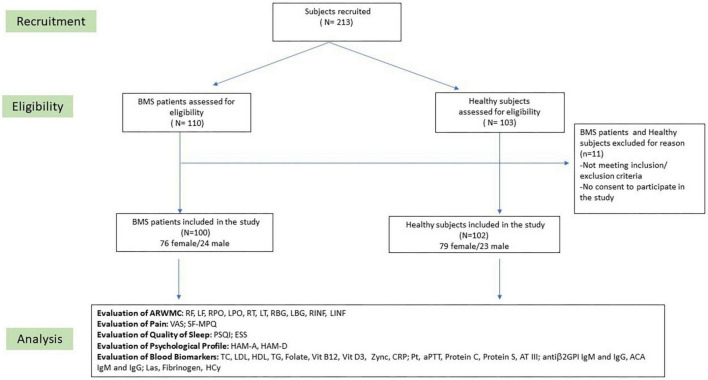
One hundred BMS patients were prospectively recruited and underwent magnetic resonance imaging (MRI) of the brain. Their ARWMCs scores were compared with those of an equal number of healthy subjects matched for age and sex. Intensity and quality of pain, psychological profile, and blood biomarkers of BMS patients were further investigated to find potential predictors of WMHs. Specifically, the Numeric Rating Scale (NRS), Short-Form McGill Pain Questionnaire (SF-MPQ), Hamilton rating scale for Depression and Anxiety (HAM-D and HAM-A), Pittsburgh Sleep Quality Index (PSQI), Epworth Sleepiness Scale (ESS) were administered.
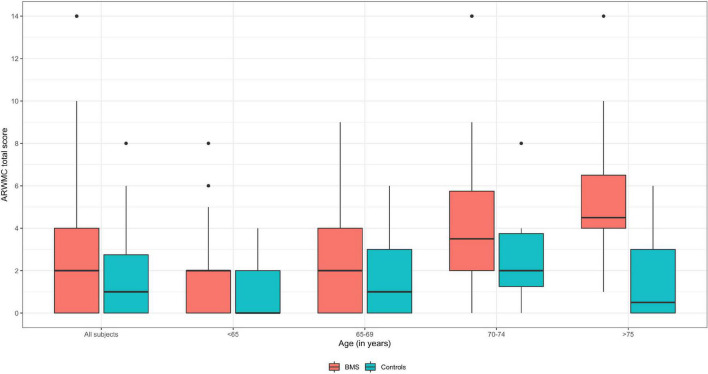
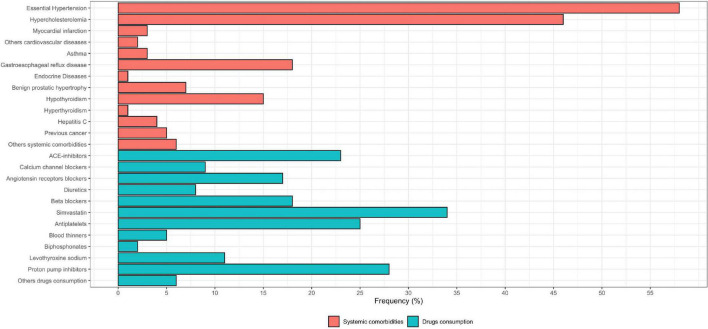
The BMS patients presented statistically significant higher scores on the ARWMCs compared to the controls, especially in the right frontal, left frontal, right parietal-occipital, left parietal-occipital, right temporal and left temporal lobes (-values: <0.001, <0.001, 0.005, 0.002, 0.009, 0.002, and <0.001, respectively). Age, a lower educational level, unemployment, essential hypertension, and hypercholesterolemia were correlated to a higher total score on the ARWMCs (-values: <0.001, 0.016, 0.014, 0.001, and 0.039, respectively). No correlation was found with the blood biomarkers, NRS, SF-MPQ, HAM-A, HAM-D, PSQI, and ESS.
Patients with BMS showed a higher frequency of WMHs of the brain as suggested by the higher ARWCs scores compared with the normal aging of the healthy subjects. These findings could have a role in the pathophysiology of the disease and potentially affect and enhance pain perception.
脑白质高信号(WMHs)在正常衰老、各种痴呆亚型以及慢性疼痛中均有观察到,在疼痛处理中起关键作用。本研究的目的是通过年龄相关性白质变化量表(ARWMCs)评估灼口综合征(BMS)患者的脑白质高信号,并分析其预测因素。
前瞻性招募了100例BMS患者,并对其进行脑部磁共振成像(MRI)检查。将他们的ARWMCs评分与年龄和性别匹配的同等数量健康受试者的评分进行比较。进一步研究BMS患者的疼痛强度和性质、心理状况以及血液生物标志物,以寻找脑白质高信号的潜在预测因素。具体而言,使用了数字评分量表(NRS)、简化麦吉尔疼痛问卷(SF-MPQ)、汉密尔顿抑郁和焦虑评定量表(HAM-D和HAM-A)、匹兹堡睡眠质量指数(PSQI)、爱泼华嗜睡量表(ESS)。
与对照组相比,BMS患者的ARWMCs评分在统计学上显著更高,尤其是在右侧额叶、左侧额叶、右侧顶枕叶、左侧顶枕叶、右侧颞叶和左侧颞叶(p值分别为:<0.001、<0.001、0.005、0.002、0.009、0.002和<0.001)。年龄、较低的教育水平、失业、原发性高血压和高胆固醇血症与ARWMCs的较高总分相关(p值分别为:<0.001、0.016、0.014、0.001和0.039)。未发现与血液生物标志物、NRS、SF-MPQ、HAM-A、HAM-D、PSQI和ESS存在相关性。
与健康受试者的正常衰老相比,BMS患者的ARWCs评分较高,表明其脑白质高信号的发生率更高。这些发现可能在该疾病的病理生理学中起作用,并可能影响和增强疼痛感知。