Xiao Shuiming, Chu Yang, Chen Yanjun, Zhao Qinghe, Liao Baosheng, Zhang Jingjing, Gao Yuan, Xu Jiang, Chen Shilin
Institute of Chinese Materia Medica, China Academy of Chinese Medical Sciences, Beijing 100700, China.
College of Pharmacy, Hubei University of Chinese Medicine, Wuhan 430065, China.
Chin Herb Med. 2021 Aug 3;14(1):48-57. doi: 10.1016/j.chmed.2021.08.001. eCollection 2022 Jan.
Plant hormones act as chemical messengers in the regulation of plant development and metabolism. The production of ginsenosides in hybrid is promoted by auxins that are transported and accumulated by PIN-FORMED (PIN) and PIN-LIKES (PILS) auxin transporters. However, genome-wide studies of PIN/PILS of ginseng are still scarce. In current study, identification and transcriptional profiling of / gene families, as well as their potential relationship with ginsenoside biosynthesis in were investigated.
/ genes in was identified in silico genome-wide analysis, followed by phylogenetic relationships, gene structure, and protein profiles investigation. Moreover, previously reported RNA-sequence data from various tissues and roots after infection were utilized for / genes expression pattern analysis. The Pearson's correlation analysis of specific / genes expression level and main ginsenoside contents were taken to reveal the potential relationship between auxin transports and ginsenoside biosynthesis in .
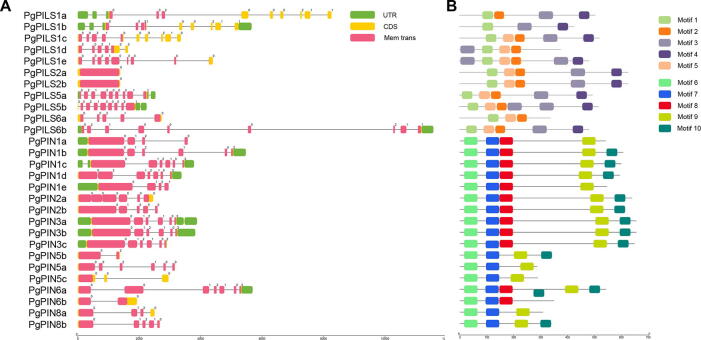
A genome-wide search of genome for homologous auxin transporter genes identified a total of 17 and 11 genes. Sequence alignment, putative motif organization, and sub-cellular localization indicated redundant and complementary biological functions of these / genes. Most / genes were differentially expressed in a tissue-specific manner, and showed significant correlations with ginsenoside content correspondingly. Eight auxin transporter genes, including both and subfamily members, were positively correlated with ginsenoside content (cor > 0.60; value <0.05). The expression levels of eleven auxin transporter genes were increased dramatically in the early stage (0-0.5 DPI) after infection, accompanied with various overall expression patterns, implying the dynamic auxin transport in response to biotic stress.
Based on the results, we speculate that the accumulation or depletion in temporal or spatial manner of auxin by PIN/PILS transporters involved in the regulation of HMGR activity and subsequent ginsenoside biosynthesis.
植物激素作为化学信使参与植物发育和代谢的调控。生长素通过PIN形成蛋白(PIN)和类PIN蛋白(PILS)生长素转运体进行运输和积累,从而促进杂交人参中人参皂苷的产生。然而,人参中PIN/PILS的全基因组研究仍然匮乏。在本研究中,对/基因家族进行了鉴定和转录谱分析,并研究了它们与人参中人参皂苷生物合成的潜在关系。
通过全基因组分析在计算机上鉴定了/基因,随后对其系统发育关系、基因结构和蛋白质谱进行了研究。此外,利用先前报道的来自不同组织和感染后根的RNA序列数据进行/基因表达模式分析。对特定/基因表达水平与主要人参皂苷含量进行Pearson相关性分析,以揭示生长素转运与人参中人参皂苷生物合成之间的潜在关系。
在人参基因组中对同源生长素转运体基因进行全基因组搜索,共鉴定出17个/基因和11个/基因。序列比对、假定基序组织和亚细胞定位表明这些/基因具有冗余和互补的生物学功能。大多数/基因以组织特异性方式差异表达,并相应地与人参皂苷含量显示出显著相关性。包括/和/亚家族成员在内的8个生长素转运体基因与人参皂苷含量呈正相关(相关系数>0.60;P值<0.05)。1种生长素转运体基因的表达水平在感染后早期(0-0.5天)显著增加,伴随着各种整体表达模式,这意味着生长素在应对生物胁迫时的动态运输。
基于这些结果,我们推测PIN/PILS转运体以时间或空间方式积累或消耗生长素,参与了3-羟基-3-甲基戊二酰辅酶A还原酶(HMGR)活性的调节以及随后的人参皂苷生物合成。