Department of Pediatric Dentistry and Dental Public Health, Faculty of Dentistry, Alexandria University, Alexandria, Egypt.
Department of Medical Microbiology and Immunology, Faculty of Medicine, Alexandria University, Alexandria, Egypt.
BMC Oral Health. 2022 Sep 19;22(1):411. doi: 10.1186/s12903-022-02447-0.
Children with cerebral palsy (CP) are at high risk for dental caries. Alteration of some salivary properties encountered among them compared to healthy children, could play a role in this elevated risk.
The aim of the present study was to assess salivary physicochemical properties; including total antioxidant (TAC), flow rate, viscosity, pH and buffering capacity, as well as Streptococcus mutans level among children with CP, also to correlate these variables to their caries experience.
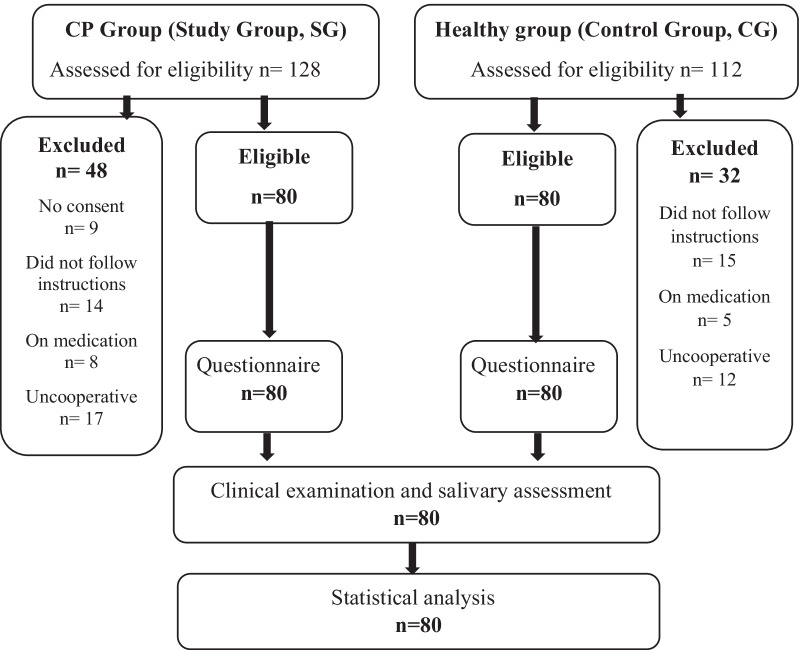
This case control study included 80 children with CP, study group (SG) and matched number of healthy children for control group (CG). Interview-based questionnaire, clinical examination, salivary biochemical and microbiological investigations using MALDI-TOF were done.
In SG, the caries experience in primary teeth dmft and S. mutans log value were significantly higher than CG (P = 0.039, P = 0.002) while unstimulated salivary flow rate, buffering capacity and salivary TAC were significantly lower (P < 0.0001). Multivariate linear regression showed that the presence of CP was significantly associated with the greatest variation in caries experience in the primary teeth and permanent teeth. Higher unstimulated salivary flow rate, or an increase in buffering capacity by 1 ml of acid/ml of saliva were associated with lower number of the affected primary and permanent teeth. On the other hand, One-unit increase in S. mutans log count and higher salivary TAC were associated with higher caries experience.
Children with CP have higher caries experience (dmf) due to lower salivary protective factors and higher S. mutans counts.
脑瘫(CP)患儿患龋齿的风险较高。与健康儿童相比,他们的一些唾液特性发生改变,这可能是导致这种风险增加的原因之一。
本研究旨在评估脑瘫患儿的唾液理化特性,包括总抗氧化能力(TAC)、流速、黏度、pH 值和缓冲能力,以及变形链球菌水平,并将这些变量与他们的龋齿经历相关联。
本病例对照研究纳入了 80 名脑瘫患儿,分为研究组(SG)和匹配数量的健康儿童对照组(CG)。通过问卷调查、临床检查、MALDI-TOF 进行唾液生化和微生物学检测。
在 SG 中,乳牙的龋齿经验 dmft 和变形链球菌 log 值明显高于 CG(P=0.039,P=0.002),而未刺激唾液流速、缓冲能力和唾液 TAC 明显较低(P<0.0001)。多元线性回归显示,脑瘫的存在与乳牙和恒牙龋齿经验的最大变化显著相关。未刺激唾液流速较高或缓冲能力增加 1 毫升酸/ml 唾液与受影响的乳牙和恒牙数量减少相关。另一方面,变形链球菌 log 计数增加一个单位和唾液 TAC 增加与更高的龋齿经验相关。
脑瘫患儿的龋齿经历(dmf)较高,这是由于唾液保护因子较低和变形链球菌计数较高所致。