Liu Hanze, Cheng Xuemei, Guan Huida, Wang Changhong
Institute of Chinese Materia Medica, Shanghai University of Traditional Chinese Medicine, the MOE Key Laboratory for Standardization of Chinese Medicines, Shanghai Key Laboratory of Compound Chinese Medicines, Shanghai R&D Centre for Standardization of Chinese Medicines, the SATCM Key Laboratory for New Resources and Quality Evaluation of Chinese Medicines, 1200 Cailun Road, Shanghai 201203, China.
J Anal Methods Chem. 2022 Sep 10;2022:5269545. doi: 10.1155/2022/5269545. eCollection 2022.
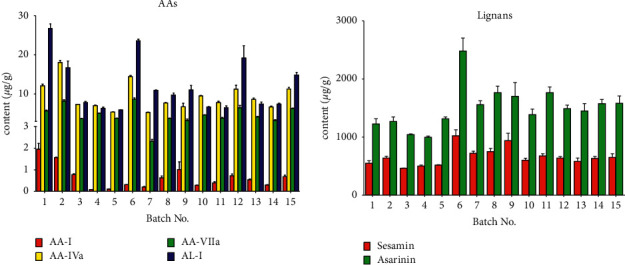
Asari Radix et Rhizoma (AR) is a widely-used Chinese herbal medicine containing multiple active lignans and rare nephrotoxic components-aristolochic acids derivatives (AAs). However, the current quality control method carried out by Chinese Pharmacopoeia has defects in trace AAs detection and insufficient marker ingredients, which is unable to comprehensively evaluate the efficacy and safety of AR. To improve the quality control method of AR, a rapid, sensitive, and reliable chromatographic analytic method based on ultra-high-performance liquid chromatography-triple quadrupole tandem mass spectrometry (UHPLC-QqQ-MS) was established for the simultaneous analysis of multiple AAs and lignans in AR samples. Positive electrospray ionization mode with multiple reaction monitoring (MRM) was applied for the detection of the eight analytes. The method showed available linearity ( ≥ 0.991), the limit of quantification (2-5 ng/mL), precision (RSD <8.12%), and accuracy (89.78-112.16%). A total of 6 AAs and 2 lignans were quantified for their content in 15 AR samples. The content of AA-IVa, AA-VIIa, and aristololactam I (AL-I) was much higher than the AA-I controlled by pharmacopoeia. Considering the potential toxicity of AAs, AA-IVa, AA-VIIa, and AL-I should also be controlled in AR. A considerable amount of active sesamin was detected in AR, suggesting that it could be added as a quality marker for the quality control of AR. The newly developed analytical method could be applied for the fast evaluation of toxic AA's content and quality during quality control of AR or preparations containing AR.
细辛是一种广泛使用的中药材,含有多种活性木脂素和罕见的肾毒性成分——马兜铃酸衍生物(AAs)。然而,现行《中国药典》执行的质量控制方法在痕量AAs检测方面存在缺陷,且指标成分不足,无法全面评价细辛的有效性和安全性。为改进细辛的质量控制方法,建立了一种基于超高效液相色谱-三重四极杆串联质谱(UHPLC-QqQ-MS)的快速、灵敏、可靠的色谱分析方法,用于同时分析细辛样品中的多种AAs和木脂素。采用正电喷雾电离模式和多反应监测(MRM)对8种分析物进行检测。该方法具有良好的线性(r≥0.991)、定量限(2-5 ng/mL)、精密度(RSD<8.12%)和准确度(89.78-112.16%)。对15个细辛样品中的6种AAs和2种木脂素进行了含量测定。AA-IVa、AA-VIIa和马兜铃内酰胺I(AL-I)的含量远高于药典规定的AA-I。考虑到AAs的潜在毒性,细辛中也应控制AA-IVa、AA-VIIa和AL-I的含量。在细辛中检测到相当数量的活性芝麻素,表明其可作为细辛质量控制的质量标志物添加。新建立的分析方法可用于细辛或含细辛制剂质量控制过程中有毒AAs含量和质量的快速评价。