Department of Clinical Laboratory, Binhai County People's Hospital, Binhai, Yancheng, Jiangsu 224500, China.
Department of Clinical Laboratory,Yancheng Third People's Hospital (The Yancheng School of Clinical Medicine of Nanjing Medical University, The Sixth Affiliated Hospital of Nantong University, The Affiliated Yancheng Hospital of Southeast University Medical College), Yancheng, Jiangsu 224001, China.
J Healthc Eng. 2022 Sep 10;2022:3630429. doi: 10.1155/2022/3630429. eCollection 2022.
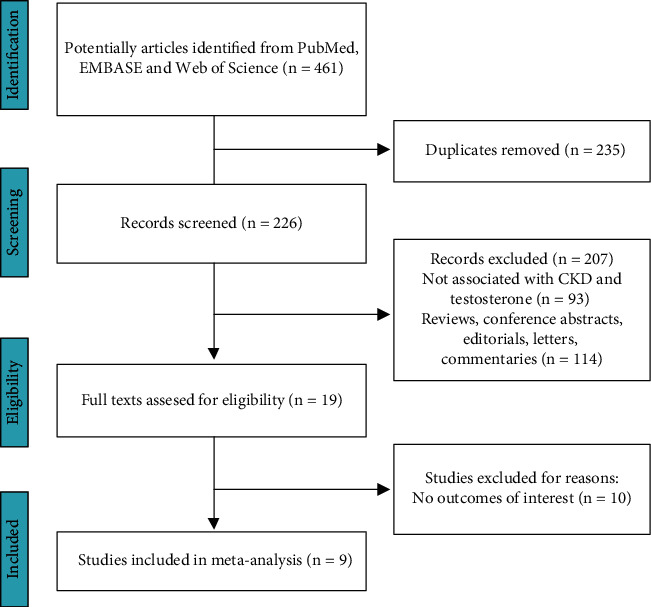
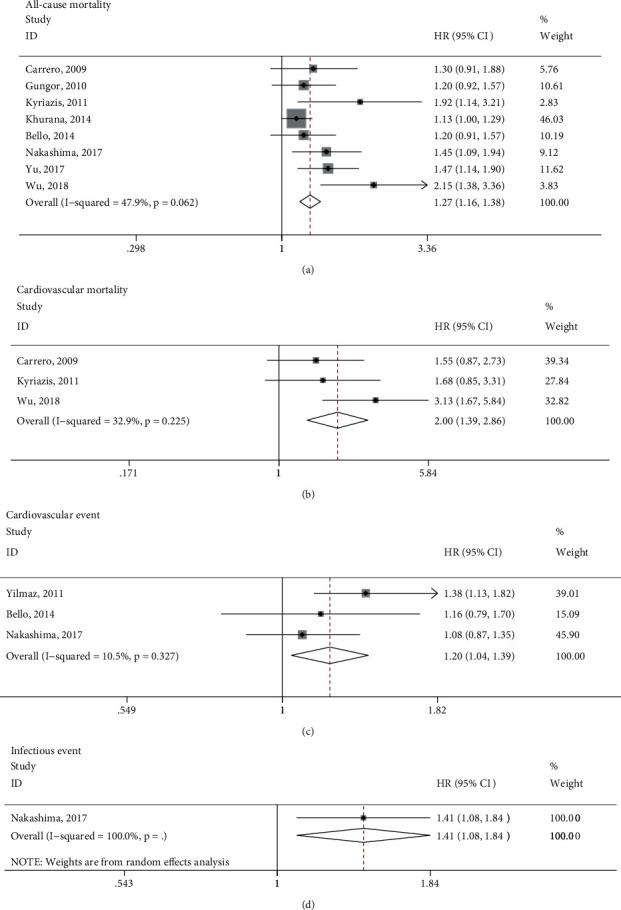
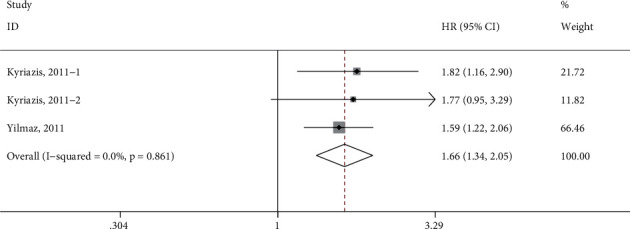
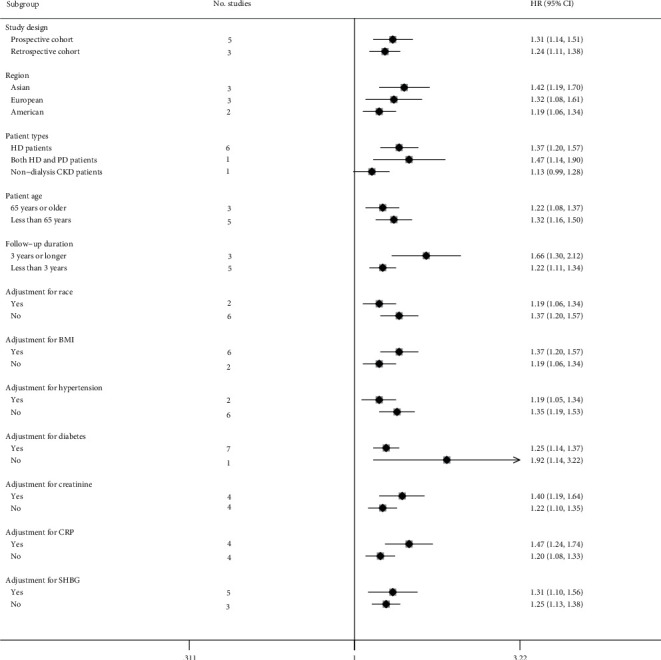
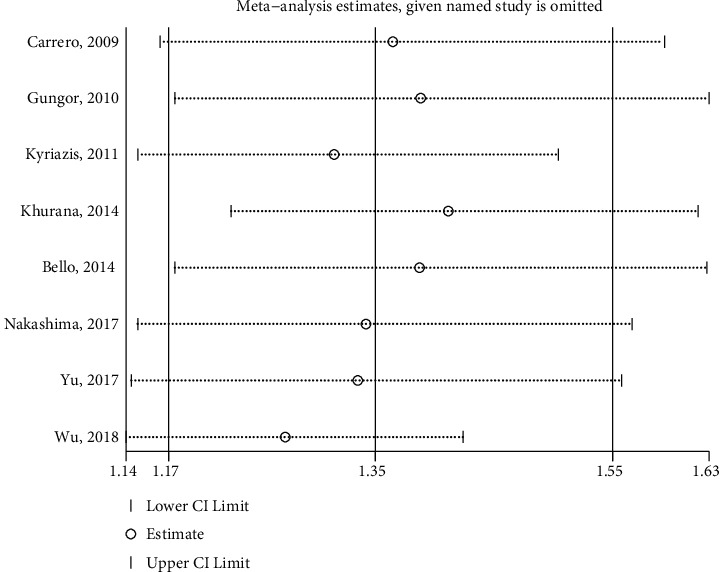
The phenomenon of low testosterone level is extremely common in male patients with chronic kidney diseases (CKDs). This meta-analysis aimed to evaluate whether the low circulating testosterone could independently predict adverse outcomes among male patients with chronic kidney diseases (CKDs). The data till May 2022 were systematically searched from Pubmed, Web of Science, and Embase from inception. Studies meeting the PICOS (population, intervention/exposure, control/comparison, outcomes, and study design) principles were included in this meta-analysis. Study-specific effect estimates were pooled using fixed-effects ( > 50%) or random-effects models ( < 50%). Ultimately, 9 cohort studies covering 5331 patients with CKDs were involved in this meta-analysis. The results suggested that per 1-standard deviation (SD) decrease in total testosterone independently increased the risk of all-cause mortality by 27% [hazard risk (HR) 1.27, 95% confidence interval (CI) 1.16-1.38], cardiovascular mortality by 100% (HR 2.00, 95% CI 1.39-2.86), cardiovascular events by 20% (HR 1.20, 95% CI 1.04-1.39), and infectious events by 41% (HR 1.41, 95% CI 1.08-1.84). Besides, with per 1-SD decrease in free testosterone, the risk of overall adverse events increased by 66% (HR 1.66, 95% CI 1.34-2.05). Stratified analyses indicated that the negative relationship of the total testosterone with all-cause death risk was independent of factors involving age, race, body mass index, diabetes, hypertension, C-reactive protein, creatinine, and sex hormone binding globulin. In conclusion, it was identified that low endogenous testosterone could serve as an independent predictor of adverse clinical events among male patients with CKDs.
低睾酮水平在慢性肾脏病(CKD)男性患者中极为常见。本荟萃分析旨在评估循环低睾酮是否可独立预测慢性肾脏病(CKD)男性患者的不良结局。系统检索了 2022 年 5 月前 Pubmed、Web of Science 和 Embase 中的数据。本荟萃分析纳入符合人群(population)、干预/暴露(intervention/exposure)、对照/比较(control/comparison)、结局(outcomes)和研究设计(study design)原则的研究。采用固定效应模型( > 50%)或随机效应模型( < 50%)汇总研究特异性效应估计值。最终纳入 9 项队列研究,共纳入 5331 例 CKD 患者。结果表明,总睾酮每降低 1 个标准差(SD),全因死亡率独立增加 27%[风险比(HR)1.27,95%置信区间(CI)1.16-1.38],心血管死亡率增加 100%(HR 2.00,95%CI 1.39-2.86),心血管事件增加 20%(HR 1.20,95%CI 1.04-1.39),感染事件增加 41%(HR 1.41,95%CI 1.08-1.84)。此外,游离睾酮每降低 1 个 SD,总不良事件风险增加 66%(HR 1.66,95%CI 1.34-2.05)。分层分析表明,总睾酮与全因死亡风险的负相关独立于年龄、种族、体重指数、糖尿病、高血压、C 反应蛋白、肌酐和性激素结合球蛋白等因素。总之,内源性睾酮水平降低可作为 CKD 男性患者不良临床事件的独立预测指标。