Department of Biosciences, University of Durham, UK.
Department of Chemistry, University of Durham, UK.
FEBS Lett. 2023 Jan;597(1):141-150. doi: 10.1002/1873-3468.14500. Epub 2022 Sep 26.
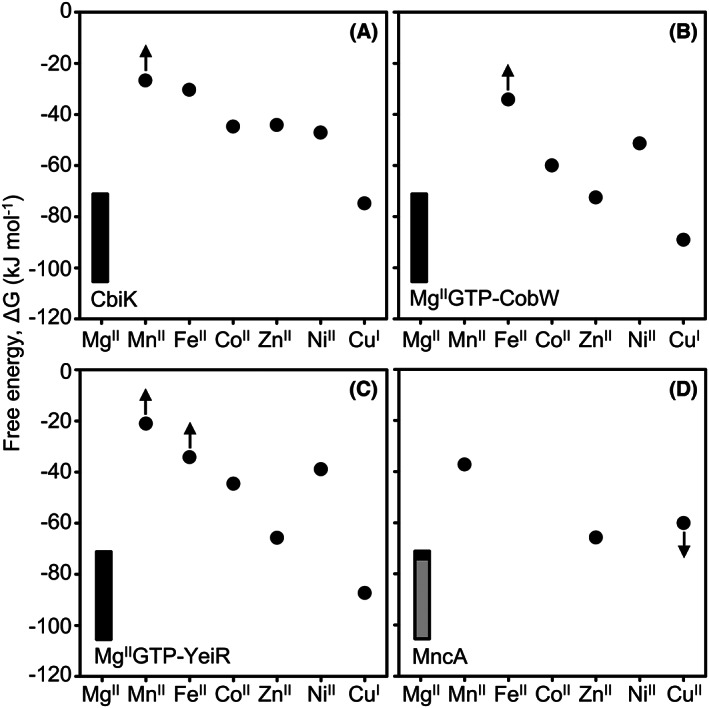
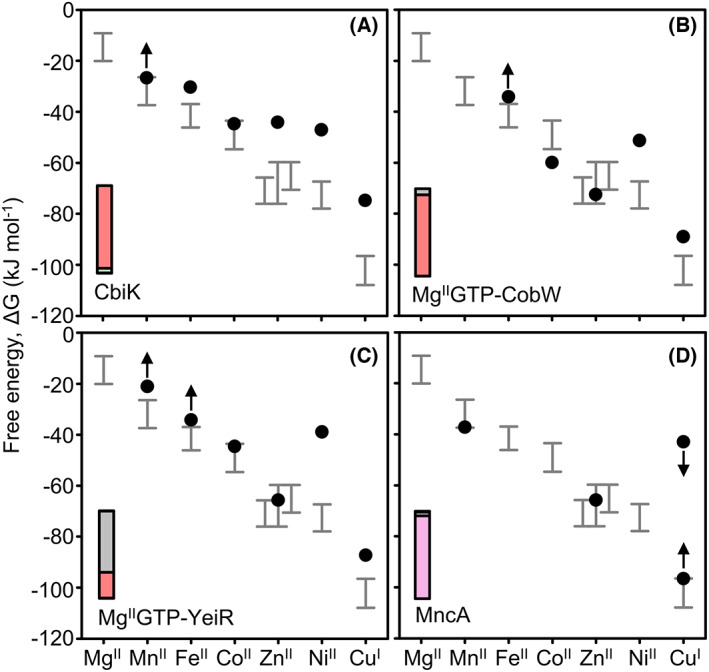
Metalation, the acquisition of metals by proteins, must avoid mis-metalation with tighter binding metals. This is illustrated by four selected proteins that require different metals: all show similar ranked orders of affinity for bioavailable metals, as described in a universal affinity series (the Irving-Williams series). Crucially, cellular protein metalation occurs in competition with other metal binding sites. The strength of this competition defines the intracellular availability of each metal: its magnitude has been estimated by calibrating a cells' set of DNA-binding, metal-sensing, transcriptional regulators. This has established that metal availabilities (as free energies for forming metal complexes) are maintained to the inverse of the universal series. The tightest binding metals are least available. With these availabilities, correct metalation is achieved.
金属化,即蛋白质获取金属的过程,必须避免与结合更紧密的金属发生错误的金属化。这可以通过四种需要不同金属的选定蛋白质来说明:它们都显示出对生物可用金属的相似亲和力排序,如在通用亲和力系列(Irving-Williams 系列)中所述。至关重要的是,细胞蛋白的金属化是在与其他金属结合位点的竞争中发生的。这种竞争的强度决定了每种金属在细胞内的可用性:通过校准一组细胞的 DNA 结合、金属感应、转录调节剂,已经对其强度进行了估计。这已经确定了金属的可用性(作为形成金属配合物的自由能)保持在通用系列的倒数。结合最紧密的金属的可用性最低。有了这些可用性,就可以实现正确的金属化。