Department of Chemistry and Biochemistry, University of California, San Diego, La Jolla, CA, USA.
Nature. 2022 Mar;603(7901):522-527. doi: 10.1038/s41586-022-04469-8. Epub 2022 Mar 2.
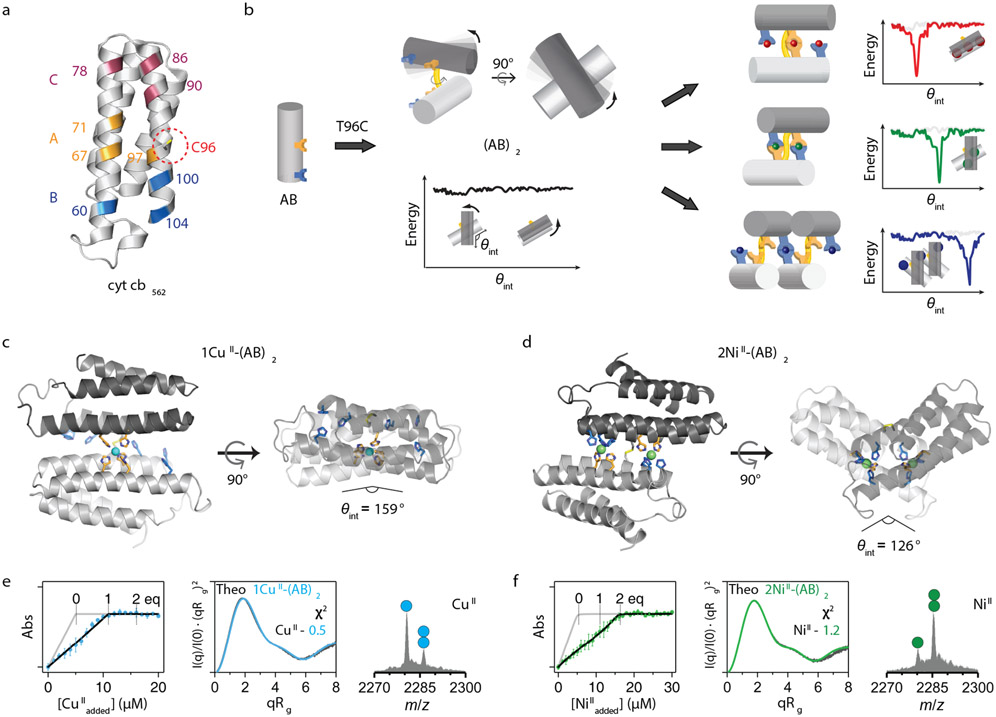
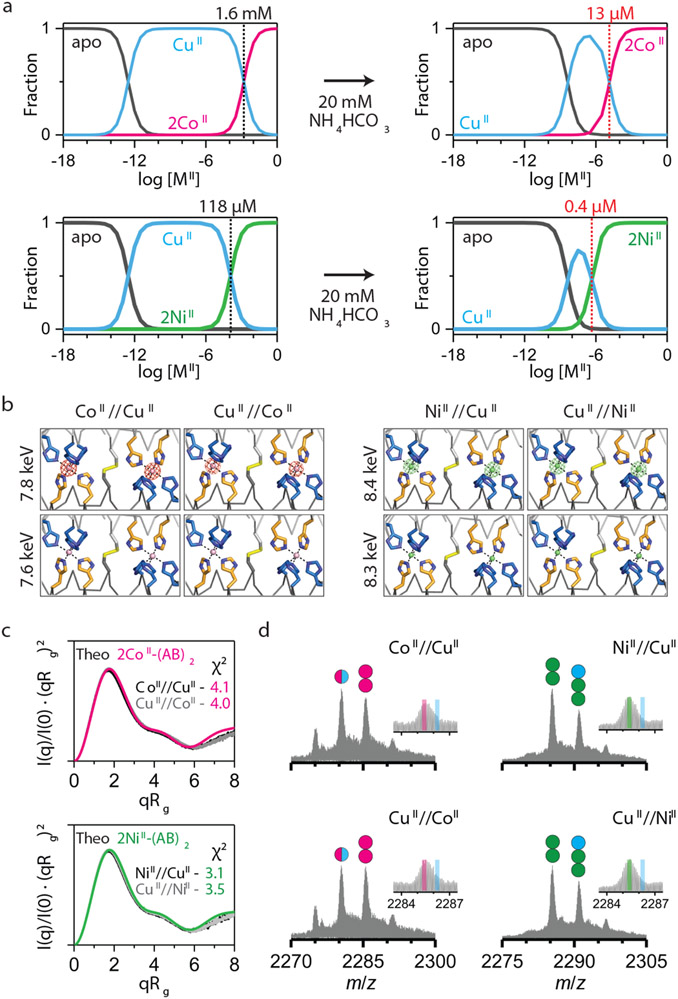
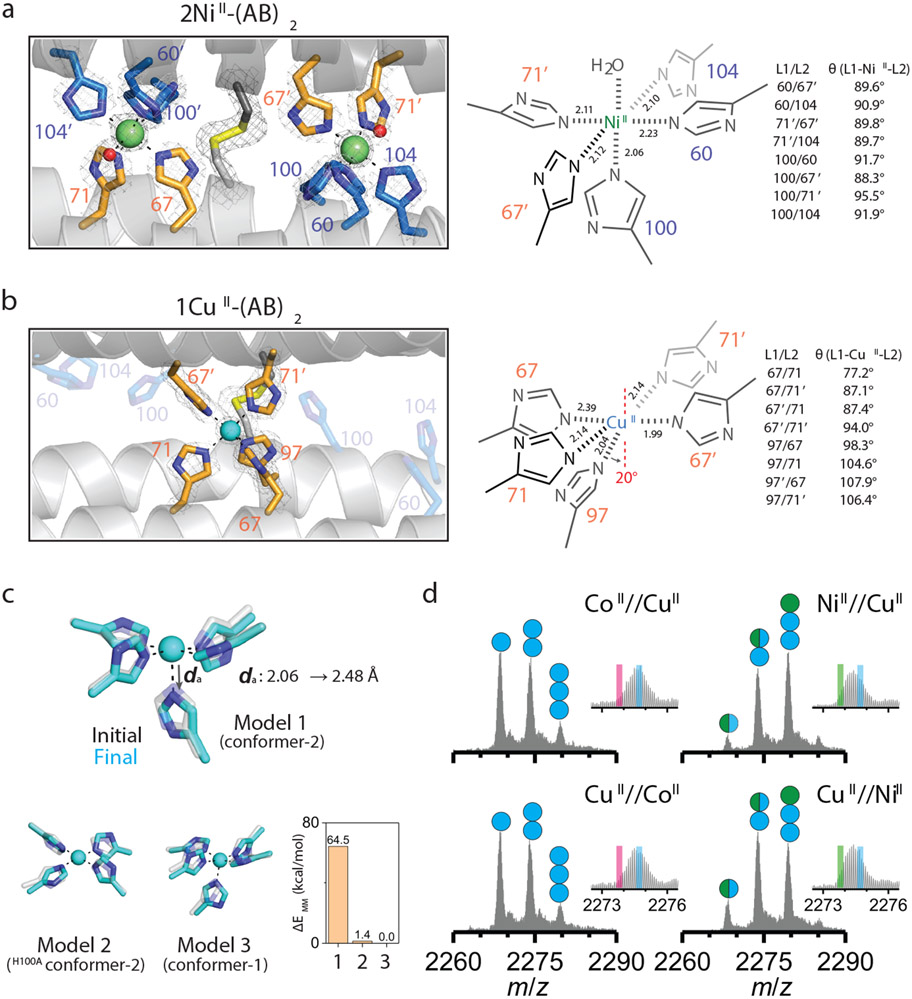
Selective metal coordination is central to the functions of metalloproteins: each metalloprotein must pair with its cognate metallocofactor to fulfil its biological role. However, achieving metal selectivity solely through a three-dimensional protein structure is a great challenge, because there is a limited set of metal-coordinating amino acid functionalities and proteins are inherently flexible, which impedes steric selection of metals. Metal-binding affinities of natural proteins are primarily dictated by the electronic properties of metal ions and follow the Irving-Williams series (Mn < Fe < Co < Ni < Cu > Zn) with few exceptions. Accordingly, metalloproteins overwhelmingly bind Cu and Zn in isolation, regardless of the nature of their active sites and their cognate metal ions. This led organisms to evolve complex homeostatic machinery and non-equilibrium strategies to achieve correct metal speciation. Here we report an artificial dimeric protein, (AB), that thermodynamically overcomes the Irving-Williams restrictions in vitro and in cells, favouring the binding of lower-Irving-Williams transition metals over Cu, the most dominant ion in the Irving-Williams series. Counter to the convention in molecular design of achieving specificity through structural preorganization, (AB) was deliberately designed to be flexible. This flexibility enabled (AB) to adopt mutually exclusive, metal-dependent conformational states, which led to the discovery of structurally coupled coordination sites that disfavour Cu ions by enforcing an unfavourable coordination geometry. Aside from highlighting flexibility as a valuable element in protein design, our results illustrate design principles for constructing selective metal sequestration agents.
每种金属蛋白都必须与其同源金属辅因子配对,以发挥其生物学功能。然而,仅通过三维蛋白质结构实现金属选择性是一个巨大的挑战,因为金属配位氨基酸功能的种类有限,而且蛋白质本身具有柔韧性,这阻碍了对金属的空间选择。天然蛋白质的金属结合亲和力主要由金属离子的电子性质决定,并遵循 Irving-Williams 系列(Mn < Fe < Co < Ni < Cu > Zn),但也有少数例外。因此,无论其活性位点和同源金属离子的性质如何,金属蛋白都压倒性地单独结合 Cu 和 Zn。这导致生物体进化出复杂的动态平衡机制和非平衡策略来实现正确的金属形态。在这里,我们报告了一种人工二聚体蛋白 (AB),它在体外和细胞内热力学上克服了 Irving-Williams 的限制,有利于结合 Irving-Williams 系列中较低的过渡金属,而不是最占主导地位的 Cu 离子。与通过结构预组织实现特异性的分子设计惯例相反,(AB) 被故意设计为具有柔韧性。这种灵活性使 (AB) 能够采用相互排斥的、依赖金属的构象状态,这导致发现了结构耦合的配位位点,通过强制不利的配位几何结构来排斥 Cu 离子。除了强调灵活性是蛋白质设计中的一个有价值的元素外,我们的结果还说明了构建选择性金属螯合剂的设计原则。