Department of Biosciences, Durham University, Durham, UK.
Department of Chemistry, Durham University, Durham, UK.
Metallomics. 2022 Sep 1;14(9). doi: 10.1093/mtomcs/mfac058.
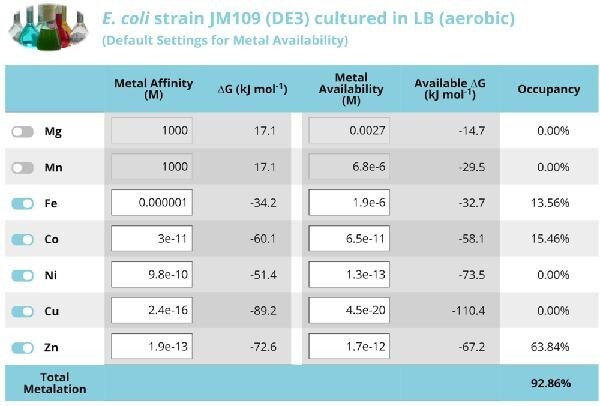
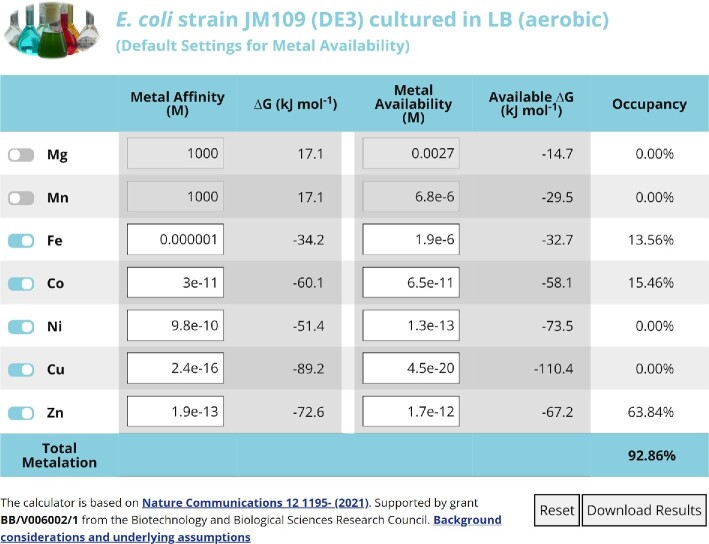
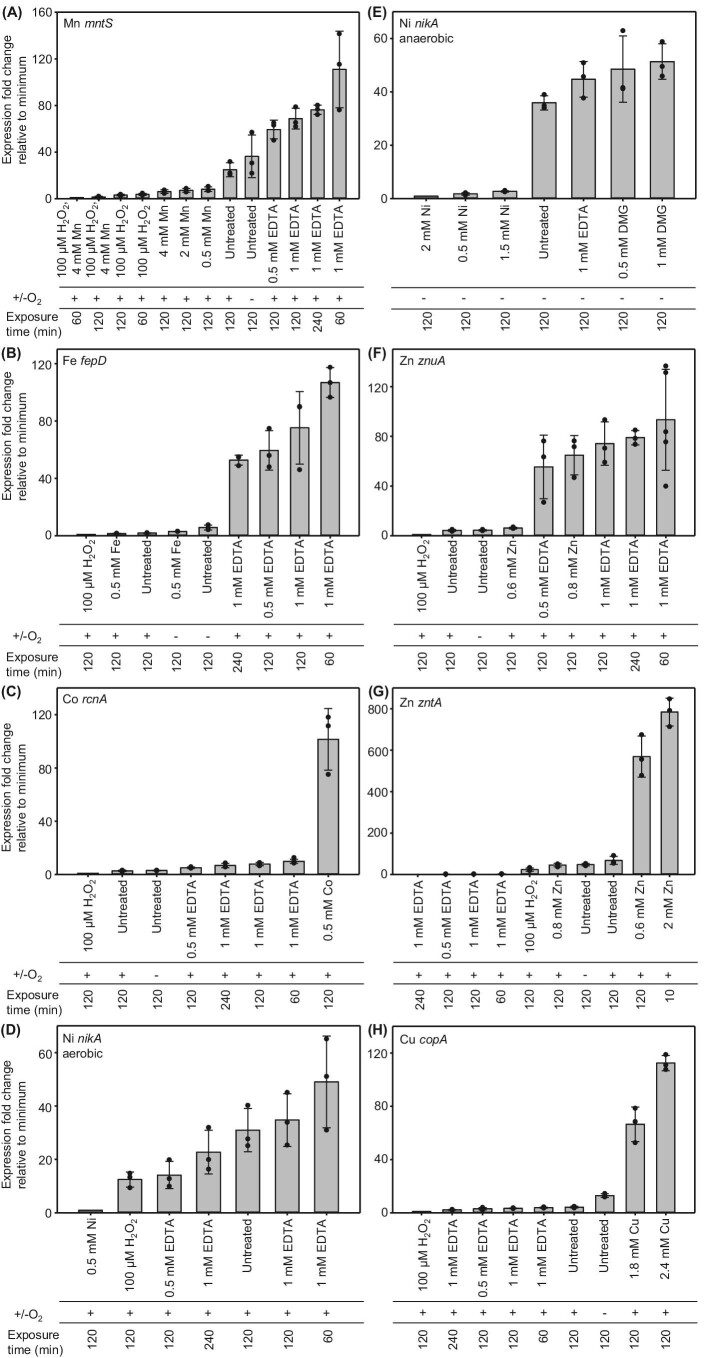
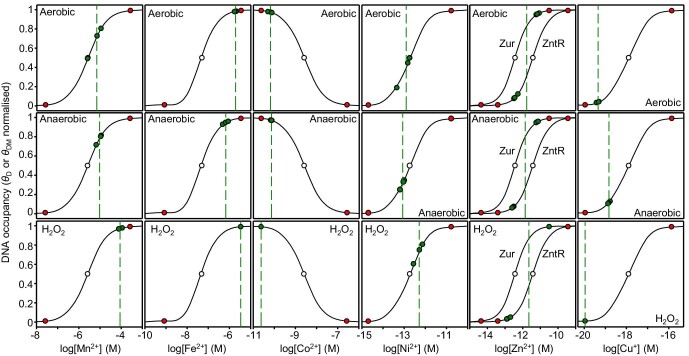
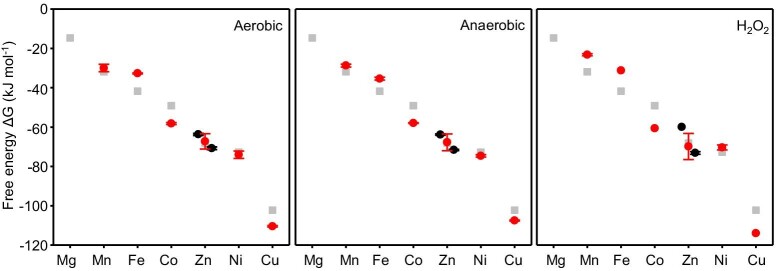
Three Web-based calculators, and three analogous spreadsheets, have been generated that predict in vivo metal occupancies of proteins based on known metal affinities. The calculations exploit estimates of the availabilities of the labile buffered pools of different metals inside a cell. Here, metal availabilities have been estimated for a strain of Escherichia coli that is commonly used in molecular biology and biochemistry research, e.g. in the production of recombinant proteins. Metal availabilities have been examined for cells grown in Luria-Bertani (LB) medium aerobically, anaerobically, and in response to H2O2 by monitoring the abundance of a selected set of metal-responsive transcripts by quantitative polymerase chain reaction (qPCR). The selected genes are regulated by DNA-binding metal sensors that have been thermodynamically characterized in related bacterial cells enabling gene expression to be read out as a function of intracellular metal availabilities expressed as free energies for forming metal complexes. The calculators compare these values with the free energies for forming complexes with the protein of interest, derived from metal affinities, to estimate how effectively the protein can compete with exchangeable binding sites in the intracellular milieu. The calculators then inter-compete the different metals, limiting total occupancy of the site to a maximum stoichiometry of 1, to output percentage occupancies with each metal. In addition to making these new and conditional calculators available, an original purpose of this article was to provide a tutorial that discusses constraints of this approach and presents ways in which such calculators might be exploited in basic and applied research, and in next-generation manufacturing.
已经生成了三个基于网络的计算器和三个类似的电子表格,这些计算器和表格可根据已知的金属亲和力预测蛋白质的体内金属占有率。这些计算利用了细胞内不同金属的可利用缓冲池的可用性估计。在这里,已经针对通常用于分子生物学和生物化学研究的大肠杆菌菌株(例如在重组蛋白生产中)估计了金属的可用性。通过定量聚合酶链反应(qPCR)监测一组选定的金属响应转录物的丰度,检查了在有氧、无氧和响应 H2O2 条件下培养的细胞中的金属可用性。所选基因受 DNA 结合金属传感器的调控,这些传感器在相关细菌细胞中进行了热力学表征,从而可以根据细胞内金属可用性作为形成金属配合物的自由能来读取基因表达,这些金属可用性以形成金属配合物的自由能来表示。计算器将这些值与从金属亲和力得出的与感兴趣的蛋白质形成配合物的自由能进行比较,以估计蛋白质与细胞内环境中的可交换结合位点竞争的有效性。然后,计算器会使不同的金属相互竞争,将该位点的总占有率限制在最大化学计量比为 1,以输出每种金属的占有率百分比。除了提供这些新的和有条件的计算器外,本文的原始目的之一是提供一个教程,讨论该方法的限制,并介绍如何在基础和应用研究以及下一代制造中利用这些计算器。