Zhejiang Province Center for Disease Control and Prevention, Hangzhou, Zhejiang Province, China.
Key Laboratory for Vaccine, Prevention and Control of Infectious Disease of Zhejiang Province, Hangzhou, Zhejiang Province, China.
PLoS One. 2022 Sep 20;17(9):e0274421. doi: 10.1371/journal.pone.0274421. eCollection 2022.
Zhejiang, ranked in the top three in HFMD (hand, foot, and mouth disease) incidence, is located in the Yangtze River Delta region of southeast China. Since 2016, the EV71 vaccine has been promoted in Zhejiang Province. This study aimed to investigate the trend and seasonal variation characteristics of HFMD from 2010 to 2021 and estimate the reduction in enterovirus 71 infection after vaccine use.
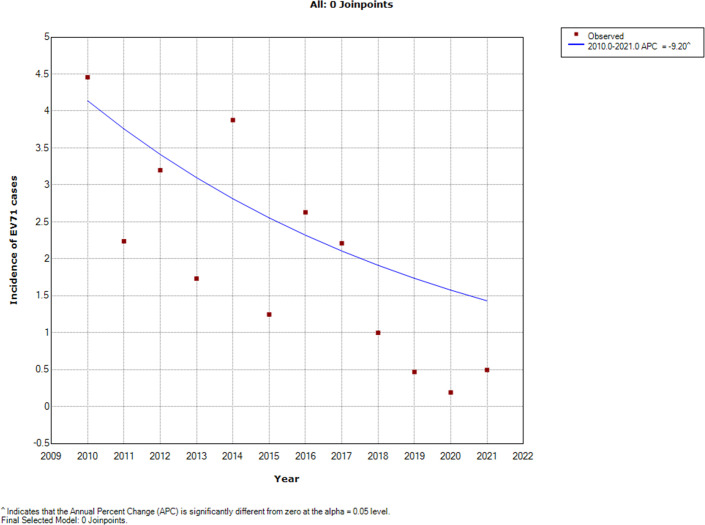
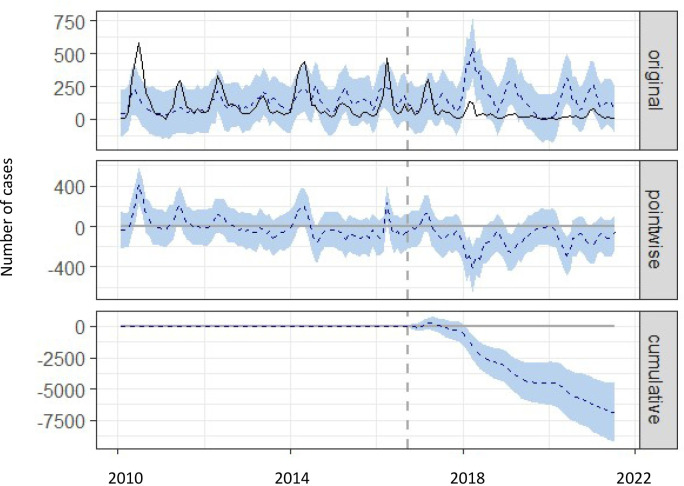
The data on HFMD cases in Zhejiang Province from January 2010 to December 2021 were obtained from this network system. Individual information on cases and deaths was imported, and surveillance information, including demographic characteristics and temporal distributions, was computed by the system. The Joinpoint regression model was used to describe continuous changes in the incidence trend. The BSTS (Bayesian structural time-series models) model was used to estimate the monthly number of cases from 2017 to 2021 based on the observed monthly incidence during 2010-2016 by accounting for seasonality and long-term trends. The seasonal variation characteristics of HFMD pathogens were detected by wavelet analysis.
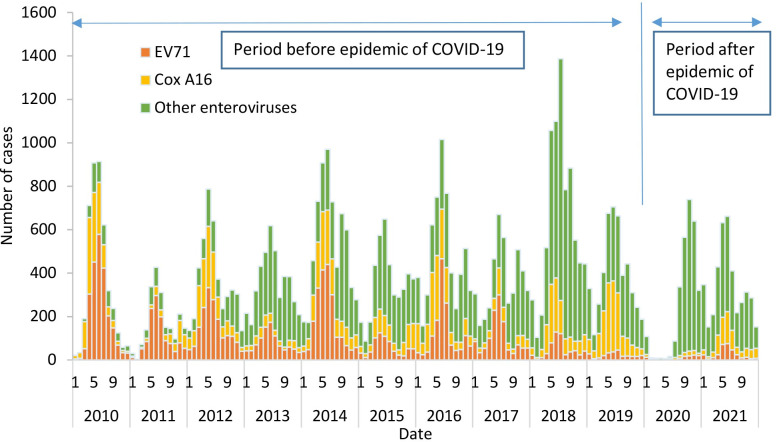
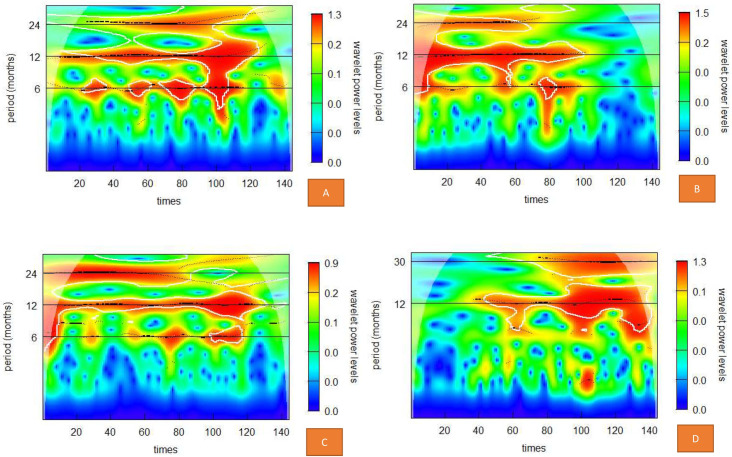
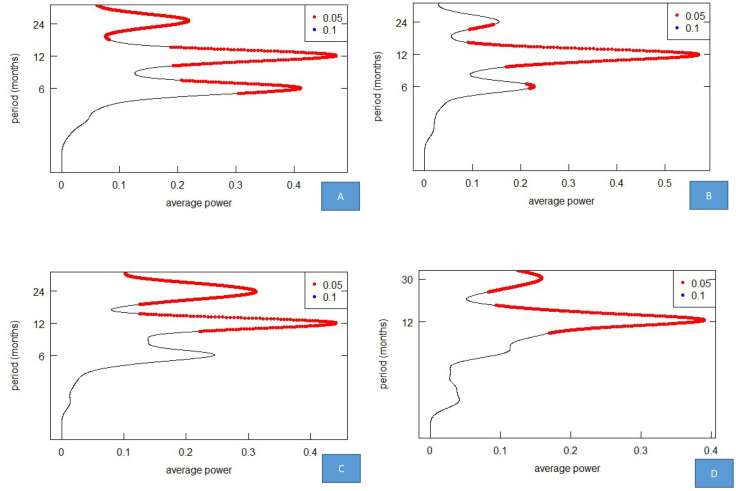
From 2010 to 2021, the annual incidence rate fluctuated between 98.81 cases per 100,000 in 2020 and 435.63 cases per 100,000 in 2018, and 1711 severe HFMD cases and 106 fatal cases were reported in Zhejiang Province, China. The annual percent change (APC) in EV71 cases was -30.72% (95% CI: -45.10 to -12.50) from 2016 to 2021. The wavelet transform of total incidence and number of cases of the three pathogens all showed significant periodicity on the 1-year scale. The average 2-year scale periodicity was significant for the total incidence, EV71 cases and Cox A16 cases, but the other enterovirus cases showed significant periodicity on the 30-month scale. The 6-month scale periodicity was significant for the total incidence, EV71 case and Cox A16 case but not for the other enteroviruses case. The relative error percentage of the performance of the BSTS model was 0.3%. The estimated number of cases from 2017 to 2021 after the EV-A71 vaccines were used was 9422, and the reduction in the number of cases infected with the EV71 virus was 73.43% compared to 70.80% when the impact of the COVID-19 epidemic in 2020 was excluded.
Since 2010, the incidence of EV71 infections has shown an obvious downward trend. All types of viruses showed significant periodicity on the 1-year scale. The periodicity of the biennial peak is mainly related to EV71 and Cox A16 before 2017 and other enteroviruses since 2018. The half-year peak cycle of HFMD was mainly caused by EV71 and Cox A6 infection. The expected incidence will be 2.76 times(include the cases of 2020) and 2.43 times(exclude the cases of 2020) higher than the actual value assuming that the measures of vaccination are not taken. EV71 vaccines are very effective and should be administered in the age window between 5 months and 5 years.
浙江省手足口病(HFMD)发病率位居全国前三,位于中国东南地区的长江三角洲地区。自 2016 年以来,浙江省已推广使用 EV71 疫苗。本研究旨在调查 2010 年至 2021 年 HFMD 的趋势和季节性变化特征,并估计疫苗使用后肠道病毒 71 型感染的减少情况。
从 2010 年 1 月至 2021 年 12 月,从该网络系统中获取浙江省 HFMD 病例数据。导入病例和死亡的个体信息,并由系统计算监测信息,包括人口统计学特征和时间分布。使用 Joinpoint 回归模型描述发病率趋势的连续变化。使用贝叶斯结构时间序列模型(BSTS)模型根据 2010-2016 年期间的每月发病率来估计 2017 年至 2021 年的每月病例数,同时考虑季节性和长期趋势。通过小波分析检测 HFMD 病原体的季节性变化特征。
2010 年至 2021 年,浙江省的年发病率在 2020 年的 98.81 例/10 万和 2018 年的 435.63 例/10 万之间波动,共报告了 1711 例严重 HFMD 病例和 106 例死亡病例。2016 年至 2021 年,EV71 病例的年百分比变化(APC)为-30.72%(95%CI:-45.10 至-12.50)。总发病率和三种病原体病例数的小波变换均显示出 1 年尺度上的显著周期性。总发病率、EV71 病例和 Cox A16 病例的平均 2 年尺度周期性显著,但其他肠道病毒病例在 30 个月尺度上表现出显著周期性。总发病率、EV71 病例和 Cox A16 病例的 6 个月尺度周期性显著,但其他肠道病毒病例则不显著。BSTS 模型性能的相对误差百分比为 0.3%。使用 EV-A71 疫苗后,2017 年至 2021 年的估计病例数为 9422 例,与 2020 年排除 COVID-19 疫情影响时 EV71 病毒感染病例减少 73.43%相比,减少了 70.80%。
自 2010 年以来,EV71 感染的发病率呈明显下降趋势。所有类型的病毒在 1 年尺度上均显示出显著的周期性。两年高峰的周期性主要与 2017 年之前的 EV71 和 Cox A16 以及 2018 年之后的其他肠道病毒有关。HFMD 的半年高峰周期主要由 EV71 和 Cox A6 感染引起。假设不采取疫苗接种措施,预期发病率将比实际值高 2.76 倍(包括 2020 年的病例)和 2.43 倍(排除 2020 年的病例)。EV71 疫苗非常有效,应在 5 个月至 5 岁的年龄窗口内接种。