
通过半导体纳米晶体能量转移敏化实现超薄硅太阳能电池极限性能增强的光学模拟
Optical simulation of ultimate performance enhancement in ultrathin Si solar cells by semiconductor nanocrystal energy transfer sensitization.
作者信息
Yalin Brandon, Liapis Andreas C, Eisaman Matthew D, Nykypanchuk Dmytro, Nam Chang-Yong
机构信息
Department of Physics and Astronomy, Stony Brook University Stony Brook New York 11794 USA.
Center for Functional Nanomaterials, Brookhaven National Laboratory Upton New York 11973 USA
出版信息
Nanoscale Adv. 2021 Jan 8;3(4):991-996. doi: 10.1039/d0na00835d. eCollection 2021 Feb 23.
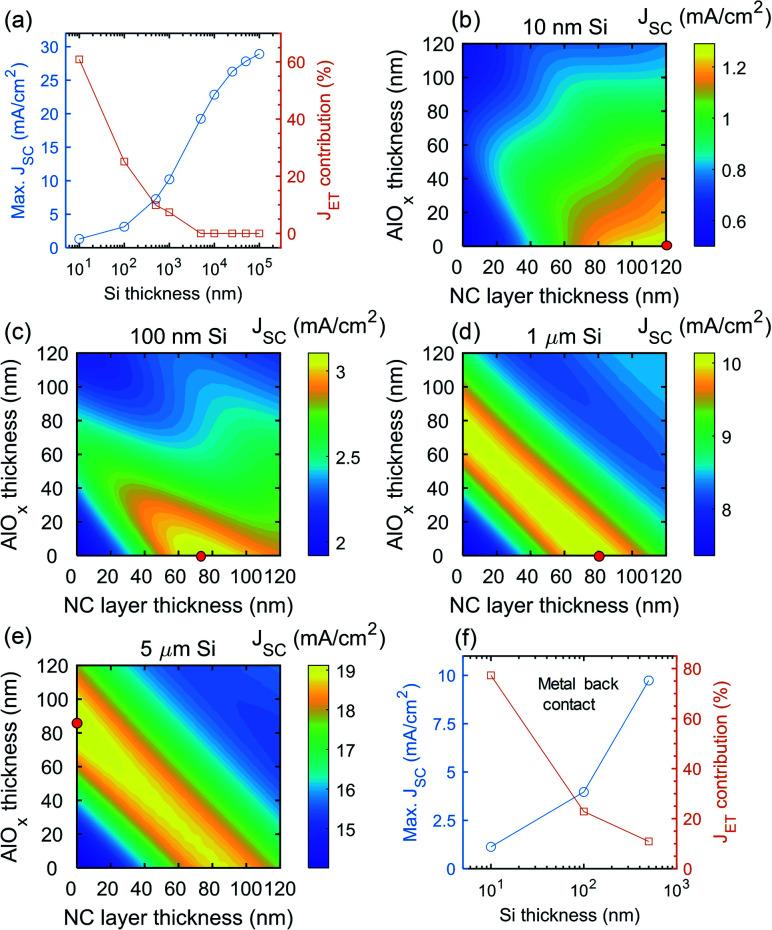
Energy transfer (ET) from nanocrystals (NCs) has shown potential to enhance the optoelectronic performance of ultrathin semiconductor devices such as ultrathin Si solar cells, but the experimental identification of optimal device geometries for maximizing the performance enhancement is highly challenging due to a large parameter space. Here, we have demonstrated a general theoretical framework combining transfer matrix method (TMM) simulations and energy transfer (ET) calculations to reveal critical device design guidelines for developing an efficient, NC-based ET sensitization of ultrathin Si solar cells, which are otherwise infeasible to identify experimentally. The results uncover that the ET-driven NC sensitization is highly effective in enhancing the short circuit current ( ) in sub-100 nm-thick Si layers, where, for example, the ET contribution can account for over 60% of the maximum achievable in 10 nm-thick ultrathin Si. The study also reveals the limitation of the ET approach, which becomes ineffective for Si active layers thicker than 5 μm, being dominated by conventional optical coupling. The demonstrated simulation approach not only enables the development of efficient ultrathin Si solar cells but also should be applicable to precisely assessing and analyzing diverse experimental device geometries and configurations for developing new efficient ET-based ultrathin semiconductor optoelectronic devices.
纳米晶体(NCs)的能量转移(ET)已显示出增强超薄半导体器件(如超薄硅太阳能电池)光电性能的潜力,但由于参数空间较大,要通过实验确定使性能增强最大化的最佳器件几何结构极具挑战性。在此,我们展示了一个结合转移矩阵法(TMM)模拟和能量转移(ET)计算的通用理论框架,以揭示开发高效的基于纳米晶体的超薄硅太阳能电池ET敏化的关键器件设计准则,而这些准则通过实验是难以确定的。结果表明,ET驱动的NC敏化在增强厚度小于100nm的硅层的短路电流( )方面非常有效,例如,在10nm厚的超薄硅中,ET贡献可占最大可实现短路电流的60%以上。该研究还揭示了ET方法的局限性,对于厚度大于5μm的硅有源层,ET方法变得无效,此时传统光耦合起主导作用。所展示的模拟方法不仅能够开发高效的超薄硅太阳能电池,还应适用于精确评估和分析各种实验器件的几何结构和配置,以开发新型高效的基于ET的超薄半导体光电器件。


 Zotero 插件