Faculty of Health Sciences and Medicine, Bond University, Gold Coast, Queensland, Australia.
Menzies Health Institute Queensland, Griffith University, Gold Coast, Queensland, Australia.
Health Soc Care Community. 2022 Nov;30(6):e5775-e5785. doi: 10.1111/hsc.14009. Epub 2022 Sep 22.
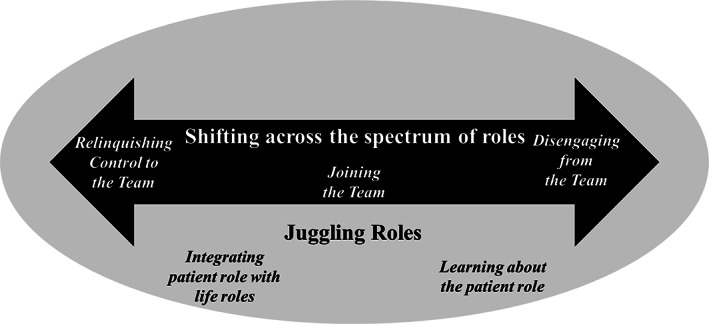
Interprofessional collaborative practice has been shown to be an appropriate model of care for chronic disease management in primary care. However, how patients play a role in this model is relatively unknown. The aim of this constructivist grounded theory focus group study was to explore the perceptions of patient advocates regarding the role of patients in interprofessional collaborative practice for chronic conditions in primary care. Primary data were collected from patient advocates, from public and private Australian organisations and who represent patients with chronic disease in primary care, through focus groups in July-August 2020. Videoconference focus groups were recorded, transcribed verbatim and inductively, thematically analysed using the five-step approach by Charmaz: (1) initial line-by-line coding, (2) focused coding, (3) memo writing, (4) categorisation and (5) theme and sub-theme development. Three focus groups comprising 17 patient advocates with diverse cultural and professional backgrounds participated. Two themes and five sub-themes relating to interprofessional collaborative practice teams were constructed from the data. In theme 1, patients 'shifted across the spectrum of roles' from 'relinquishing control to the team', 'joining the team' to 'disengaging from the team'. The second theme was the need for 'juggling roles' by 'integrating patient role with life roles', and 'learning about the patient role'. The diversity and variability of patient roles as described by patient advocates highlight the challenges of working with people with chronic conditions. The diverse patient roles described by advocates are an important finding that may better inform communication between patients and health professionals when managing chronic conditions. From the health professional perspective, identification of the role of a patient may be challenging. Therefore, future research should explore the development of a tool to assist both patients and health professionals to identify patient roles as they move across the spectrum, with the support of policy makers. This tool should aim to identify and promote patient engagement in interprofessional collaborative practice in primary care settings.
跨专业协作实践已被证明是慢性病管理的一种合适的初级保健护理模式。然而,患者在这种模式中扮演什么角色还相对未知。本建构主义扎根理论焦点小组研究的目的是探讨患者倡导者对慢性病初级保健中跨专业协作实践中患者角色的看法。主要数据来自于患者倡导者,他们来自澳大利亚的公共和私营组织,代表初级保健中的慢性病患者,通过 2020 年 7 月至 8 月的焦点小组收集。视频会议焦点小组进行了录音、逐字转录,并使用 Charmaz 的五步方法进行了归纳主题分析:(1)初始逐行编码,(2)重点编码,(3)写备忘录,(4)分类和(5)主题和子主题发展。三个焦点小组由 17 名具有不同文化和专业背景的患者倡导者组成。从数据中构建了两个与跨专业协作实践团队相关的主题和五个子主题。主题 1 中,患者“在角色之间转移”,从“向团队放弃控制权”到“加入团队”,再到“脱离团队”。第二个主题是“通过将患者角色与生活角色相结合”和“了解患者角色”,需要“平衡角色”。患者倡导者所描述的患者角色的多样性和可变性突出了与慢性病患者合作的挑战。倡导者所描述的多样化的患者角色是一个重要的发现,这可能会更好地告知慢性病管理中患者与卫生专业人员之间的沟通。从卫生专业人员的角度来看,确定患者的角色可能具有挑战性。因此,未来的研究应该探索开发一种工具,以帮助患者和卫生专业人员在政策制定者的支持下,识别患者在跨专业协作实践中的角色。该工具的目的应是识别和促进患者在初级保健环境中参与跨专业协作实践。