Department of Public Health, North South University, Dhaka, Bangladesh.
Department of Health Research Methods, Evidence and Impact, McMaster University, Hamilton, Ontario, Canada.
PLoS One. 2022 Sep 22;17(9):e0274965. doi: 10.1371/journal.pone.0274965. eCollection 2022.
Depression is one of the most serious yet understudied issues among Bangladeshi nurses, bringing health dangers to this workforce. This study aimed to investigate how workplace violence (WPV), bullying, burnout, and job satisfaction are correlated with depression and identify the factors associated with depression among Bangladeshi nurses.
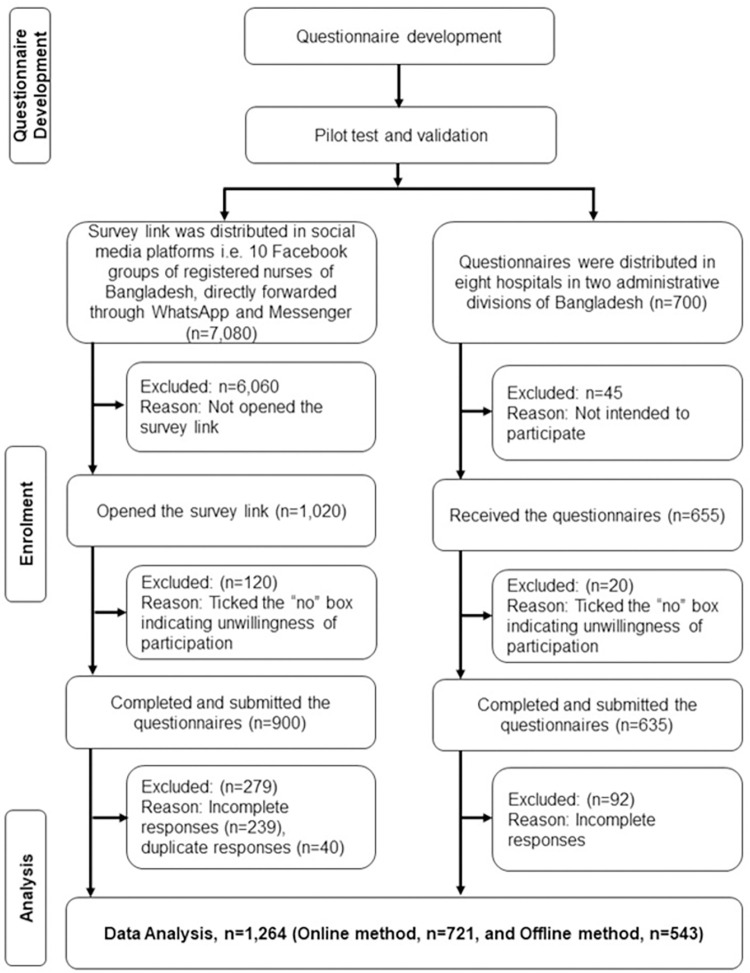
For this cross-sectional study, data were collected between February 26, 2021, and July 10, 2021 from the Bangladeshi registered nurses. The Workplace Violence Scale (WPVS), the Short Negative Acts Questionnaire [S-NAQ], the Burnout Measure-Short version (BMS), the Short Index of Job Satisfaction (SIJS-5), and the Patient Health Questionnaire (PHQ-9) were used to measure WPV, bullying, burnout, job satisfaction, and depression, respectively. Inferential statistics include Pearson's correlation test, t-test, one-way ANOVA test, multiple linear regression, and multiple hierarchal regression analyses were performed.
The study investigated 1,264 nurses (70.02% female) with an average age of 28.41 years (SD = 5.54). Depression was positively correlated with WPV, bullying, and burnout and negatively correlated with job satisfaction (p <0.001). According to the multiple linear regression model, depression was significantly lower among nurses with diploma degrees (β = -1.323, 95% CI = -2.149 to -0.497) and bachelor's degrees (β = -1.327, 95% CI = -2.131 to- 0.523) compared to the nurses with master's degree. The nurses who worked extended hours (>48 hours) had a significantly higher depression score (β = 1.490, 95% CI = 0.511 to 2.470) than those who worked ≤ 36 hours. Depression was found to be significantly higher among those who did not receive a timely salary (β = 2.136, 95% CI = 1.138 to 3.134), rewards for good works (β = 1.862, 95% CI = 1.117 to 2.607), and who had no training on WPV (β = 0.895, 95% CI = 0.092 to 1.698).
Controlling burnout, bullying, and workplace violence, as well as improving the work environment for nurses and increasing job satisfaction, are the essential indicators of reducing depression. This can be accomplished with integrative support from hospital executives, policymakers, and government officials.
抑郁是孟加拉国护士中最严重但研究最少的问题之一,给这一劳动力群体带来了健康风险。本研究旨在调查工作场所暴力(WPV)、欺凌、倦怠和工作满意度与抑郁的相关性,并确定与孟加拉国护士抑郁相关的因素。
本横断面研究于 2021 年 2 月 26 日至 2021 年 7 月 10 日期间从孟加拉国注册护士中收集数据。使用工作场所暴力量表(WPVS)、短期消极行为问卷[S-NAQ]、倦怠量表-简短版(BMS)、工作满意度简短指数(SIJS-5)和患者健康问卷(PHQ-9)分别测量 WPV、欺凌、倦怠、工作满意度和抑郁。推断性统计包括皮尔逊相关检验、t 检验、单因素方差分析、多元线性回归和多元层次回归分析。
本研究调查了 1264 名护士(70.02%为女性),平均年龄为 28.41 岁(SD=5.54)。抑郁与 WPV、欺凌和倦怠呈正相关,与工作满意度呈负相关(p<0.001)。根据多元线性回归模型,与硕士学位的护士相比,具有文凭(β=-1.323,95%CI=-2.149 至-0.497)和学士学位(β=-1.327,95%CI=-2.131 至-0.523)的护士抑郁程度显著降低。每周工作时间超过 48 小时(β=1.490,95%CI=0.511 至 2.470)的护士抑郁评分明显高于每周工作时间≤36 小时的护士。未及时获得工资(β=2.136,95%CI=1.138 至 3.134)、工作表现不佳奖励(β=1.862,95%CI=1.117 至 2.607)和未接受 WPV 培训(β=0.895,95%CI=0.092 至 1.698)的护士抑郁程度显著更高。
控制倦怠、欺凌和工作场所暴力,改善护士的工作环境,提高工作满意度,是降低抑郁的重要指标。这可以通过医院管理人员、政策制定者和政府官员的综合支持来实现。