Brockmann Pablo E, Gozal David
Department of Pediatric Pulmonology, Division of Pediatrics, School of Medicine, Pontificia Universidad Católica de Chile, Santiago 8330074, Chile.
Pediatric Sleep Center, School of Medicine, Pontificia Universidad Católica de Chile, Lira 85, 5to piso, Santiago 8330074, Chile.
Children (Basel). 2022 Aug 25;9(9):1278. doi: 10.3390/children9091278.
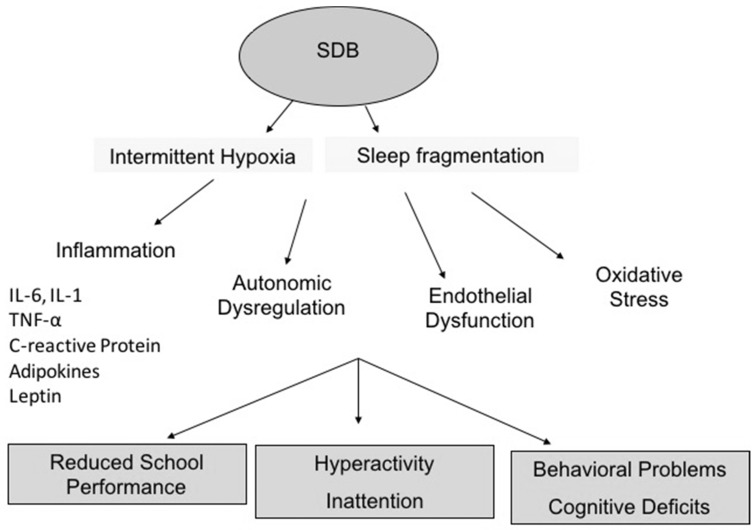
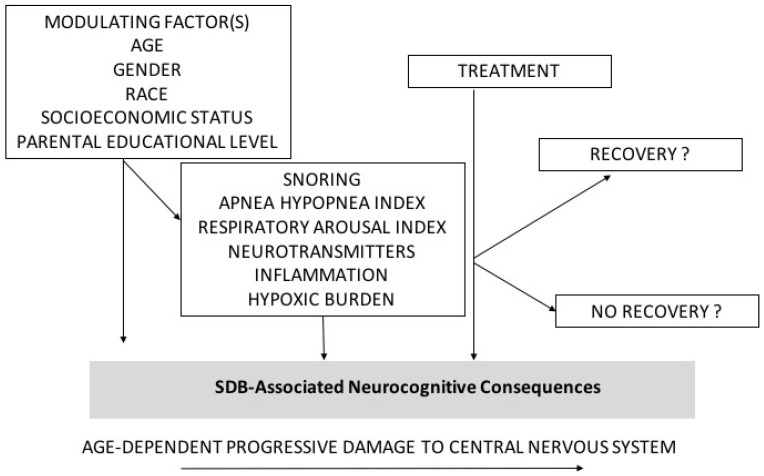
Sleep-disordered breathing (SDB) is a prevalent disease in children characterized by snoring and narrowing of the upper airway leading to gas exchange abnormalities during sleep as well as sleep fragmentation. SDB has been consistently associated with problematic behaviors and adverse neurocognitive consequences in children but causality and determinants of susceptibility remain incompletely defined. Since the 1990s several studies have enlightened these associations and consistently reported poorer academic performance, lower scores on neurocognitive tests, and behavioral abnormalities in children suffering from SDB. However, not all children with SDB develop such consequences, and severity of SDB based on standard diagnostic indices has often failed to discriminate among those children with or without neurocognitive risk. Accordingly, a search for discovery of markers and clinically useful tools that can detect those children at risk for developing cognitive and behavioral deficits has been ongoing. Here, we review the advances in this field and the search for possible detection approaches and unique phenotypes of children with SDB who are at greater risk of developing neurocognitive consequences.
睡眠呼吸障碍(SDB)是一种在儿童中普遍存在的疾病,其特征为打鼾以及上呼吸道狭窄,导致睡眠期间气体交换异常和睡眠片段化。SDB一直与儿童的问题行为和不良神经认知后果相关,但因果关系和易感性的决定因素仍未完全明确。自20世纪90年代以来,多项研究揭示了这些关联,并一致报告称,患有SDB的儿童学业成绩较差、神经认知测试得分较低且存在行为异常。然而,并非所有患有SDB的儿童都会出现这些后果,基于标准诊断指标的SDB严重程度往往无法区分那些有或没有神经认知风险的儿童。因此,一直在寻找能够检测出有发展为认知和行为缺陷风险的儿童的标志物及临床有用工具。在此,我们回顾该领域的进展,以及寻找可能的检测方法和SDB患儿中更易出现神经认知后果的独特表型。