Drozd Arleta, Kotlęga Dariusz, Nowacki Przemysław, Ciećwież Sylwester, Trochanowski Tomasz, Szczuko Małgorzata
Department of Human Nutrition and Metabolomics, Pomeranian Medical University in Szczecin, 71-460 Szczecin, Poland.
Department of Pharmacology and Toxicology, University of Zielona Góra, 65-001 Zielona Góra, Poland.
Biomedicines. 2022 Sep 6;10(9):2200. doi: 10.3390/biomedicines10092200.
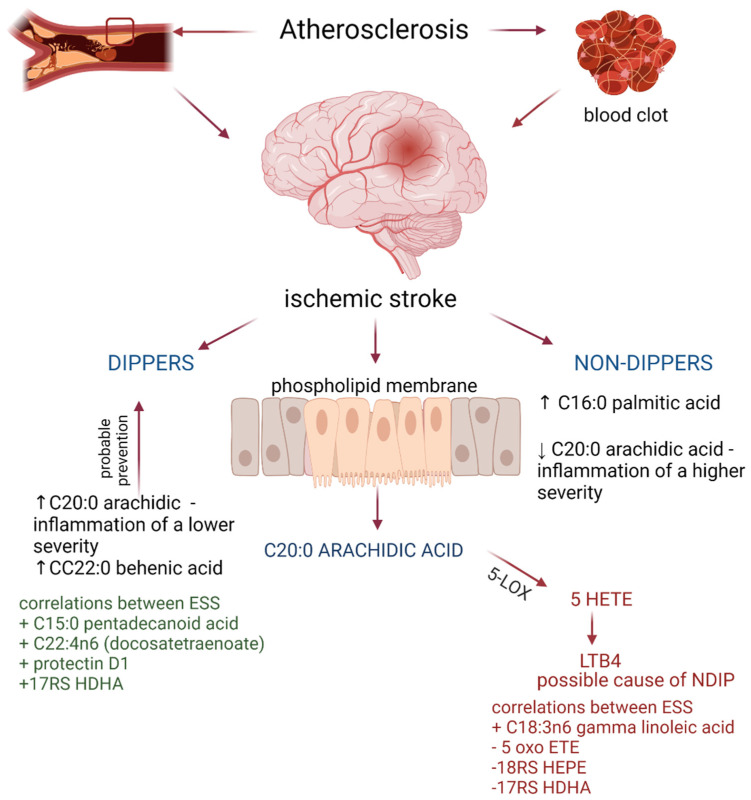
This paper discusses the role of inflammation in the pathogenesis of nondipping blood pressure and its role in the pathogenesis of obstructive sleep apnea syndrome. The aim of the study was to assess the impact of free fatty acids (FAs) and their inflammatory metabolites on the nondipping phenomenon and the risk of sleep apnea in stroke patients.
Sixty-four ischemic stroke patients were included in the prospective study. Group I consisted of 33 patients with a preserved physiological dipping effect (DIP), while group II included 31 patients with the nondipping phenomenon (NDIP). All subjects had FA gas chromatography and inflammatory metabolite measurements performed with the use of liquid chromatography, their 24 h blood pressure was recorded, and they were assessed with the Epworth sleepiness scale (ESS).
In the nondipping group a higher level of C16:0 palmitic acid was observed, while lower levels were observed in regard to C20:0 arachidic acid, C22:0 behenic acid and C24:1 nervonic acid. A decreased leukotriene B4 level was recorded in the nondipping group. None of the FAs and derivatives correlated with the ESS scale in the group of patients after stroke. Correlations were observed after dividing into the DIP and NDIP groups. In the DIP group, a higher score of ESS was correlated with numerous FAs and derivatives. Inflammation of a lower degree and a higher level of anti-inflammatory mediators from EPA and DHA acids favored the occurrence of the DIP. A high level of C18: 3n6 gamma linoleic acid indicating advanced inflammation, intensified the NDIP effect.
We demonstrated potential novel associations between the FA levels and eicosanoids in the pathogenesis of the nondipping phenomenon. There are common connections between fatty acids, their metabolites, inflammation, obstructive sleep apnea syndrome and nondipping in stroke patients.
本文讨论炎症在非勺型血压发病机制中的作用及其在阻塞性睡眠呼吸暂停综合征发病机制中的作用。本研究的目的是评估游离脂肪酸(FAs)及其炎症代谢产物对中风患者非勺型现象和睡眠呼吸暂停风险的影响。
64例缺血性中风患者纳入前瞻性研究。第一组由33例具有保留的生理性勺型效应(DIP)的患者组成,而第二组包括31例具有非勺型现象(NDIP)的患者。所有受试者均进行了脂肪酸气相色谱分析,并使用液相色谱法测量炎症代谢产物,记录其24小时血压,并采用爱泼华嗜睡量表(ESS)进行评估。
在非勺型组中观察到较高水平的C16:0棕榈酸,而在C20:0花生酸、C22:0山嵛酸和C24:1神经酸方面观察到较低水平。非勺型组中白三烯B4水平降低。中风后患者组中,没有一种脂肪酸及其衍生物与ESS量表相关。在分为DIP组和NDIP组后观察到相关性。在DIP组中,较高的ESS评分与多种脂肪酸及其衍生物相关。较低程度的炎症以及来自EPA和DHA酸的较高水平的抗炎介质有利于勺型效应的发生。高水平的C18:3n6γ-亚麻酸表明炎症进展,加剧了非勺型效应。
我们证明了脂肪酸水平和类花生酸在非勺型现象发病机制中潜在的新关联。脂肪酸、其代谢产物、炎症、阻塞性睡眠呼吸暂停综合征以及中风患者的非勺型之间存在共同联系。