Zadran Amanullah, Ho An V D, Zadran Layma, Ventura Curiel Irene J, Pham Tang-Tung, Thuan Duong Thi Bich, Kost Gerald J
Point-of-Care Testing Center for Teaching and Research (POCT CTRTM) Pathology and Laboratory Medicine, School of Medicine, University of California, Davis, CA 95616, USA.
Department of Orthopedics and Rehabilitation, University of Medicine and Pharmacy at Ho Chi Minh City, Ho Chi Minh City 70000, Vietnam.
Diagnostics (Basel). 2022 Aug 24;12(9):2047. doi: 10.3390/diagnostics12092047.
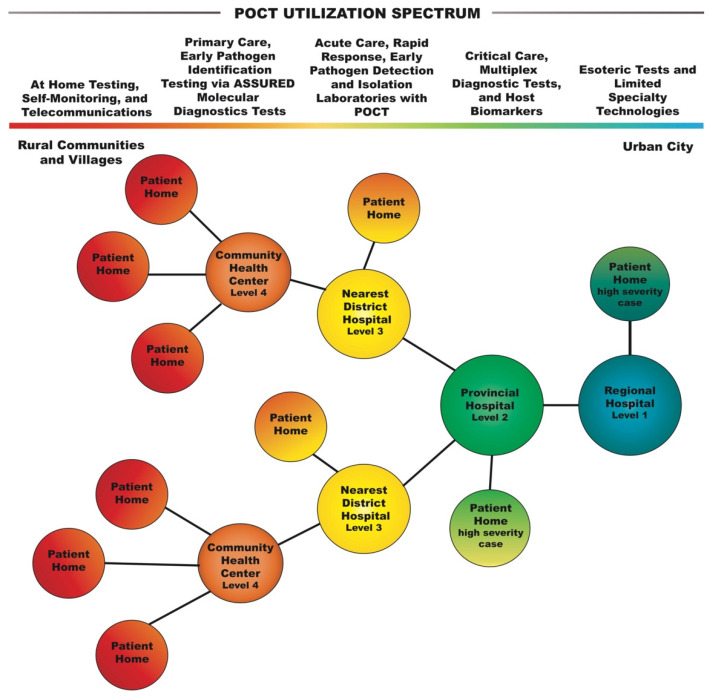
Our primary objectives were (a) to determine the need for and the availability of point-of-care testing (POCT) for infectious diseases and (b) to recommend point-of-care testing strategies and Spatial Care Paths (SCPs) that enhance public health preparedness in the regional districts of Thua Thien Hue Province (TTHP), Central Vietnam, where we conducted field surveys. Medical professionals in seven community health centers (CHCs), seven district hospitals (DHs) and one provincial hospital (PH) participated. Survey questions (English and Vietnamese) determined the status of diagnostic testing capabilities for infectious diseases and other acute medical challenges in TTHP. Infectious disease testing was limited: six of seven CHCs (86%) lacked infectious disease tests. One CHC (14%, 1/7) had two forms of diagnostic tests available for the detection of malaria. All CHCs lacked adequate microbiology laboratories. District hospitals had few diagnostic tests for infectious diseases (tuberculosis and syphilis), blood culture (29%, 2/7), and pathogen culture (57%, 4/7) available. The PH had broader diagnostic testing capabilities but lacked preparedness for highly infectious disease threats (e.g., Ebola, MERS-CoV, SARS, Zika, and monkeypox). All sites reported having COVID-19 rapid antigen tests; COVID-19 RT-PCR tests were limited to higher-tier hospitals. We conclude that infectious disease diagnostic testing should be improved and POC tests must be supplied near patients' homes and in primary care settings for the early detection of infected individuals and the mitigation of the spread of new COVID-19 variants and other highly infectious diseases.
(a)确定传染病即时检测(POCT)的需求和可用性;(b)推荐即时检测策略和空间护理路径(SCP),以加强越南中部承天顺化省(TTHP)各地区的公共卫生防范能力,我们在这些地区进行了实地调查。七家社区卫生中心(CHC)、七家 district 医院(DH)和一家省级医院(PH)的医学专业人员参与了调查。调查问题(英文和越南文)确定了 TTHP 传染病诊断检测能力以及其他急性医疗挑战的现状。传染病检测有限:七家 CHC 中有六家(86%)缺乏传染病检测。一家 CHC(14%,1/7)有两种用于检测疟疾的诊断测试。所有 CHC 都缺乏足够的微生物实验室。district 医院可用于传染病(结核病和梅毒)、血培养(29%,2/7)和病原体培养(57%,4/7)的诊断测试很少。省级医院具有更广泛的诊断检测能力,但缺乏应对高传染性疾病威胁(如埃博拉、中东呼吸综合征冠状病毒、非典、寨卡病毒和猴痘)的准备。所有场所均报告有新冠病毒快速抗原检测;新冠病毒逆转录聚合酶链反应检测仅限于上级医院。我们得出结论,应改进传染病诊断检测,必须在患者家中附近和基层医疗环境中提供即时检测,以便早期发现感染者,并减轻新冠病毒新变种和其他高传染性疾病的传播。