Department of Radiotherapy, Veneto Institute of Oncology IOV-IRCCS, 35128 Padua, Italy.
Department of Biology, University of Padua, 35131 Padua, Italy.
Int J Mol Sci. 2022 Sep 6;23(18):10211. doi: 10.3390/ijms231810211.
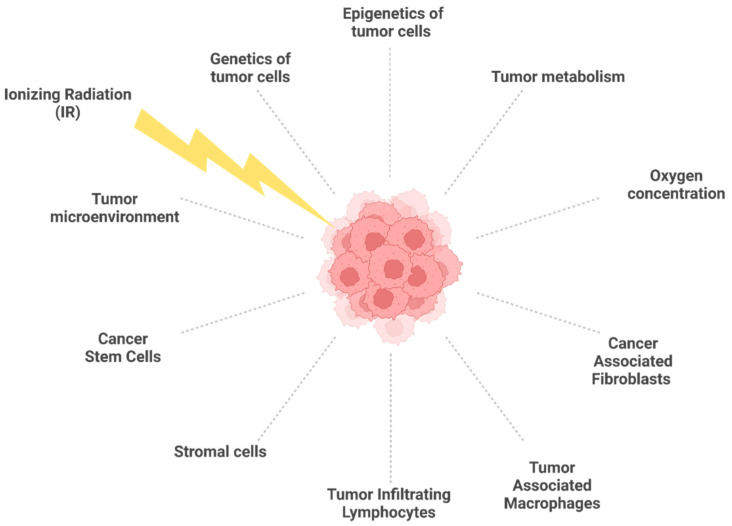
Cancer treatment with ionizing radiation (IR) is a well-established and effective clinical method to fight different types of tumors and is a palliative treatment to cure metastatic stages. Approximately half of all cancer patients undergo radiotherapy (RT) according to clinical protocols that employ two types of ionizing radiation: sparsely IR (i.e., X-rays) and densely IR (i.e., protons). Most cancer cells irradiated with therapeutic doses exhibit radio-induced cytotoxicity in terms of cell proliferation arrest and cell death by apoptosis. Nevertheless, despite the more tailored advances in RT protocols in the last few years, several tumors show a relatively high percentage of RT failure and tumor relapse due to their radioresistance. To counteract this extremely complex phenomenon and improve clinical protocols, several factors associated with radioresistance, of both a molecular and cellular nature, must be considered. Tumor genetics/epigenetics, tumor microenvironment, tumor metabolism, and the presence of non-malignant cells (i.e., fibroblast-associated cancer cells, macrophage-associated cancer cells, tumor-infiltrating lymphocytes, endothelial cells, cancer stem cells) are the main factors important in determining the tumor response to IR. Here, we attempt to provide an overview of how such factors can be taken advantage of in clinical strategies targeting radioresistant tumors.
用电离辐射(IR)治疗癌症是一种成熟且有效的临床方法,可用于治疗不同类型的肿瘤,也是治疗转移性阶段的姑息疗法。根据采用两种电离辐射的临床方案,大约一半的癌症患者接受放射治疗(RT):稀疏电离辐射(即 X 射线)和密集电离辐射(即质子)。大多数接受治疗剂量照射的癌细胞会因细胞增殖停滞和细胞凋亡而表现出放射性细胞毒性。然而,尽管近年来 RT 方案在更具针对性方面取得了进展,但由于肿瘤的放射抗性,仍有相当比例的肿瘤显示 RT 失败和肿瘤复发。为了对抗这种极其复杂的现象并改进临床方案,必须考虑与放射抗性相关的几个因素,包括分子和细胞特性。肿瘤遗传学/表观遗传学、肿瘤微环境、肿瘤代谢以及非恶性细胞(即成纤维细胞相关癌细胞、巨噬细胞相关癌细胞、肿瘤浸润淋巴细胞、内皮细胞、癌症干细胞)的存在是决定肿瘤对 IR 反应的主要因素。在这里,我们试图概述如何在针对放射抗性肿瘤的临床策略中利用这些因素。