Cardiac Arrhythmia Service and Cardiovascular Research Center (S.A.L.), Massachusetts General Hospital, Boston, MA.
Harvard Medical School, Boston, MA (S.A.L., S.J.A., D.E.S., A.S.F.).
Circulation. 2022 Nov 8;146(19):1415-1424. doi: 10.1161/CIRCULATIONAHA.122.060291. Epub 2022 Sep 23.
Morbidity from undiagnosed atrial fibrillation (AF) may be preventable with early detection. Many consumer wearables contain optical photoplethysmography (PPG) sensors to measure pulse rate. PPG-based software algorithms that detect irregular heart rhythms may identify undiagnosed AF in large populations using wearables, but minimizing false-positive detections is essential.
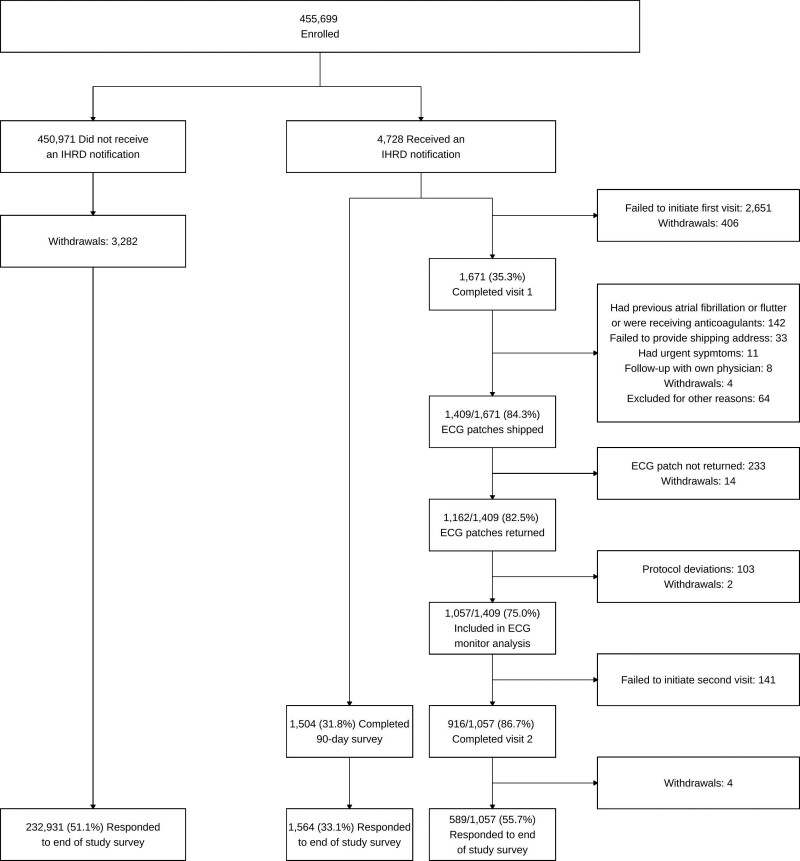
We performed a prospective remote clinical trial to examine a novel PPG-based algorithm for detecting undiagnosed AF from a range of wrist-worn devices. Adults aged ≥22 years in the United States without AF, using compatible wearable Fitbit devices and Android or iOS smartphones, were included. PPG data were analyzed using a novel algorithm that examines overlapping 5-minute pulse windows (tachograms). Eligible participants with an irregular heart rhythm detection (IHRD), defined as 11 consecutive irregular tachograms, were invited to schedule a telehealth visit and were mailed a 1-week ambulatory ECG patch monitor. The primary outcome was the positive predictive value of the first IHRD during ECG patch monitoring for concurrent AF.
A total of 455 699 participants enrolled (median age 47 years, 71% female, 73% White) between May 6 and October 1, 2020. IHRDs occurred for 4728 (1%) participants, and 2070 (4%) participants aged ≥65 years during a median of 122 (interquartile range, 110-134) days at risk for an IHRD. Among 1057 participants with an IHRD notification and subsequent analyzable ECG patch monitor, AF was present in 340 (32.2%). Of the 225 participants with another IHRD during ECG patch monitoring, 221 had concurrent AF on the ECG and 4 did not, resulting in an IHRD positive predictive value of 98.2% (95% CI, 95.5%-99.5%). For participants aged ≥65 years, the IHRD positive predictive value was 97.0% (95% CI, 91.4%-99.4%).
A novel PPG software algorithm for wearable Fitbit devices exhibited a high positive predictive value for concurrent AF and identified participants likely to have AF on subsequent ECG patch monitoring. Wearable devices may facilitate identifying individuals with undiagnosed AF.
URL: https://www.
gov; Unique identifier: NCT04380415.
通过早期检测,可能可以预防未确诊的心房颤动(AF)引起的发病。许多消费类可穿戴设备都包含光学光电容积描记法(PPG)传感器来测量脉搏率。基于 PPG 的软件算法可以通过可穿戴设备在大人群中识别未确诊的 AF,但最小化假阳性检测至关重要。
我们进行了一项前瞻性远程临床试验,以检查一种新的基于 PPG 的算法,用于从各种腕戴设备中检测未确诊的 AF。年龄在 22 岁及以上、使用兼容的 Fitbit 可穿戴设备和 Android 或 iOS 智能手机的美国成年人无 AF 病史,均被纳入研究。使用一种新的算法分析 PPG 数据,该算法检查重叠的 5 分钟脉搏窗口(tachograms)。符合以下条件的参与者被邀请进行远程医疗访问并邮寄为期一周的动态心电图贴片监测器:存在不规则心律检测(IHRD),定义为 11 次连续不规则 tachograms。
共有 455699 名参与者于 2020 年 5 月 6 日至 10 月 1 日期间登记(中位年龄 47 岁,71%为女性,73%为白人)。有 4728 名(1%)参与者出现 IHRD,2070 名(4%)年龄≥65 岁的参与者在中位 122(四分位间距,110-134)天的 IHRD 风险期间出现 IHRD。在 1057 名有 IHRD 通知和随后可分析的心电图贴片监测的参与者中,340 名(32.2%)存在 AF。在心电图贴片监测期间又出现 IHRD 的 225 名参与者中,221 名心电图显示 AF,4 名没有,因此 IHRD 的阳性预测值为 98.2%(95%CI,95.5%-99.5%)。对于年龄≥65 岁的参与者,IHRD 的阳性预测值为 97.0%(95%CI,91.4%-99.4%)。
适用于 Fitbit 可穿戴设备的新型 PPG 软件算法对并发 AF 具有较高的阳性预测值,并能识别出随后在心电图贴片监测中可能患有 AF 的参与者。可穿戴设备可能有助于识别未确诊的 AF 患者。
网址:https://www.
gov;唯一标识符:NCT04380415.