Department of Internal Medicine.
Department of Medicine, Division of Cardiology.
Am J Med. 2023 Jan;136(1):63-71.e1. doi: 10.1016/j.amjmed.2022.08.035. Epub 2022 Sep 21.
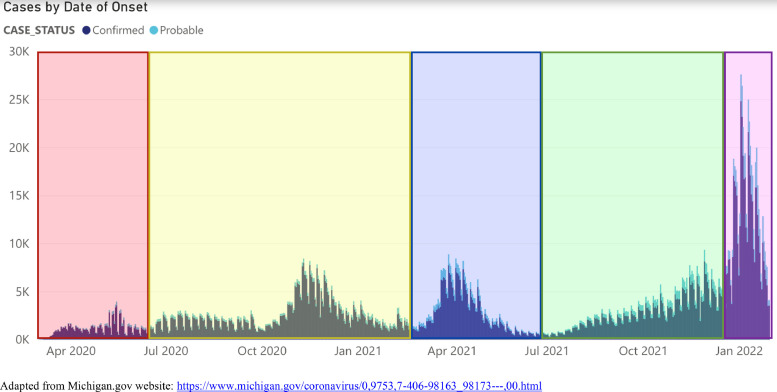
The coronavirus disease 2019 (COVID-19) pandemic has unfolded in distinct surges. Understanding how surges differ may reveal important insights into the evolution of the pandemic and improve patient care.
We leveraged the Michigan Medicine COVID-19 Cohort, a prospective observational study at an academic tertiary medical center that systematically enrolled 2309 consecutive patients hospitalized for COVID-19, comprising 5 distinct surges.
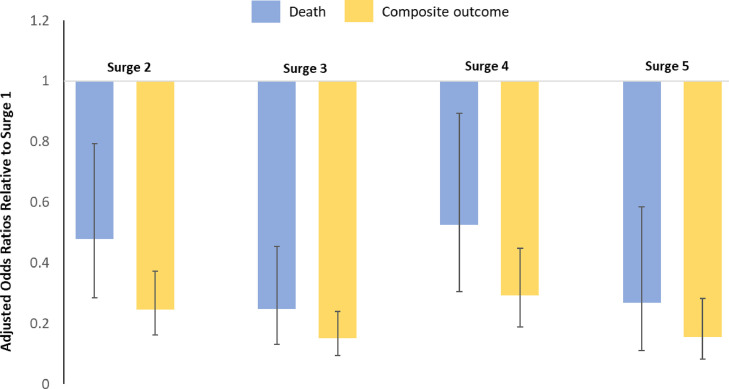
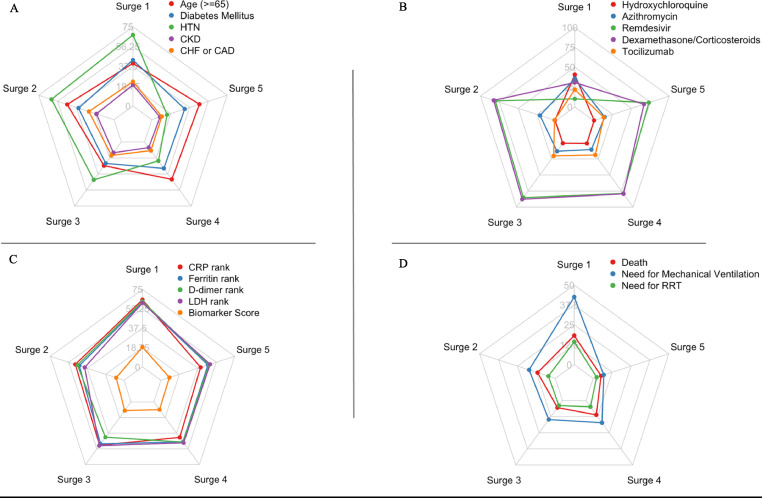
As the pandemic evolved, patients hospitalized for COVID-19 tended to have a lower burden of comorbidities and a lower inflammatory burden as measured by admission levels of C-reactive protein, ferritin, lactate dehydrogenase, and D-dimer. Use of hydroxychloroquine and azithromycin decreased substantially after Surge 1, while use of corticosteroids and remdesivir markedly increased (P < .001 for all). In-hospital mortality significantly decreased from 18.3% in Surge 1 to 5.3% in Surge 5 (P < .001). The need for mechanical ventilation significantly decreased from 42.5% in Surge 1 to 7.0% in Surge 5 (P < .001), while the need for renal replacement therapy decreased from 14.4% in Surge 1 to 2.3% in Surge 5 (P < .001). Differences in patient characteristics, treatments, and inflammatory markers accounted only partially for the differences in outcomes between surges.
The COVID-19 pandemic has evolved significantly with respect to hospitalized patient populations and therapeutic approaches, and clinical outcomes have substantially improved. Hospitalization after the first surge was independently associated with improved outcomes, even after controlling for relevant clinical covariates.
2019 年冠状病毒病(COVID-19)大流行呈明显的波浪式发展。了解波浪式变化的差异可能会揭示大流行演变的重要见解,并改善患者的治疗效果。
我们利用密歇根大学医学 COVID-19 队列,这是一项在学术三级医疗中心进行的前瞻性观察性研究,该研究系统地招募了 2309 名连续住院的 COVID-19 患者,包括 5 个不同的波浪式发展。
随着大流行的发展,COVID-19 住院患者的合并症负担和炎症负担较低,入院时 C 反应蛋白、铁蛋白、乳酸脱氢酶和 D-二聚体水平均较低。在第一波浪式发展后,羟氯喹和阿奇霉素的使用量大幅下降,而皮质类固醇和瑞德西韦的使用量显著增加(所有 P 值均<.001)。住院死亡率从第一波浪式发展的 18.3%显著下降至第五波浪式发展的 5.3%(P<.001)。需要机械通气的比例从第一波浪式发展的 42.5%显著下降至第五波浪式发展的 7.0%(P<.001),而需要肾脏替代治疗的比例从第一波浪式发展的 14.4%下降至第五波浪式发展的 2.3%(P<.001)。患者特征、治疗方法和炎症标志物的差异仅部分解释了波浪式发展之间的结果差异。
COVID-19 大流行在住院患者人群和治疗方法方面发生了显著变化,临床结果有了显著改善。与第一波浪式发展相比,第一波浪式发展后的住院与改善的结果相关,即使在控制了相关临床协变量后也是如此。