Clinical Epidemiology Division, Department of Medicine Solna, Karolinska Institutet, Stockholm, Sweden
Rheumatology, Karolinska University Hospital, Stockholm, Sweden.
Ann Rheum Dis. 2023 Feb;82(2):189-197. doi: 10.1136/ard-2022-223050. Epub 2022 Sep 23.
To assess and compare the incidence of venous thromboembolism (VTE) in patients with rheumatoid arthritis (RA) treated with Janus kinase inhibitors (JAKi), tumour necrosis factor inhibitors (TNFi) or other biological disease modifying antirheumatic drugs (bDMARDs). For contextualisation, to assess VTE incidences in the Swedish general population and in the RA source population.
We performed a nationwide register-based, active comparator, new user design cohort study in Sweden from 2010 to 2021. The Swedish Rheumatology Quality Register was linked to national health registers to identify treatment cohorts (exposure) of initiators of a JAKi, a TNFi, or a non-TNFi bDMARD (n=32 737 treatment initiations). We also identified a general population cohort (matched 1:5, n=92 108), and an 'overall RA' comparator cohort (n=85 722). Outcome was time to first VTE during the follow-up, overall and by deep vein thrombosis (DVT) and pulmonary embolism (PE). We calculated incidence rates (IR) and multivariable-adjusted HRs using Cox regression.
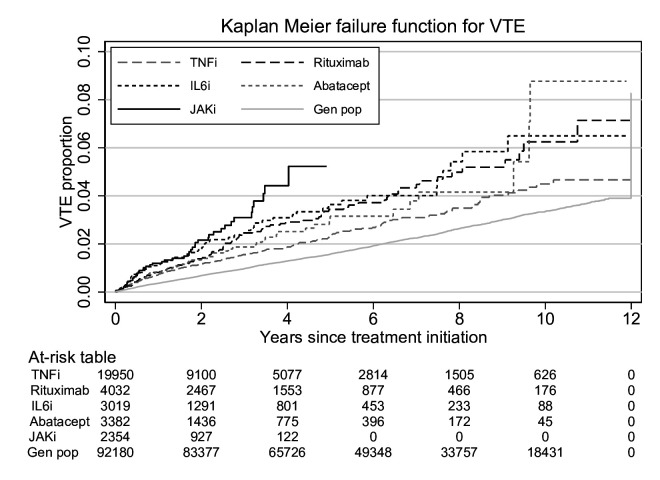
Based on 559 incident VTE events, the age- and sex-standardised (to TNFi) IR (95% CI) for VTE was 5.15 per 1000 person-years (4.58 to 5.78) for patients treated with TNFi, 11.33 (8.54 to 15.04) for patients treated with JAKi, 5.86 (5.69 to 6.04) in the overall RA cohort and 3.28 (3.14 to 3.43) in the general population. The fully adjusted HR (95% CI) for VTE with JAKi versus TNFi was 1.73 (1.24 to 2.42), the corresponding HR for PE was 3.21 (2.11 to 4.88) and 0.83 (0.47 to 1.45) for DVT.
Patients with RA treated with JAKi in clinical practice are at increased risk of VTE compared with those treated with bDMARDs, an increase numerically confined to PE.
评估和比较接受 Janus 激酶抑制剂(JAKi)、肿瘤坏死因子抑制剂(TNFi)或其他生物改善抗风湿药物(bDMARD)治疗的类风湿关节炎(RA)患者的静脉血栓栓塞(VTE)发生率。为了进行背景评估,还评估了瑞典普通人群和 RA 源人群中的 VTE 发生率。
我们在瑞典进行了一项基于全国登记的、活性对照的、新用户设计的队列研究,时间范围为 2010 年至 2021 年。瑞典风湿病质量登记与国家健康登记相关联,以确定 JAKi、TNFi 或非 TNFi bDMARD 的起始治疗队列(暴露)(n=32737 例治疗起始)。我们还确定了一个普通人群队列(匹配 1:5,n=92108)和一个“总体 RA”对照队列(n=85722)。随访期间的首要 VTE 是结局,总体和深静脉血栓形成(DVT)和肺栓塞(PE)分别进行评估。我们使用 Cox 回归计算发病率(IR)和多变量调整后的 HR。
根据 559 例新发 VTE 事件,TNFi 标准化(标准化至 TNFi)的年龄和性别调整的 VTE 发病率(IR)(95%CI)为接受 TNFi 治疗的患者为 5.15/1000 人年(4.58 至 5.78),接受 JAKi 治疗的患者为 11.33/1000 人年(8.54 至 15.04),总体 RA 队列为 5.86/1000 人年(5.69 至 6.04),普通人群为 3.28/1000 人年(3.14 至 3.43)。JAKi 与 TNFi 相比 VTE 的完全调整 HR(95%CI)为 1.73(1.24 至 2.42),PE 的相应 HR 为 3.21(2.11 至 4.88),DVT 为 0.83(0.47 至 1.45)。
与接受 bDMARD 治疗的患者相比,临床实践中接受 JAKi 治疗的 RA 患者 VTE 风险增加,增加的风险在数值上仅限于 PE。