Division of Rheumatology, Department of Internal Medicine, Seoul National University Bundang Hospital, 166 Gumiro Bundang-gu Kyeongki-do, Seongnam-si, South Korea.
Department of Internal Medicine, Seoul National University College of Medicine, Seoul, South Korea.
Arthritis Res Ther. 2023 Jul 26;25(1):129. doi: 10.1186/s13075-023-03111-w.
To compare infectious risk between JAK inhibitors (JAKis) versus TNF inhibitors (TNFis) among rheumatoid arthritis (RA) patients in Korea.
Using 2009-2019 Korea National Health Insurance Service database, we conducted a cohort study on RA patients initiating a JAKi or TNFi. The primary outcomes were herpes zoster (HZ), serious bacterial (SBI), and opportunistic infections (OI). Propensity-score fine-stratification (PSS) and weighting were applied to adjust for > 70 baseline covariates. Hazard ratios (HRs) and 95% confidence intervals (CIs) were estimated using Cox proportional hazard models comparing JAKi versus TNFi users.
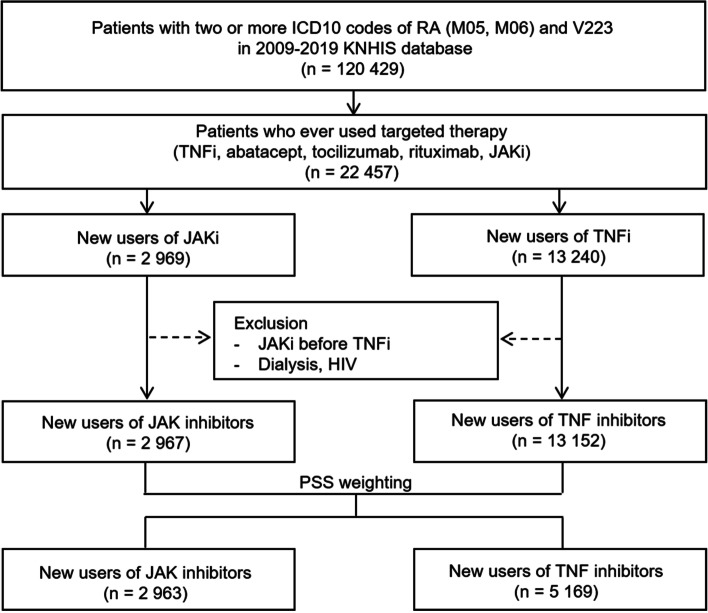
We included 2963 JAKi initiators PSS-weighted on 5169 TNFi initiators. During a follow-up of 1.16 years, the most frequent type of infections was HZ with incidence rate (IR) per 100 person-years of 11.54 and 4.88 in JAKi and TNFi users, respectively. The IR of SBI was 1.39 and 1.32, respectively. The OI was rare with a majority being tuberculosis and showed an IR of 0.11 and 0.49 in JAKi and TNFi users, respectively. The PSS-weighted HR (95% CI) for individual types of infections was 2.37 (2.00-2.80) for HZ, 1.04 (0.71-1.52) for SBI, and 0.25 (0.09-0.73) for OI.
This population-based cohort study on RA patients treated with JAKi or TNFi in Korea showed an exceptionally high IR of HZ in both treatment groups compared to that from Western countries, with an approximately doubled risk associated with JAKi versus TNFi use. The risk of SBI was comparable, but the risk of OI, particularly tuberculosis, was less among JAKi than TNFi initiators.
比较韩国类风湿关节炎(RA)患者使用 JAK 抑制剂(JAKi)与 TNF 抑制剂(TNFis)的感染风险。
利用 2009-2019 年韩国国家健康保险服务数据库,我们对开始使用 JAKi 或 TNFi 的 RA 患者进行了队列研究。主要结局是带状疱疹(HZ)、严重细菌感染(SBI)和机会性感染(OI)。采用倾向评分精细分层(PSS)和加权法调整了>70 项基线协变量。使用 Cox 比例风险模型比较 JAKi 与 TNFi 使用者,估计了危险比(HR)和 95%置信区间(CI)。
我们纳入了 2963 名 PSS 加权的 JAKi 初治患者,共 5169 名 TNFi 初治患者。在 1.16 年的随访期间,最常见的感染类型是 HZ,JAKi 和 TNFi 使用者的发病率(IR)分别为每 100 人年 11.54 和 4.88。SBI 的 IR 分别为 1.39 和 1.32。OI 较为罕见,大多数为结核,IR 分别为 JAKi 和 TNFi 使用者的 0.11 和 0.49。各种类型感染的 PSS 加权 HR(95%CI)分别为 HZ 2.37(2.00-2.80)、SBI 1.04(0.71-1.52)和 OI 0.25(0.09-0.73)。
这项针对韩国接受 JAKi 或 TNFis 治疗的 RA 患者的基于人群的队列研究显示,与西方国家相比,两组治疗的 HZ 发病率极高,JAKi 与 TNFi 相比,风险增加约两倍。SBI 的风险相当,但 JAKi 初治者的 OI 风险,特别是结核感染风险低于 TNFi 初治者。