Pediatric Urology, Cengiz Gokcek Maternity and Children's Hospital, Gaziantep, Turkey.
Pediatrics, Cengiz Gokcek Maternity and Children's Hospital, Gaziantep, Turkey.
J Pediatr Urol. 2022 Oct;18(5):680.e1-680.e7. doi: 10.1016/j.jpurol.2022.08.018. Epub 2022 Sep 6.
SARS-COV-2 is associated with unexpected symptoms. Several studies in adults reported urinary frequency with COVID-19. The aim of this study is to reveal lower urinary tract symptoms associated with COVID-19 (CALUTS) in children.
PATIENTS-METHODS: All children diagnosed with COVID-19 and associated multisystem inflammatory syndrome in children (MIS-C) between November 2020-June 2021 in our hospital were reviewed and asked for urinary symptoms at the time of or following their disease. The ones reporting symptoms were invited for further evaluation. Parents were inquired for their child's former bladder and bowel function, their symptoms after the diagnosis of COVID-19 or MIS-C, onset and duration of the symptoms, and their current state. They were questioned for the frequency of voiding as well as dysuria, odor, and the presence of incontinence as well as other symptoms of COVID-19. The patients who reported symptoms at the time of inquiry were followed for cessation of symptoms. The parameters age, sex, need for hospitalization and admission to ICU were also compared to the whole group to evaluate the main characteristics of patients with lower urinary tract symptoms.
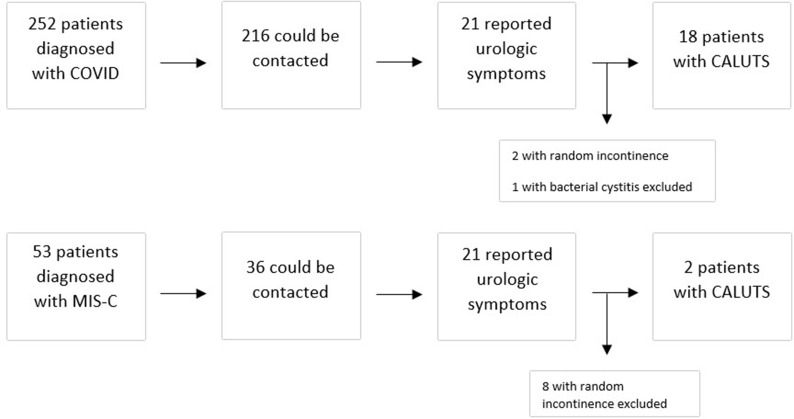
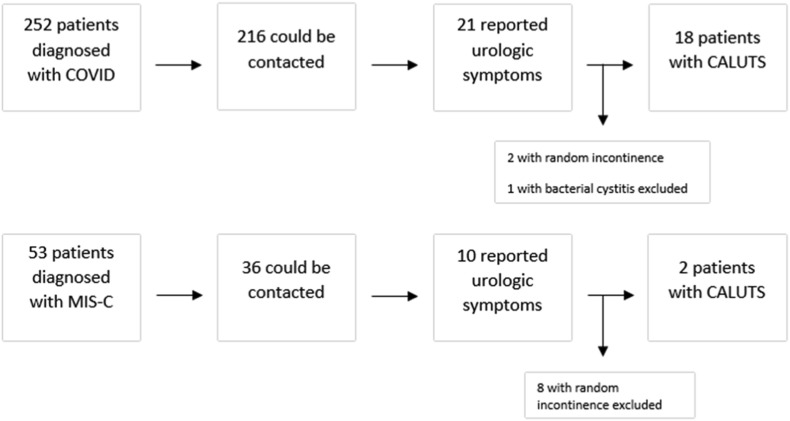
In total 20 patients (18/216 with acute disease and 2/36 with MIS-C) reported CALUTS (figure). Age and sex distribution were not significantly different from the patients without urinary symptoms (p = 0.777 and p = 0.141 respectively). All were otherwise healthy children with no concomitant chronic diseases other than overactive bladder in two. There were 13 girls and 7 boys. Mean age was 11 years (±5 years). Thirteen of the patients were older than 10 years; however, there were also 3 children under 5 years of age. All parents described a sudden onset of extremely increased urinary frequency and urgency lasting for weeks which disappeared gradually. Median bladder and bowel dysfunction questionnaire (BBDQ) score before COVID-19 was 2.5 (1-18) which increased to a median of 22 (15-29) at the time of the symptoms (p < 0.001). The timing of onset and duration of symptoms were variable and not associated with symptom severity (p = 0.306 and p = 0.450 respectively). Eight patients (40%) reported diarrhea. The duration of diarrhea was limited to less than one week in all.
Our study revealed that SARS-COV-2 can be associated with lower urinary tract symptoms also in children both during the acute phase and MIS-C. Further studies are necessary to understand the etiopathogenesis and prevalence of this unexpected aspect of COVID-19.
SARS-CoV-2 与意想不到的症状有关。几项针对成年人的研究报告了 COVID-19 与尿频有关。本研究的目的是揭示儿童 COVID-19 相关下尿路症状(CALUTS)。
患者-方法:对 2020 年 11 月至 2021 年 6 月期间在我院诊断为 COVID-19 和儿童多系统炎症综合征(MIS-C)的所有儿童进行了回顾,并在疾病发生时或之后询问他们的尿路症状。报告有症状的儿童被邀请进行进一步评估。询问家长孩子以前的膀胱和肠道功能、COVID-19 或 MIS-C 诊断后的症状、症状的开始和持续时间以及目前的状态。询问他们排尿频率以及尿痛、异味、尿失禁以及其他 COVID-19 症状。报告症状时进行随访以了解症状是否停止。还比较了年龄、性别、住院和入住 ICU 的需要等参数与整个组,以评估有下尿路症状患者的主要特征。
共有 20 名患者(18/216 名急性疾病患者和 2/36 名 MIS-C 患者)报告 CALUTS(图)。年龄和性别分布与无尿路症状的患者无显著差异(p=0.777 和 p=0.141)。所有患者均为其他健康儿童,除 2 例膀胱过度活动症外,无其他合并慢性疾病。其中女孩 13 名,男孩 7 名。平均年龄为 11 岁(±5 岁)。13 名患者年龄大于 10 岁;然而,也有 3 名儿童年龄小于 5 岁。所有家长均描述了突然出现的极度尿频和尿急,持续数周后逐渐消失。COVID-19 前膀胱和肠道功能障碍问卷(BBDQ)评分中位数为 2.5(1-18),症状出现时中位数增加至 22(15-29)(p<0.001)。症状的开始和持续时间不同,与症状严重程度无关(p=0.306 和 p=0.450)。8 名患者(40%)报告腹泻。所有患者的腹泻持续时间均不到一周。
本研究表明,SARS-CoV-2 也可引起儿童急性疾病和 MIS-C 期间的下尿路症状。需要进一步研究以了解 COVID-19 这一意外方面的病因和患病率。