Laros Sara S A, Dieckens Dennis, Blazis Stephan P, van der Heide Johannes A
Department of Medical Physics and Engineering, Albert Schweitzer Hospital, Afdeling Klinische Fysica - Medische Techniek, Albert Schweitzerplaats 25, 3318 AT, Dordrecht, The Netherlands.
Department of Nuclear Medicine, Albert Schweitzer Hospital, Dordrecht, The Netherlands.
EJNMMI Phys. 2022 Sep 24;9(1):66. doi: 10.1186/s40658-022-00494-8.
[F] FDG PET-CT has an important role in the initial staging of lung cancer; however, accurate differentiation between activity in malignant and benign intrathoracic lymph nodes on PET-CT scans can be challenging. The purpose of the current study was to investigate the effect of incorporating primary tumour data and clinical features to differentiate between [F] FDG-avid malignant and benign intrathoracic lymph nodes.
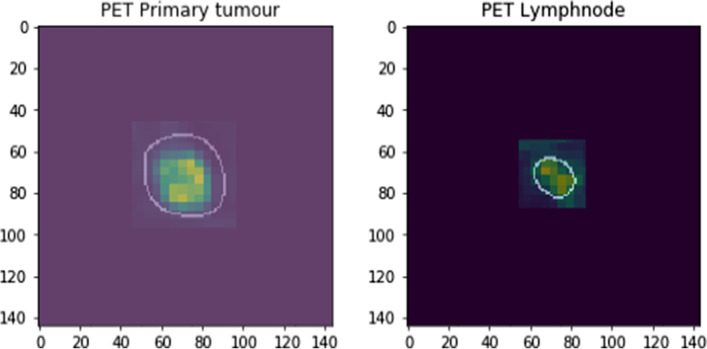
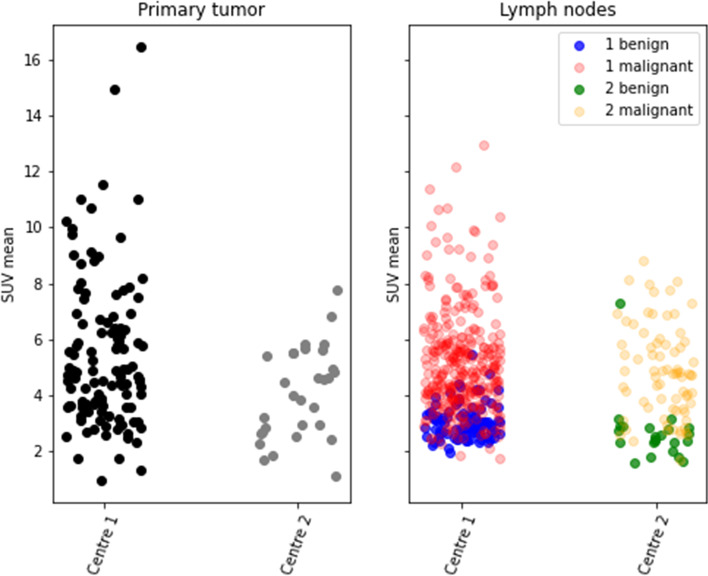
We retrospectively selected lung cancer patients who underwent PET-CT for initial staging in two centres in the Netherlands. The primary tumour and suspected lymph node metastases were annotated and cross-referenced with pathology results. Lymph nodes were classified as malignant or benign. From the image data, we extracted radiomic features and trained the classifier model using the extreme gradient boost (XGB) algorithm. Various scenarios were defined by selecting different combinations of data input and clinical features. Data from centre 1 were used for training and validation of the models using the XGB algorithm. To determine the performance of the model in a different hospital, the XGB model was tested using data from centre 2.
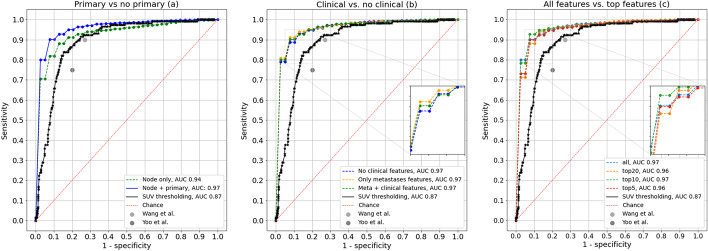
Adding primary tumour data resulted in a significant gain in the performance of the trained classifier model. Adding the clinical information about distant metastases did not lead to significant improvement. The performance of the model in the test set (centre 2) was slightly but statistically significantly lower than in the validation set (centre 1).
Using the XGB algorithm potentially leads to an improved model for the classification of intrathoracic lymph nodes. The inclusion of primary tumour data improved the performance of the model, while additional knowledge of distant metastases did not. In patients in whom metastases are limited to lymph nodes in the thorax, this may reduce costly and invasive procedures such as endobronchial ultrasound or mediastinoscopy procedures.
[F] FDG PET-CT在肺癌的初始分期中具有重要作用;然而,在PET-CT扫描中准确区分恶性和良性胸内淋巴结的活性可能具有挑战性。本研究的目的是探讨纳入原发肿瘤数据和临床特征对区分[F] FDG摄取的恶性和良性胸内淋巴结的影响。
我们回顾性选择了在荷兰两个中心接受PET-CT进行初始分期的肺癌患者。对原发肿瘤和疑似淋巴结转移灶进行标注,并与病理结果进行交叉对照。淋巴结被分类为恶性或良性。从图像数据中,我们提取了影像组学特征,并使用极端梯度提升(XGB)算法训练分类器模型。通过选择不同的数据输入和临床特征组合定义了各种场景。中心1的数据用于使用XGB算法训练和验证模型。为了确定模型在另一家医院的性能,使用中心2的数据对XGB模型进行测试。
添加原发肿瘤数据使训练后的分类器模型性能显著提高。添加远处转移的临床信息并未带来显著改善。模型在测试集(中心2)中的性能略低于验证集(中心1),但具有统计学意义。
使用XGB算法可能会改进胸内淋巴结分类模型。纳入原发肿瘤数据提高了模型的性能,而远处转移的额外信息则没有。对于转移仅限于胸部淋巴结的患者,这可能会减少诸如支气管内超声或纵隔镜检查等昂贵且有创的检查。