Women's Hospital of Nanjing Medical University, Nanjing Maternity and Child Health Care Hospital, Nanjing, Jiangsu, China.
State Key Laboratory of Reproductive Medicine, School of Public Health, Nanjing Medical University, Nanjing, China.
mSystems. 2022 Oct 26;7(5):e0046522. doi: 10.1128/msystems.00465-22. Epub 2022 Sep 26.
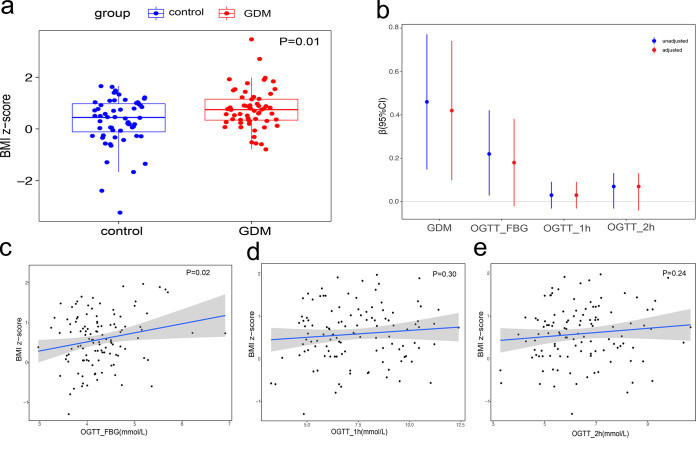
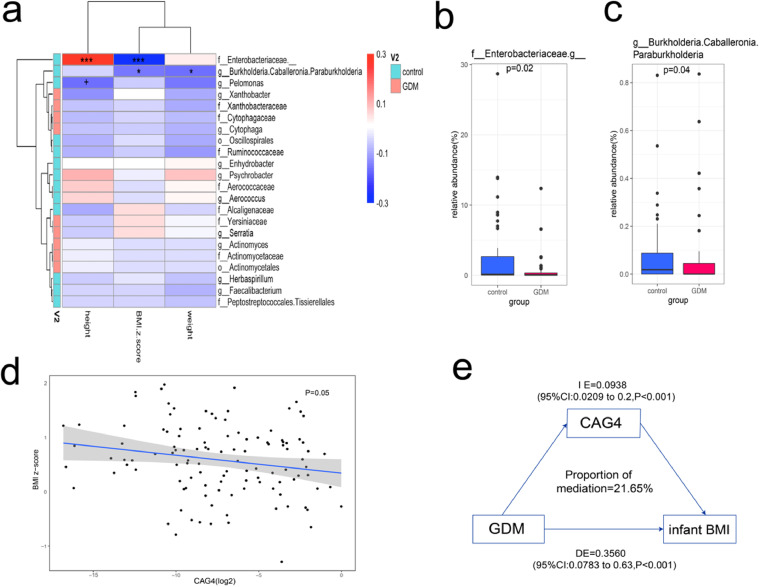
The connection between gestational diabetes mellitus (GDM) and the offspring's development, such as obesity, is well established. Emerging evidence indicates that the microbiota of the neonate's meconium is associated with maternal GDM status. To explore whether the association between GDM and infant body mass index (BMI) in early childhood is affected by the meconium microbiota, we recruited 120 mothers (60 healthy women and 60 with GDM) and their newborns from the Women's Hospital of Nanjing Medical University. Meconium of 120 neonates was collected within a few hours after birth and sequenced using 16S rRNA sequencing analysis. Children's BMI was measured at 12 months of age. The results revealed that infants born to mothers with GDM had increased BMI Z-scores at 12 months old and that the β-diversity of their meconium microbiota was reduced. Several genera were observed to be significantly different between the GDM and control groups. The genus and an untitled genus in the family enriched in neonates born to healthy mothers were found to be negatively associated with infant BMI by using regression analysis. A coabundance group depleted in the GDM group was correlated negatively with 12-month BMI and mediated 21.65% of the association between GDM and infant BMI by mediation analyses. This study provided evidence for the associations among maternal GDM, the meconium microbiota, and infant BMI. Maternal GDM was demonstrated to affect infant BMI, mediated by the gut microbiome. Gut microbiome interventions might represent a novel technique to decrease the risk of GDM-induced childhood obesity. Using 16S rRNA sequencing analysis, regression analysis and mediation analysis were used to explore whether maternal gestational diabetes mellitus (GDM) changed the function and composition of the meconium microbiota and whether this explained the GDM-induced alterations of infant body mass index (BMI). This study showed that gut microbiome dysbiosis induced by maternal GDM might play an important role in the increased infant BMI during the first 12 months of life. Therefore, gut microbiome interventions might represent a novel technique to decrease the risk of GDM-induced childhood obesity.
妊娠糖尿病(GDM)与后代发育的关系,如肥胖,已得到充分证实。新出现的证据表明,新生儿胎粪中的微生物群与母亲 GDM 状态有关。为了探索 GDM 与婴儿出生后 12 个月内的 BMI 是否受胎粪微生物群的影响,我们招募了 120 名母亲(60 名健康女性和 60 名 GDM 女性)及其新生儿,来自南京医科大学附属妇产医院。在新生儿出生后数小时内采集 120 名新生儿的胎粪,并进行 16S rRNA 测序分析。在 12 个月时测量儿童的 BMI。结果表明,GDM 母亲所生婴儿在 12 个月时的 BMI Z 评分增加,胎粪微生物群的 β 多样性减少。观察到一些属在 GDM 组和对照组之间存在显著差异。在回归分析中,发现健康母亲所生婴儿中丰富的属和科中未命名属与婴儿 BMI 呈负相关。通过中介分析,GDM 组中减少的共现群与 12 个月时的 BMI 呈负相关,与 GDM 和婴儿 BMI 之间的关联中介了 21.65%。本研究为 GDM 母亲、胎粪微生物群和婴儿 BMI 之间的关联提供了证据。研究表明,GDM 母亲会影响婴儿的 BMI,这是由肠道微生物群介导的。肠道微生物组干预可能是降低 GDM 引起的儿童肥胖风险的一种新方法。使用 16S rRNA 测序分析、回归分析和中介分析,探讨了母体妊娠糖尿病(GDM)是否改变了胎粪微生物群的功能和组成,以及这是否解释了 GDM 引起的婴儿体重指数(BMI)的变化。这项研究表明,GDM 引起的肠道微生物组失调可能在婴儿出生后 12 个月内 BMI 增加中发挥重要作用。因此,肠道微生物组干预可能是降低 GDM 引起的儿童肥胖风险的一种新方法。