Mascarenhas Saraiva Miguel, Ribeiro Tiago, Afonso João, Ferreira João P S, Cardoso Hélder, Andrade Patrícia, Parente Marco P L, Jorge Renato N, Macedo Guilherme
Department of Gastroenterology, São João University Hospital, Porto, Portugal.
WGO Gastroenterology and Hepatology Training Center, Porto, Portugal.
GE Port J Gastroenterol. 2021 Sep 27;29(5):331-338. doi: 10.1159/000518901. eCollection 2022 Sep.
Capsule endoscopy has revolutionized the management of patients with obscure gastrointestinal bleeding. Nevertheless, reading capsule endoscopy images is time-consuming and prone to overlooking significant lesions, thus limiting its diagnostic yield. We aimed to create a deep learning algorithm for automatic detection of blood and hematic residues in the enteric lumen in capsule endoscopy exams.
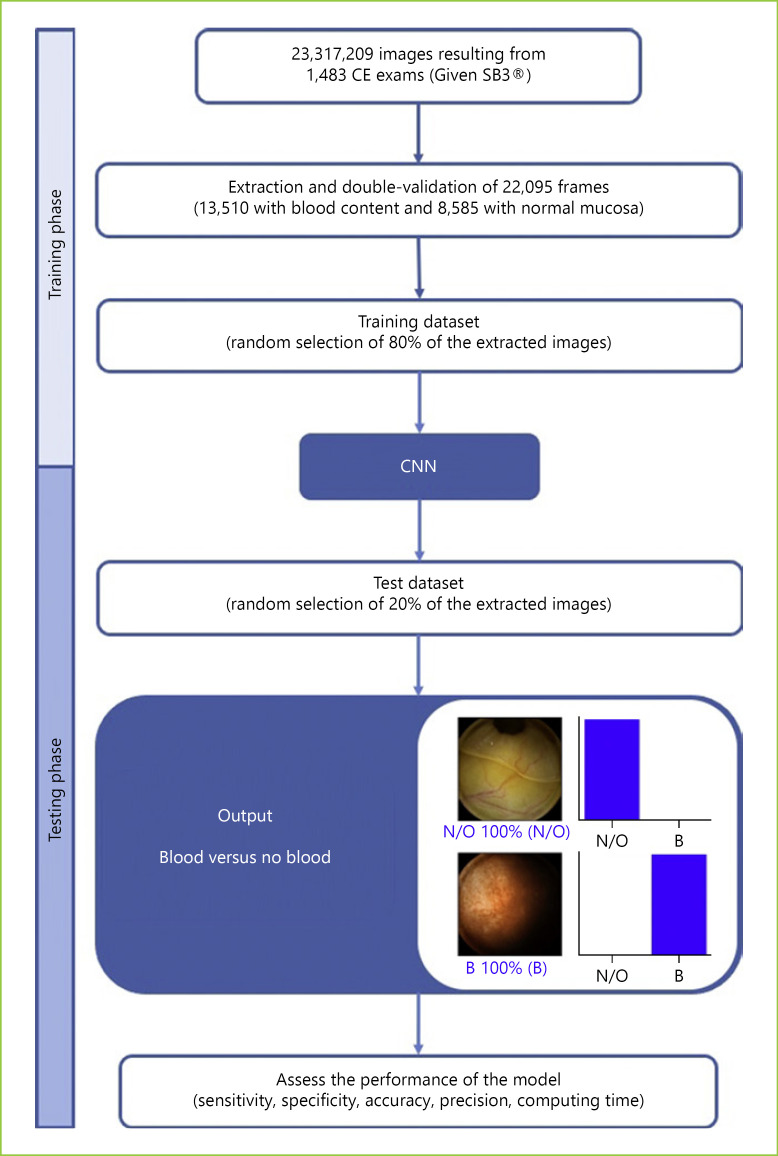
A convolutional neural network was developed based on a total pool of 22,095 capsule endoscopy images (13,510 images containing luminal blood and 8,585 of normal mucosa or other findings). A training dataset comprising 80% of the total pool of images was defined. The performance of the network was compared to a consensus classification provided by 2 specialists in capsule endoscopy. Subsequently, we evaluated the performance of the network using an independent validation dataset (20% of total image pool), calculating its sensitivity, specificity, accuracy, and precision.
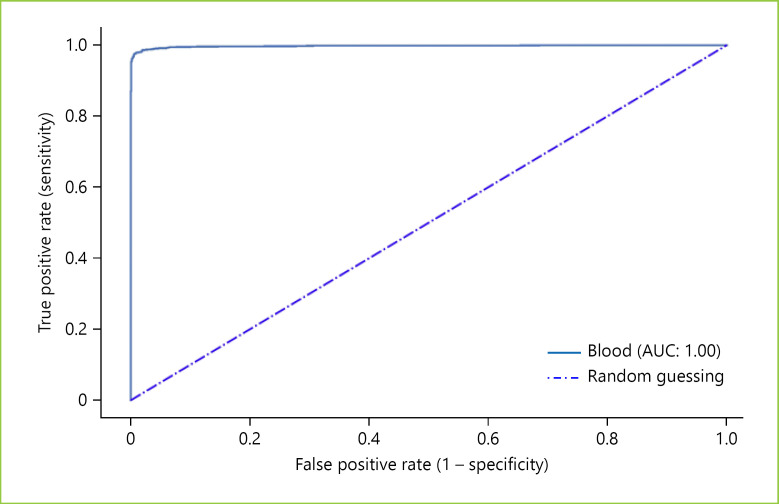
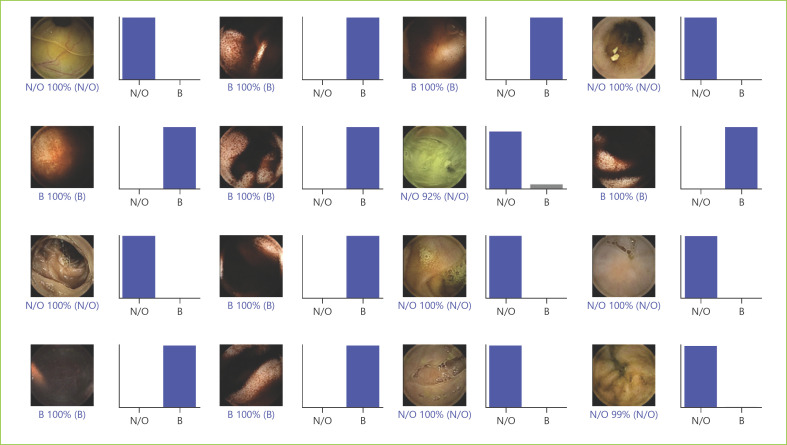
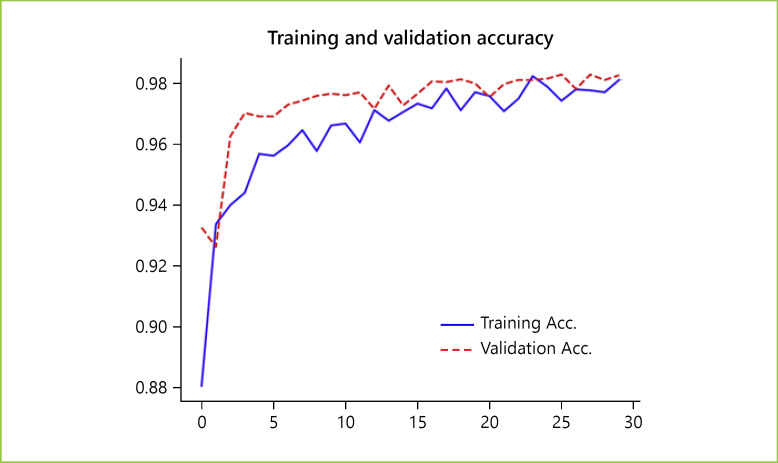
Our convolutional neural network detected blood and hematic residues in the small bowel lumen with an accuracy and precision of 98.5 and 98.7%, respectively. The sensitivity and specificity were 98.6 and 98.9%, respectively. The analysis of the testing dataset was completed in 24 s (approximately 184 frames/s).
DISCUSSION/CONCLUSION: We have developed an artificial intelligence tool capable of effectively detecting luminal blood. The development of these tools may enhance the diagnostic accuracy of capsule endoscopy when evaluating patients presenting with obscure small bowel bleeding.
胶囊内镜已彻底改变了不明原因胃肠道出血患者的管理方式。然而,阅读胶囊内镜图像耗时且容易忽略重要病变,从而限制了其诊断率。我们旨在创建一种深度学习算法,用于在胶囊内镜检查中自动检测肠腔内的血液和血凝块。
基于总共22095张胶囊内镜图像(13510张包含肠腔血液的图像和8585张正常黏膜或其他表现的图像)开发了一个卷积神经网络。定义了一个包含80%图像总数的训练数据集。将该网络的性能与两位胶囊内镜专家提供的一致分类进行比较。随后,我们使用独立验证数据集(图像总数的20%)评估该网络的性能,计算其敏感性、特异性、准确性和精确性。
我们的卷积神经网络检测小肠肠腔内血液和血凝块的准确性和精确性分别为98.5%和98.7%。敏感性和特异性分别为98.6%和98.9%。测试数据集的分析在24秒内完成(约184帧/秒)。
讨论/结论:我们开发了一种能够有效检测肠腔血液的人工智能工具。这些工具的开发可能会提高胶囊内镜在评估不明原因小肠出血患者时的诊断准确性。