
严肃游戏与饮食行为:对过去五年(2018 - 2022年)的系统综述
Serious games and eating behaviors: A systematic review of the last 5 years (2018-2022).
作者信息
Limone Pierpaolo, Messina Giovanni, Toto Giusi Antonia
机构信息
Learning Science Hub, Department of Clinical and Experimental Medicine, University of Foggia, Foggia, Italy.
出版信息
Front Nutr. 2022 Sep 8;9:978793. doi: 10.3389/fnut.2022.978793. eCollection 2022.
BACKGROUND
Serious game intervention has emerged over the years as a popular strategy for solving the problem of unhealthy eating behavior. This has prompted several scholars to explore its significant impact on eating behaviors, identifying its positive effect on nutritional knowledge and eating behaviors. However, since this research field is yet nascent, an update in knowledge is required to further inform the real-world practice as an alternative intervention for instating healthy eating behavior. Therefore, this current research utilized a systematic review method to reveal the latest state of this concept of a serious game and eating behavior, to identify the position of the literature and shed light on under-researched and emerging areas by recommending future investigations.
METHOD
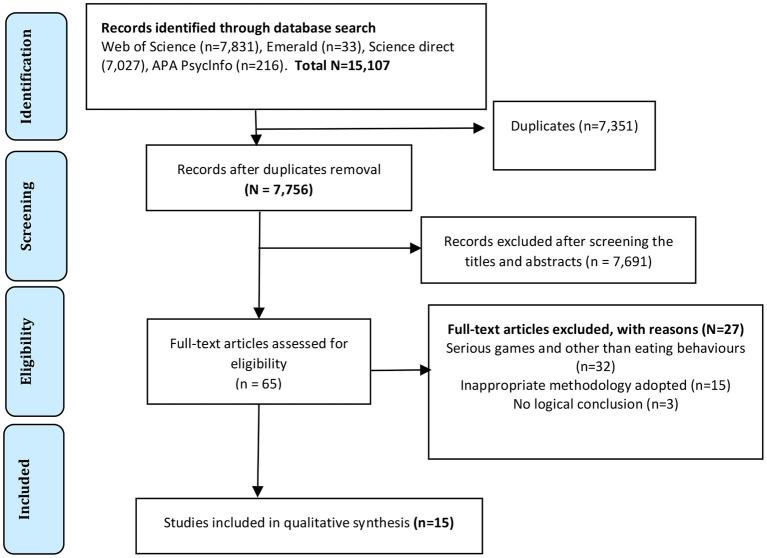
To achieve the object of this research, four electronic databases- Science Direct, Web of Science (WoS), APA PsyclNFO, and Emerald- were searched using predefined keywords (search string) relating to the review topic. A total of 15,107 results were retrieved from the databases. After title, abstract, and full-text screening, 15 studies were included following inclusion criteria.
KEY FINDINGS
The result of this research demonstrated that various designs of serious games comprise an effective intervention for changing eating behavior in both children and adults and addressed the risks of childhood obesity and overweight. The findings also show that the design of the games is co-designed by different specialists such as a nutritionist, psychologist and developer, among others, as either single or multiple players. The effectiveness of the games was attributed to behavior techniques (BT), cognitive theories (CT), and socio-cognitive theories (SCT) of behavior change technique (BCT), incorporating an element of implicit learning in serious games. Feedback and reward were the most reported influencing strategies and self-reporting the evaluation approach.
CONCLUSION
This research contributed significantly to the body of knowledge in the field of serious games as the most recent review of evidence in the research area. Evidence from 93.33% of the included studies confirmed the effectiveness of serious games in addressing eating behavior. This study concludes that serious games are an effective intervention for improving healthy eating behavior and decreasing unhealthy eating behavior and that various elements of behavior change techniques are essential components of implicit nutritional learning through the games. In addition, it is concluded that the risk of childhood obesity and overweight can be reduced or prevented by leveraging the strength of these games. The need for future research in this field was also pointed out by this study.
背景
多年来,严肃游戏干预已成为解决不健康饮食行为问题的一种流行策略。这促使几位学者探讨其对饮食行为的重大影响,确定其对营养知识和饮食行为的积极作用。然而,由于该研究领域尚处于起步阶段,需要更新知识,以便为现实世界的实践提供更多信息,作为建立健康饮食行为的替代干预措施。因此,本研究采用系统评价方法,揭示严肃游戏与饮食行为这一概念的最新状态,确定文献的位置,并通过推荐未来的研究,阐明研究不足和新兴的领域。
方法
为实现本研究的目标,使用与综述主题相关的预定义关键词(检索词)在四个电子数据库——科学Direct、科学网(WoS)、美国心理学会心理学文摘数据库(APA PsyclNFO)和Emerald中进行检索。从数据库中总共检索到15107条结果。经过标题、摘要和全文筛选,根据纳入标准纳入了15项研究。
主要发现
本研究结果表明,各种设计的严肃游戏是改变儿童和成人饮食行为的有效干预措施,并解决了儿童肥胖和超重的风险。研究结果还表明,游戏的设计由营养师、心理学家和开发者等不同专家共同设计,有单人或多人游戏模式。游戏的有效性归因于行为技术(BT)、认知理论(CT)和行为改变技术(BCT)的社会认知理论(SCT),在严肃游戏中融入了隐性学习元素。反馈和奖励是最常被报道的影响策略,自我评价是评价方法。
结论
作为该研究领域最新的证据综述,本研究对严肃游戏领域的知识体系做出了重大贡献。93.33%的纳入研究的证据证实了严肃游戏在解决饮食行为方面的有效性。本研究得出结论,严肃游戏是改善健康饮食行为和减少不健康饮食行为的有效干预措施,行为改变技术的各种要素是通过游戏进行隐性营养学习的重要组成部分。此外,得出的结论是,利用这些游戏的优势可以降低或预防儿童肥胖和超重的风险。本研究还指出了该领域未来研究的必要性。

 Zotero 插件