Chalermsri Chalobol, Ziaei Shirin, Ekström Eva-Charlotte, Muangpaisan Weerasak, Aekplakorn Wichai, Satheannopakao Warapone, Rahman Syed Moshfiqur
Department of Women's and Children's Health, Uppsala University, Uppsala, Sweden.
Department of Preventive and Social Medicine, Faculty of Medicine Siriraj Hospital, Mahidol University, Bangkok, Thailand.
Front Nutr. 2022 Sep 8;9:1002066. doi: 10.3389/fnut.2022.1002066. eCollection 2022.
Cardiovascular diseases (CVD) are the common comorbidities in older people. Healthy diet is an essential strategy to alleviate the risk of developing CVD. Dietary diversity (DD) is an indicator of diet quality. Currently, limited research exists regarding DD and CVD in older people in developing countries, such as Thailand, despite rapid growth of older population. Therefore, this study aims to determine associations of DD with the risk of CVD and the cardiometabolic risk factors among Thai older people.
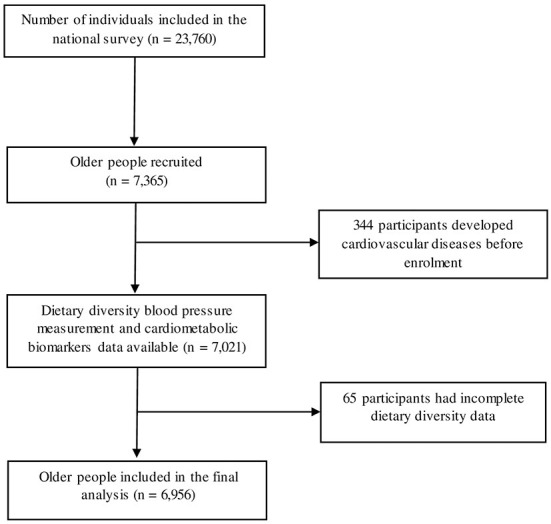
This cross-sectional study used the sub-sample of the fifth Thai National Health Examination Survey conducted from 2013 to 2015. A total of 6,956 older people aged 60 years and older and no pre-existing CVD were included.Dietary diversity score (DDS) was assessed the consumption of eight food groups using food frequency questionnaires. Each food group was scored from 0 to 4. The DDS was calculated as the sum of the scores (0-32). The risk of CVD was calculated by using a Thai cardiovascular (CV) risk score. The cardiometabolic risk factors included hypertension, diabetes mellitus (DM), total cholesterol (TC), low-density lipoprotein cholesterol (LDL-C), high-density lipoprotein cholesterol (HDL-C), and triglyceride (TG) levels. Data were adjusted for a complex survey design and analysed using linear and logistic regression models.
In the adjusted model, DDS had a significant negative association with log-Thai CV risk score, with adjusted (95% CI) values of -0.01 (-0.01, -0.01). Regarding the cardiometabolic risk factors, DDS had a significant negative association with hypertension, DM and log-TG levels, with adjusted OR (95% CI) values of 0.97 (95% CI 0.97, 0.98) for hypertension, 0.94 (0.93, 0.95) for DM, and adjusted (95% CI) values of -0.002 (-0.004, -0.001) for log-TG level. DDS was positively associated with TC and LDL-C, with adjusted (95% CI) values of 0.59 (0.38, 0.80) for TC and 0.59 (0.38, 0.79) for LDL-C levels, while DDS was not associated with HDL-C level.
Higher DD was associated with a lower risk of CVD among Thai older people. The nutritional policies or interventions should encourage a diverse food intake for the prevention of CVD in this population.
心血管疾病(CVD)是老年人常见的合并症。健康饮食是降低患心血管疾病风险的重要策略。饮食多样性(DD)是饮食质量的一个指标。目前,在泰国等发展中国家,尽管老年人口迅速增长,但关于老年人饮食多样性与心血管疾病的研究有限。因此,本研究旨在确定泰国老年人饮食多样性与心血管疾病风险及心脏代谢危险因素之间的关联。
本横断面研究使用了2013年至2015年进行的第五次泰国国家健康检查调查的子样本。共纳入6956名60岁及以上且无心血管疾病史的老年人。使用食物频率问卷评估饮食多样性得分(DDS),该问卷涉及八类食物的消费情况。每类食物的得分从0到4分。DDS通过得分总和(0 - 32分)计算得出。心血管疾病风险通过泰国心血管(CV)风险评分计算。心脏代谢危险因素包括高血压、糖尿病(DM)、总胆固醇(TC)、低密度脂蛋白胆固醇(LDL - C)、高密度脂蛋白胆固醇(HDL - C)和甘油三酯(TG)水平。数据针对复杂的调查设计进行了调整,并使用线性和逻辑回归模型进行分析。
在调整模型中,DDS与泰国CV风险评分的对数呈显著负相关,调整后的β(95%CI)值为 - 0.01(-0.01,-0.01)。关于心脏代谢危险因素,DDS与高血压、糖尿病和甘油三酯水平的对数呈显著负相关,高血压的调整后OR(95%CI)值为0.97(95%CI 0.97,0.98),糖尿病为0.94(0.93,0.95),甘油三酯水平对数的调整后β(95%CI)值为 - 0.002(-0.004,-0.001)。DDS与总胆固醇和低密度脂蛋白胆固醇呈正相关,总胆固醇的调整后β(95%CI)值为0.59(0.38,0.80),低密度脂蛋白胆固醇水平为0.59(0.38,0.79),而DDS与高密度脂蛋白胆固醇水平无关。
在泰国老年人中,较高的饮食多样性与较低的心血管疾病风险相关。营养政策或干预措施应鼓励该人群摄入多样化食物以预防心血管疾病。