Miller Rachel L, McLaughlin Angela, Montoya Vincent, Toy Junine, Stone Sarah, Harding John, Liang Richard H, Wong Jason, Barrios Rolando, Montaner Julio S G, Joy Jeffrey B
British Columbia Centre for Excellence in HIV/AIDS, Vancouver, BC, Canada.
Bioinformatics Program, University of British Columbia, Vancouver, BC, Canada.
Lancet Reg Health Am. 2022 Dec;16:100369. doi: 10.1016/j.lana.2022.100369. Epub 2022 Sep 23.
Public health measures designed to reduce SARS-CoV-2 transmission led to reduced access to care and prevention services for people living with or at risk of acquiring HIV, particularly during the initial introduction of extensive restrictions. This reduction in access may have contributed to increases in HIV transmission not outweighed by decreases in transmission occurring as a result of reduced contact rates promoted by the same public health measures.
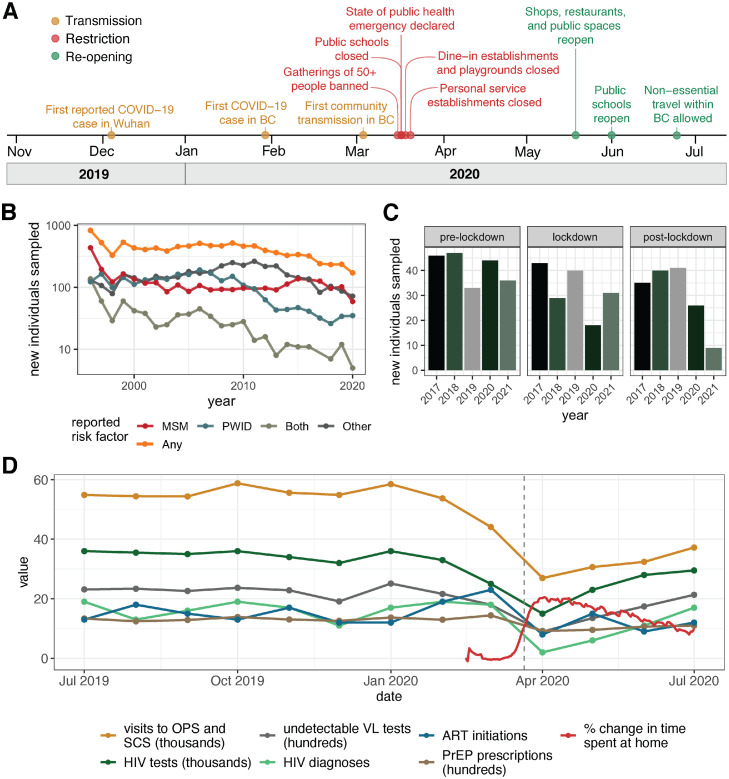
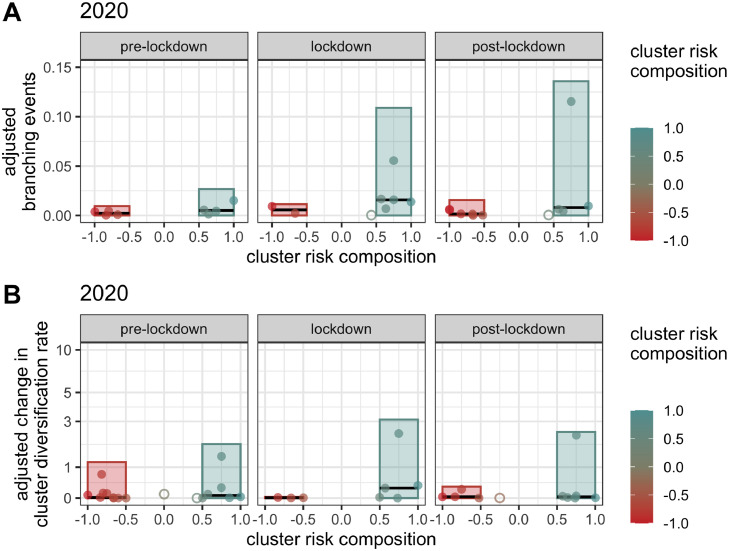
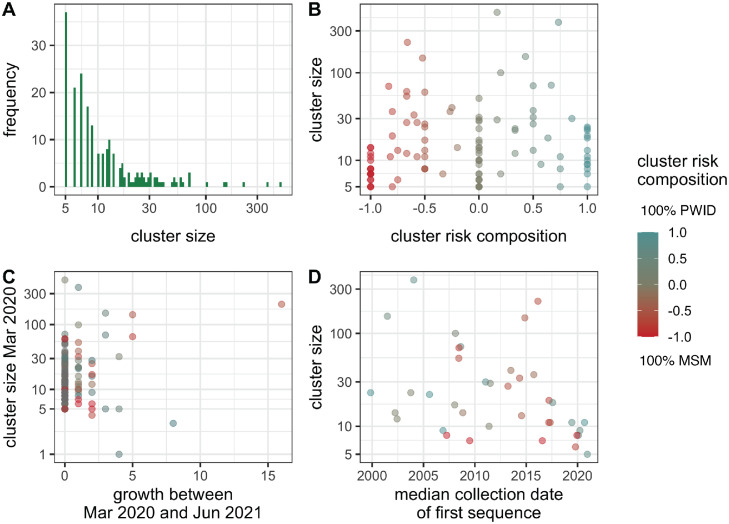
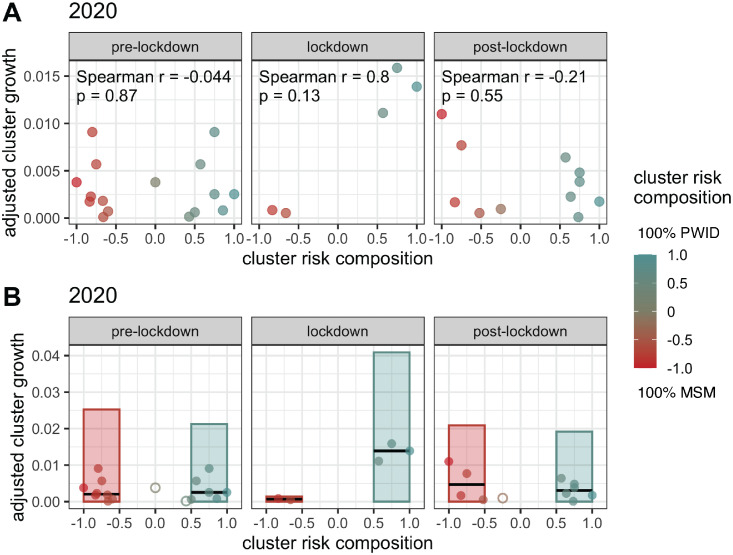
We synthesize available province-wide HIV data in British Columbia, Canada, together with public mobility data to phylogenetically investigate the early impacts of SARS-CoV-2 on HIV transmission. Cluster growth, coalescent branching events and lineage-level diversification rates were assessed in "pre-lockdown" (January 22-March 21, 2020), "lockdown" (March 22-May 20, 2020) and "post-lockdown" (May 21-July 19, 2020) to facilitate comparison of transmission trends across key populations.
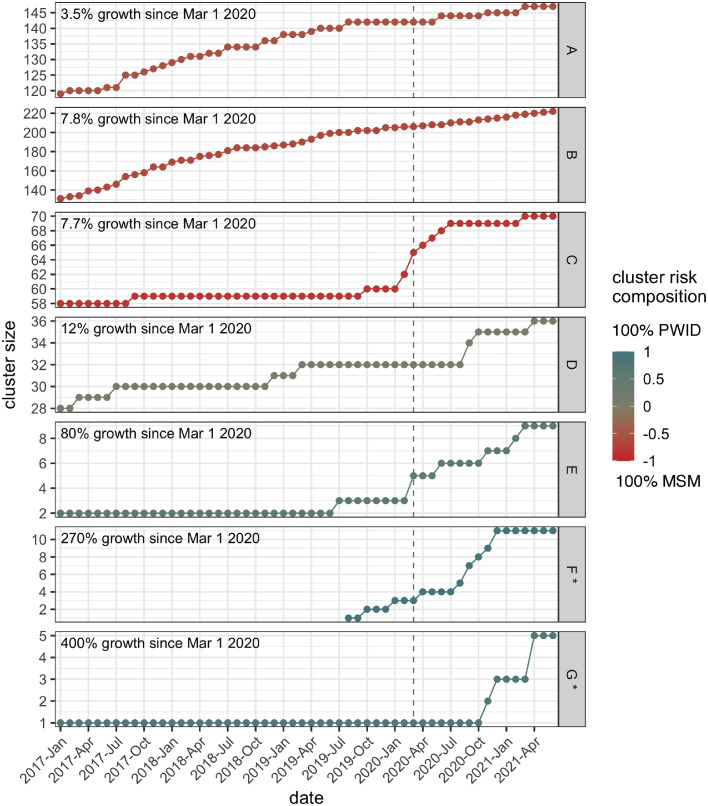
Results reveal increased HIV transmission in a limited number of clusters in association with reduced access to health services during the initial introduction of SARS-CoV-2-related restrictions. In particular, clusters associated with people who inject drugs (PWID) show rapid growth, extensive branching events in phylogenetic trees during and following the lockdown period, and elevated median change in individuals' viral diversification rates during lockdown compared to clusters associated with men who have sex with men (MSM), consistent with increased transmission rates between PWID.
Increased vigilance and innovative targeted solutions are critical to offset potential negative impacts of SARS-CoV-2 or future pandemic-related restrictions on HIV epidemic dynamics.
Funding sources include Genome Canada and Genome BC, the Public Health Agency of Canada, the BC Centre for Excellence in HIV/AIDS, and the Canadian Institutes of Health Research Coronavirus Rapid Response Programme. Student funding includes a NSERC CREATE scholarship and a Canadian Institutes of Health Research graduate fellowship.
旨在减少严重急性呼吸综合征冠状病毒2(SARS-CoV-2)传播的公共卫生措施导致感染艾滋病毒或有感染艾滋病毒风险的人群获得医疗保健和预防服务的机会减少,尤其是在最初实施广泛限制措施期间。这种获得服务机会的减少可能导致艾滋病毒传播增加,而这种增加并未被因同样的公共卫生措施促进接触率降低而导致的传播减少所抵消。
我们综合了加拿大不列颠哥伦比亚省全省可用的艾滋病毒数据以及公共交通数据,以系统发育方式研究SARS-CoV-2对艾滋病毒传播的早期影响。在“封锁前”(2020年1月22日至3月21日)、“封锁期间”(2020年3月22日至5月20日)和“解封后”(2020年5月21日至7月19日)评估聚类增长、溯祖分支事件和谱系水平的多样化率,以便于比较关键人群中的传播趋势。
结果显示,在最初实施与SARS-CoV-2相关的限制措施期间,有限数量的聚类中艾滋病毒传播增加,且与获得医疗服务的机会减少有关。特别是,与注射毒品者(PWID)相关的聚类显示出快速增长,在封锁期间及之后的系统发育树中有广泛的分支事件,并且与男男性行为者(MSM)相关的聚类相比,封锁期间个体病毒多样化率的中位数变化有所升高,这与PWID之间传播率增加一致。
提高警惕和创新的针对性解决方案对于抵消SARS-CoV-2或未来大流行相关限制对艾滋病毒流行动态可能产生的负面影响至关重要。
资金来源包括加拿大基因组局和不列颠哥伦比亚省基因组局、加拿大公共卫生局、不列颠哥伦比亚省艾滋病毒/艾滋病卓越中心以及加拿大卫生研究院冠状病毒快速反应计划。学生资金包括自然科学与工程研究理事会(NSERC)的CREATE奖学金和加拿大卫生研究院的研究生奖学金。