Research Institute for Farm Animal Biology, Institute of Genome Biology, 18196, Dummerstorf, Germany.
Saxon State Office for Environment, Agriculture and Geology, 01468, Moritzburg, Germany.
J Appl Genet. 2022 Dec;63(4):783-792. doi: 10.1007/s13353-022-00725-9. Epub 2022 Sep 29.
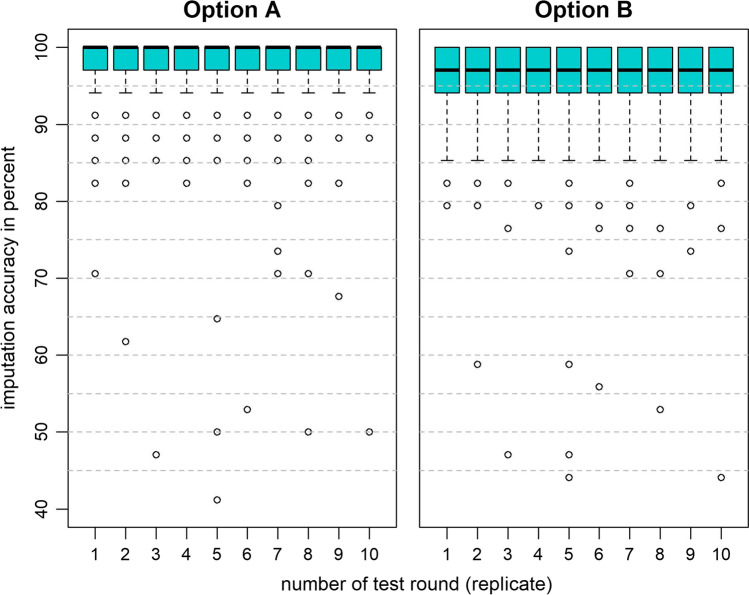
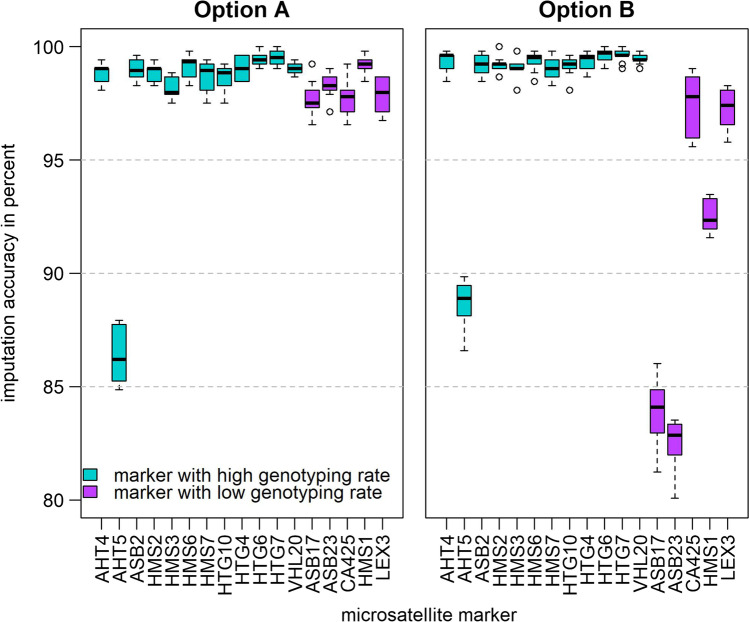
In horses, parentage control is currently performed based on an internationally standardized panel of 17 microsatellite (MS) markers comprising 12 mandatory and five optional markers. Unlike MS, single nucleotide polymorphism (SNP) profiles support a wider portfolio of genomic applications, including parentage control. A transition to SNP-based parentage control is favorable, but requires additional efforts for ensuring generation-overlapping availability of marker genotypes of the same type. To avoid double genotyping of either parents or offspring for changing to SNP technology and enable efficient transition, we tested whether MS genotypes used for parentage control could be reliably imputed from a medium-density SNP panel in German warmblood horses. Imputation accuracy was tested in a tenfold cross-validation with two approaches: within breed (option A) and across breeds (option B). Average imputation accuracies of 97.98% (A) and 96.17% (B) were achieved, respectively. Due to interbreed differences in genotyping rates, five MS markers of low genotyping rate (GTR; < 90%) could be imputed with higher accuracy within breed (98.18%) than across breeds (90.73%). MS markers with high GTR performed homogeneously well in option B (98.44%) and showed slightly lower accuracy in option A (97.90%). Among these markers, AHT5 proved to be problematic for imputation regardless of the approach, revealing accuracies of 86.40% (A) and 88.70% (B). Better results for MS markers with high GTR and savings in computational processing justified the choice of option B for routine implementation. To date, more than 9500 horses have undergone the new parentage control based on imputed MS genotypes.
在马中,亲子关系控制目前基于包含 12 个强制和 5 个可选标记的国际标准化 17 个微卫星 (MS) 标记组进行。与 MS 不同,单核苷酸多态性 (SNP) 图谱支持更广泛的基因组应用组合,包括亲子关系控制。向基于 SNP 的亲子关系控制的转变是有利的,但需要额外的努力来确保相同类型的标记基因型的代际重叠可用性。为避免为了改变到 SNP 技术而对父母或后代进行双重基因分型,并实现有效的过渡,我们测试了德国温血马中用于亲子关系控制的 MS 基因型是否可以从中等密度 SNP 面板中可靠地推断出来。在十倍交叉验证中,使用两种方法测试了估计的准确性:在品种内(选项 A)和跨品种(选项 B)。分别达到了 97.98%(A)和 96.17%(B)的平均估计准确性。由于品种间的基因型率存在差异,因此可以在品种内(98.18%)比跨品种(90.73%)更高的精度下对低基因型率(GTR;<90%)的五个 MS 标记进行估计。GTR 较高的 MS 标记在选项 B 中表现一致良好(98.44%),在选项 A 中准确性略低(97.90%)。在这些标记中,无论采用哪种方法,AHT5 的估计都存在问题,其准确性分别为 86.40%(A)和 88.70%(B)。高 GTR 的 MS 标记的结果更好,并且在计算处理方面节省了成本,这证明了选择选项 B 用于常规实施是合理的。迄今为止,已有超过 9500 匹马进行了基于推断的 MS 基因型的新亲子关系控制。