
在新西兰电子烟法规咨询中,健康和行业组织使用支持证据。
Use of supporting evidence by health and industry organisations in the consultation on e-cigarette regulations in New Zealand.
机构信息
School of Population Health, Faculty of Medical & Health Sciences, University of Auckland, Auckland, New Zealand.
School of Public Health, The University of Sydney, Sydney, New South Wales, Australia.
出版信息
PLoS One. 2022 Sep 29;17(9):e0275053. doi: 10.1371/journal.pone.0275053. eCollection 2022.
OBJECTIVES
Scientific evidence to support the development of appropriate policy for electronic cigarette use is limited by rapidly changing technology and a lack of long-term data. Perceptions of risk and benefits determine diverse framings of the e-cigarette debate and complicate policy decisions. E-cigarette use by smokers who are attempting to quit may result in improved health outcomes, while their use among young people and non-smokers may lead to adverse health consequences. The purpose of this study was to identify the types of evidence used during public consultations on proposed revisions to New Zealand's e-cigarette legislation in 2020.
METHODS
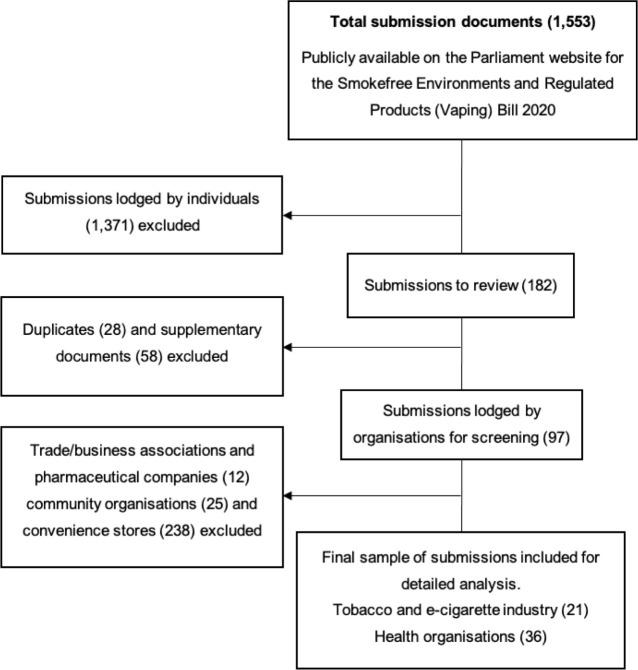
Using submissions to parliament made by the tobacco/e-cigarette industry and the health sector, we assessed the cited evidence for quality and independence measured by publication type and tobacco industry connections. We identified themes from a sub-sample of frequently cited evidence to understand how stakeholders and organisations used evidence.
RESULTS
The sample consisted of 57 submissions from the e-cigarette and tobacco industry (n = 21) and health organisations (n = 36). A total of 442 pieces of evidence were cited at least once. Health organisations were more likely to cite peer-reviewed evidence (OR = 2.99). The industry was more likely to cite evidence outside of peer review and sources with tobacco industry connections (OR = 4.08). In the sample of frequently cited evidence, youth prevalence and flavours were the most common themes. In some cases the same evidence was used by both groups to support opposing policy positions.
CONCLUSIONS
The industry continues to rely more heavily on evidence published outside of the peer-review process, which is, therefore, subjected to less scientific scrutiny. By using a smoking-cessation or harm-reduction narrative, the industry could be seen as a legitimate stakeholder in policy development.
目的
由于电子烟技术快速发展且缺乏长期数据,目前用于支持电子烟使用相关政策制定的科学证据十分有限。风险和收益的认知决定了电子烟辩论的不同框架,使政策决策变得复杂。尝试戒烟的吸烟者使用电子烟可能会带来更好的健康结果,而年轻人和非吸烟者使用电子烟可能会导致健康后果。本研究旨在确定 2020 年新西兰电子烟立法修订公众咨询中使用的证据类型。
方法
利用烟草/电子烟行业和卫生部门向议会提交的意见,我们评估了所引用证据的质量和独立性,其评估指标为发表类型和与烟草行业的关联。我们从经常引用的证据中抽取了一个子样本,以了解利益相关者和组织如何使用证据。
结果
样本包括电子烟和烟草行业(n=21)以及卫生组织(n=36)提交给议会的 57 份意见书。共引用了至少一次的证据 442 份。卫生组织更有可能引用同行评议的证据(OR=2.99)。该行业更有可能引用同行评审以外的证据和与烟草行业有联系的来源(OR=4.08)。在经常引用的证据样本中,青少年流行率和口味是最常见的主题。在某些情况下,两组都使用相同的证据来支持相反的政策立场。
结论
该行业继续更多地依赖于同行评审过程之外发表的证据,这些证据因此受到的科学审查较少。通过采用戒烟或减少伤害的叙述方式,该行业可能被视为政策制定的合法利益相关者。
 Zotero 插件