Madrigal Lillian, Manders Olivia C, Kegler Michelle, Haardörfer Regine, Piper Sarah, Blais Linelle M, Weber Mary Beth, Escoffery Cam
Rollins School of Public Health Emory University, 1518 Clifton Rd, Atlanta, GA, 30322, USA.
Implement Sci Commun. 2022 Oct 1;3(1):104. doi: 10.1186/s43058-022-00350-x.
Scaling evidence-based interventions are key to impacting population health. The National DPP lifestyle change program is one such intervention that has been scaled across the USA over the past 20 years; however, enrollment is an ongoing challenge. Furthermore, little is known about which organizations are most successful with program delivery, enrollment, and scaling. This study aims to understand more about the internal and external organization factors that impact program implementation and reach.
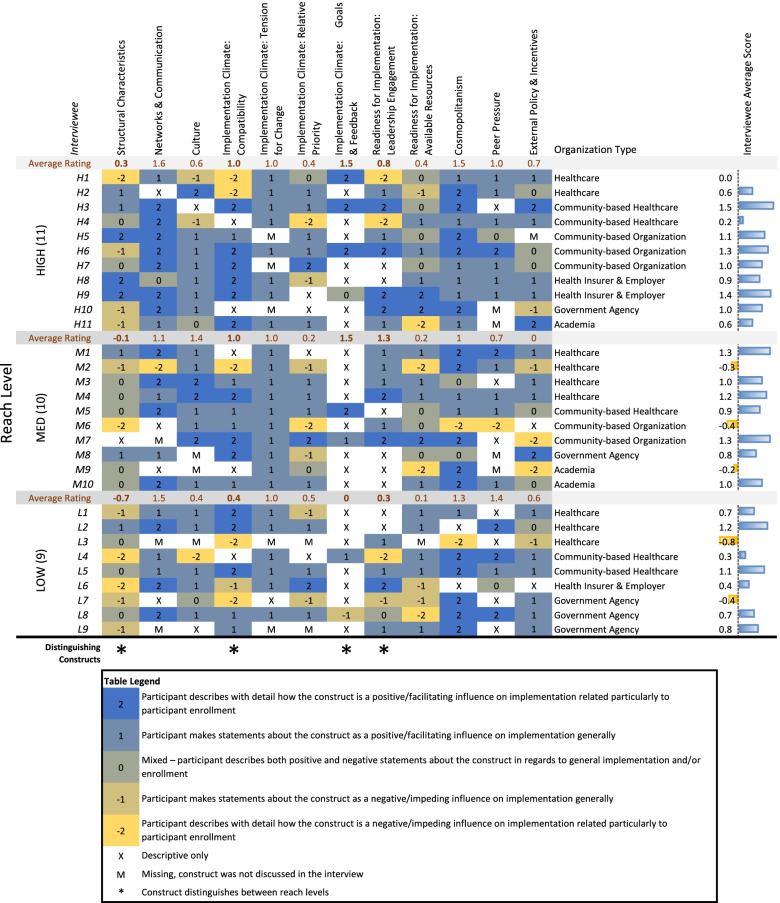
Between August 2020 and January 2021, data were collected through semi-structured key informant interviews with 30 National DPP delivery organization implementers. This study uses a qualitative cross-case construct rating methodology to assess which Consolidated Framework for Implementation Research (CFIR) inner and outer setting constructs contributed (both in valence and magnitude) to the organization's current level of implementation reach (measured by average participant enrollment per year). A construct by case matrix was created with ratings for each CFIR construct by interviewee and grouped by implementation reach level.
Across the 16 inner and outer setting constructs and subconstructs, the interviewees with greater enrollment per year provided stronger and more positive examples related to implementation and enrollment of the program, while the lower reach groups reported stronger and more negative examples across rated constructs. Four inner setting constructs/subconstructs (structural characteristics, compatibility, goals and feedback, and leadership engagement) were identified as "distinguishing" between enrollment reach levels based on the difference between groups by average rating, the examination of the number of extreme ratings within levels, and the thematic analysis of the content discussed. Within these constructs, factors such as organization size and administrative processes; program fit with existing organization services and programs; the presence of enrollment goals; and active leadership involvement in implementation were identified as influencing program reach.
Our study identified a number of influential CFIR constructs and their impact on National DPP implementation reach. These findings can be leveraged to improve efforts in recruiting and assisting delivery organizations to increase the reach and scale of the National DPP as well as other evidence-based interventions.
推广基于证据的干预措施是影响人群健康的关键。国家糖尿病预防计划(National DPP)生活方式改变项目就是这样一种在过去20年里已在美国各地推广的干预措施;然而,招募参与者仍是一项持续存在的挑战。此外,对于哪些组织在项目实施、招募和推广方面最为成功,人们了解甚少。本研究旨在更深入地了解影响项目实施和覆盖范围的内部和外部组织因素。
在2020年8月至2021年1月期间,通过对30名国家糖尿病预防计划实施组织的实施者进行半结构化关键 informant访谈收集数据。本研究采用定性跨案例构建评级方法,以评估实施研究综合框架(CFIR)的哪些内部和外部环境构建因素(在效价和量级方面)对组织当前的实施覆盖水平(以每年平均参与者招募人数衡量)有贡献。创建了一个逐案例构建矩阵,其中包含受访者对每个CFIR构建因素的评级,并按实施覆盖水平进行分组。
在16个内部和外部环境构建因素及子构建因素中,每年招募人数较多的受访者提供了与项目实施和招募相关的更强有力且更积极的示例,而覆盖范围较低的组在各评级构建因素中报告的负面示例更强且更多。基于平均评级的组间差异、各水平内极端评级数量的考察以及所讨论内容的主题分析,确定了四个内部环境构建因素/子构建因素(结构特征、兼容性、目标与反馈以及领导参与度)在招募覆盖水平之间具有“区分性”。在这些构建因素中,组织规模和行政流程、项目与现有组织服务和项目的契合度、招募目标的存在以及领导积极参与实施等因素被确定为影响项目覆盖范围的因素。
我们的研究确定了一些有影响力的CFIR构建因素及其对国家糖尿病预防计划实施覆盖范围的影响。这些发现可用于改进招募和协助实施组织的工作,以扩大国家糖尿病预防计划以及其他基于证据的干预措施的覆盖范围和规模。